Sequence diagram
A sequence diagram pins a single scenario to two axes so message order becomes unambiguous: each participant gets a vertical lifeline, and time flows strictly downward, so a message drawn lower on the page provably happens after one drawn higher — the diagram is the call order, read top to bottom.
Read the notation off the wire:
- Lifeline — a box at the top naming a participant (
:ATM,bank:BankService) with a dashed vertical line dropping from it; the object exists down that whole line. - Activation bar — a thin rectangle on a lifeline marking the span during which that object is busy executing a call (it has the stack frame).
- Synchronous call — a solid line with a filled arrowhead. The caller blocks until it returns.
- Return — a dashed line with an open arrowhead back to the caller, labelled with the value returned. Conventionally drawn only when the value matters.
- Async message — a solid line with an open (stick) arrowhead; the sender does not wait.
- Combined fragments — labelled boxes (
altfor branches,loopfor repetition,opt,par) that wrap a region with a guard condition in[brackets].
Worked trace: a $200 ATM withdrawal
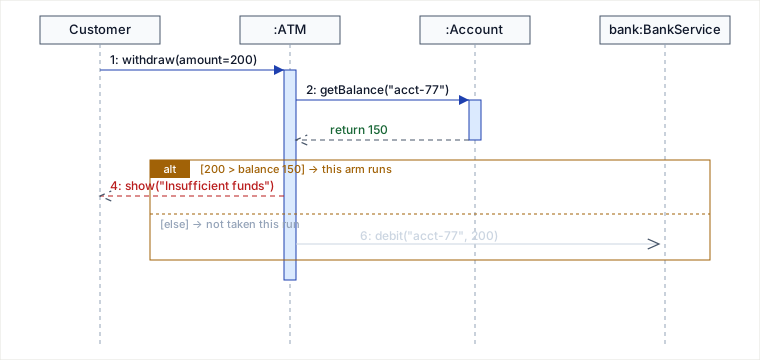
Scenario: a customer with a $150 balance asks for $200. We trace the exact messages an LLD interview answer would draw, with concrete values, so the alt branch and the return arrows are forced to mean something. Participants: Customer (actor), :ATM, :Account, bank:BankService.
| # | From → To | Message (with values) | Kind | Returns |
|---|---|---|---|---|
| 1 | Customer → :ATM | withdraw(amount=200) | sync | — |
| 2 | :ATM → :Account | getBalance("acct-77") | sync | 150 |
| 3 | alt [requested 200 > balance 150] — guard is TRUE, so this branch runs | |||
| 4 | :ATM → Customer | show("Insufficient funds") | return | — |
| 5 | [else] — guard FALSE; skipped this run | |||
| 6 | :ATM → bank:BankService | debit("acct-77", 200) (not sent) | sync | ok |
| 7 | :ATM → Customer | dispense(200) (not sent) | async | — |
The trace makes the value-dependence explicit: because getBalance returned 150, the guard 200 > 150 selected the top arm of the alt and steps 6–7 never execute on this run. Swap the input to amount=100 and the diagram is identical except the lower arm runs instead — that is the whole point of drawing the alt rather than two separate diagrams.
Pitfalls
- Treating it as a flowchart. A sequence diagram answers "who calls whom, in what order"; it is bad at branching/looping detail. People cram nested
alt/loopfragments until it is an unreadable maze — that logic belongs in an activity diagram or just pseudocode. - Confusing the two arrowheads. A filled head is a synchronous (blocking) call; an open/stick head is asynchronous or a return. Drawing a blocking
debit()with an open head silently claims fire-and-forget semantics — a real correctness lie in a payments design. - Activation bars that don't nest. If
:ATMis still active (its bar is open) it cannot have "returned" to the customer. A bar that ends before the messages it supposedly made are sent is a self-contradiction reviewers will catch. - Forgetting the guard on an
alt. Analtwith two arms and no[condition]tells the reader nothing about which arm fires when. The guard is the load-bearing part. - Modeling every method, including getters. Showing
getId(),toString(), logging calls — noise that buries the one decision (thealt) that the diagram exists to communicate. - Lifeline for a class, not an instance. The participant is an object (
:Accountora:Account), not the class. Two distinct accounts in one scenario need two lifelines.
When to reach for it — and when not
UML gives you several interaction/behavior views; the skill is picking the one that makes the thing you're worried about visible.
- Choose a sequence diagram when the risk lives in ordering and collaboration: a multi-object protocol (auth handshake, two-phase commit, saga), debugging "who called the API twice", or specifying the exact call order between services. The vertical time axis is the payoff — it makes a race or an out-of-order call jump out.
- Prefer an activity diagram when the risk is the control flow within one process: heavy branching, loops, parallel forks/joins, decision logic. Sequence diagrams degrade fast under branching; activity diagrams are built for it. Cost of choosing it: you lose the explicit object-to-object call structure.
- Prefer a communication (collaboration) diagram when you care about which objects are linked more than precise timing — it shows the same messages on a graph of objects with numbered calls. Cost: message order is encoded only in the numbers, so it's much harder to eyeball a sequence; you trade temporal clarity for topology clarity.
- Prefer a state diagram when one object's behavior depends on its history/mode (a
Connectionthat is OPEN/HALF_OPEN/CLOSED). Sequence diagrams show one path; a state machine shows all reachable transitions.
One-liner: choose a sequence diagram when the bug or design question is "in what order do these objects talk"; prefer an activity diagram when it's "what's the branching logic inside one flow", and a communication diagram when it's "which objects are even connected".
Takeaways
- Down = later. The vertical axis is a total order on messages; that ordering is the entire value proposition.
- Filled arrowhead = blocking sync call, open arrowhead = return or async — getting the head wrong misstates the contract.
- Trace a concrete run with real values: the inputs decide which
altarm fires, which is exactly what you're trying to communicate. - One scenario per diagram. If branching dominates, you wanted an activity diagram; if topology dominates, a communication diagram.
Sources: OMG UML 2.5.1 Specification (interaction diagrams, lifelines, combined fragments and guards); Martin Fowler, UML Distilled (3rd ed., ch. on Sequence Diagrams — sync vs async messaging and when to prefer activity/communication diagrams); Grady Booch et al., The Unified Modeling Language User Guide. Re-authored and deepened for this guide: added the mechanism statement, a step-by-step $200/$150 ATM withdrawal trace, a hand-authored SVG replacing the prior unlabeled figure, a pitfalls section, and a selection/trade-offs comparison against activity, communication, and state diagrams.
When NOT to draw a sequence diagram
- Static structure questions (fields, inheritance) — use class diagrams.
- Long-running async choreography with many branches — consider activity/state or a short prose trace.
Interviewer follow-ups & drills
- Why sequence over communication diagram? Time ordering and call stack depth are clearer for request/response.
- Failure teaching: missing return/timeout messages hide real production hangs — always show the failure path once.
- Drill: login with SSO — Client→App→IdP→App→Client; mark redirect vs back-channel.
🤖 Don't fully get this? Learn it with Claude
Stuck on Sequence diagram? Open Claude, copy a block below, and it'll teach you this exact concept — visually and interactively.
Build the mental picture, not memorization.
I just read a lesson on **Sequence diagram** (OO & Low-Level Design) and want to truly understand it. Explain Sequence diagram from first principles using ONE vivid real-world analogy and a visual mental model — draw it as ASCII art or a clear step-by-step diagram — with a concrete example using real numbers. Then ask me one question to check I got the mental picture, and wait for my reply. If you're unsure or a claim isn't standard, say so and reason from first principles instead of guessing.
Socratic — adapts to where you're stuck.
Teach me **Sequence diagram** interactively. Ask me ONE guiding question at a time, wait for my answer, and adapt to my confusion — build the idea with me step by step instead of explaining it all at once. If you're unsure or a claim isn't standard, say so and reason from first principles instead of guessing.
Active recall exposes what you missed.
Quiz me on **Sequence diagram** with 5 questions, easy to tricky, ONE at a time. Tell me if each answer is right; at the end, explain clearly what I got wrong and why. If you're unsure or a claim isn't standard, say so and reason from first principles instead of guessing.
Intuition + hook + flashcards for long-term memory.
Help me remember **Sequence diagram** for the long term: give the one-sentence intuition, a memorable hook/mnemonic, a tiny worked example, and 3 active-recall flashcards (Q -> A). If you're unsure or a claim isn't standard, say so and reason from first principles instead of guessing.