Common Problems Associated with Data Partitioning
Every hard problem with partitioning descends from one design decision: the function that maps a key to a partition. That mapping simultaneously fixes how evenly load spreads and how much data must move when the topology changes — so a key that looks fine on day one can produce a hotspot, an expensive reshard, and a scatter-gather query all at once. The seven classic drawbacks below are not independent gripes; they are what that single mapping costs you, and most have a concrete mechanism that tames them.
| Problem | Underlying mechanism | Concrete mitigation |
|---|---|---|
| 1. Complexity | App must route by key; joins and transactions now cross machines | A shared routing layer / query router (Vitess, Citus, a coordinator) |
| 2. Data skew | A non-uniform key concentrates rows and traffic on one partition | Hash the key and add virtual nodes; split known hot keys |
| 3. Key selection | The key permanently binds distribution and query locality | High-cardinality, low-correlation key aligned to the dominant access path |
| 4. Cross-partition queries | Scatter-gather: latency = the slowest shard that answers | Co-locate related rows, or denormalize. Be precise about indexes: a per-shard (local) index makes each branch of the scatter cheap but N requests remain; only a global term-partitioned index or an app-maintained lookup table (email → user_id) removes the fan-out, at the price of an async, possibly-stale index write (see Secondary Indexes in Partitioned Systems) |
| 5. Migration | Changing the scheme relocates keys across machines | Consistent hashing bounds movement to about K/N keys |
| 6. Maintenance | N shards means N× backups, patches, and metric streams | Automation and per-shard runbooks; managed sharding |
| 7. Cost | More nodes plus a larger operational surface | Shard only when a single node genuinely cannot cope |
Worked example: the skew, in numbers
Take a 10-million-row customer database sharded by country into 4 regional shards. If evenly loaded, each shard holds 2.5M rows. But real user bases are lopsided:
| Shard | Region | Rows | Share | Load vs even (2.5M) |
|---|---|---|---|---|
| S0 | Americas (US-heavy) | 6.0M | 60% | 2.4× |
| S1 | EMEA | 2.2M | 22% | 0.88× |
| S2 | APAC | 1.3M | 13% | 0.52× |
| S3 | Other | 0.5M | 5% | 0.20× |
S0 carries 2.4× its fair share of both storage and query traffic while S3 sits nearly idle. You cannot scale out of this by adding shards — country has fixed cardinality, so the US rows will not split. The mechanism that fixes it is to stop partitioning on a meaningful attribute and instead route on hash(user_id), whose output is uniform. With 4 shards that yields ~2.50M ± a few thousand rows each; the natural US skew disappears because a hash destroys the correlation between the key and its business meaning.
Worked example: why the resharding scheme decides your downtime
Now you must add a 5th shard to relieve load. The cost of that migration is entirely determined by the mapping function. Trace both, over the same 10M rows.
Naive: shard = hash(user_id) mod N
- With
N = 4, a row hashing to value 7 lands on shard7 mod 4 = 3. - Bump to
N = 5: that same row now maps to7 mod 5 = 2— it must physically move. - A row stays put only when
v mod 4 == v mod 5. Over any 20 consecutive values that holds for exactly 4 of them (v = 0,1,2,3). So only 20% stay; ~8M of the 10M rows relocate, and they scatter across every shard at once.
Consistent hashing
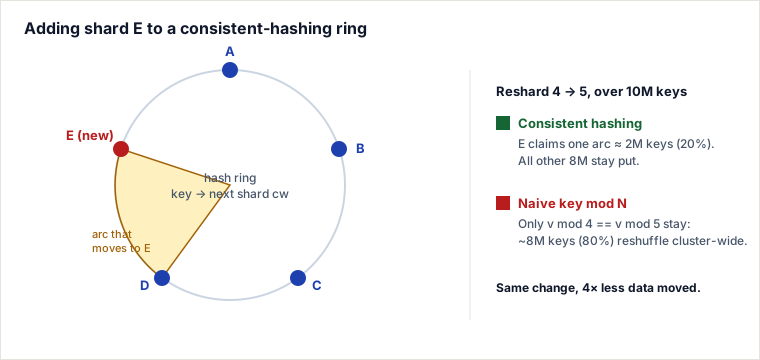
- Keys and the 4 shards are hashed onto one ring; each key belongs to the next shard clockwise.
- Inserting shard E drops a new point on the ring. E claims exactly the arc between it and its predecessor — about
1/5of the keyspace. - Only the ~2M rows (20%) in that one arc move, and they move onto E alone. The other 8M never change owner.
Same 10M rows, same +1 shard: naive hashing reshuffles 8M keys, consistent hashing touches 2M and localizes them. That 4× difference is the gap between a brief background copy and a multi-hour, cluster-wide migration.
Pitfalls
- Hashing spreads keys, not per-key load. Consistent hashing balances 10M distinct users evenly, but a single viral user_id (a celebrity, a bot account) still resolves to exactly one node. The fix is not more shards — it is salting: split the hot key into
user_id#0 … user_id#9so its traffic fans across ten partitions. - Monotonic keys defeat range partitioning. Partitioning by an auto-increment id or timestamp sends every new write to the newest partition — the whole cluster idles while one shard is on fire. Prefix the key with a hash bucket, or use hash partitioning for write-heavy tables.
- The noisy-neighbor tenant. Sharding by
tenant_idfeels clean until one enterprise customer is 90% of the volume; that tenant now owns an entire shard's capacity. Large tenants often need dedicated shards (directory-based pinning), not the shared hash pool. - Scatter-gather tail latency. A query on a non-partition column (e.g. "find users by email" when sharded by user_id) must hit all N shards; p99 latency becomes the slowest of N responses, which grows with N. Note what does and does not fix this: a local (per-shard) index on
emailonly cheapens each shard's own lookup — all N requests still go out. Removing the fan-out requires a global term-partitioned index or an app-maintained lookup table (email → user_id), which buys the single-shard read by accepting an async, possibly-stale index write. - Resharding without consistent hashing. Teams that ship
mod Ndiscover at scale that adding a node means moving ~80% of data, so they never add nodes — the cluster ossifies. Choose the rebalancing-friendly scheme before you have production data. - Silent backup inconsistency. Per-shard backups taken at different instants can't be restored into a globally consistent snapshot; cross-shard writes land in one backup and not another. You need coordinated snapshots or logical timestamps.
When to use which scheme — and when not to
These problems are really a choice between three partitioning strategies. Deciding well means matching the scheme to your dominant access pattern and your rebalancing needs.
- Hash / consistent hashing. Signals: point lookups by key dominate, writes are uniform, and cluster membership will change over time. Gain: even distribution and cheap, localized rebalancing (~K/N moved). Cost: you lose efficient range scans (adjacent keys land on different shards), and you need a rebalancing coordinator plus virtual nodes to keep variance low.
- Range partitioning. Signals: time-series or ordered data where queries are ranges ("events in March", "prices $10–$20"). Gain: a range scan touches one or few contiguous shards. Cost versus hashing: monotonic inserts create write hotspots, and skewed ranges need manual split/merge.
- Directory / lookup-based. Signals: you need explicit control — pin a huge tenant to its own shard, or migrate arbitrarily. Gain: maximum flexibility; move any key anywhere. Cost versus hashing: the directory is an extra hop on every request and a single point of failure you must replicate and cache.
Choose consistent hashing when key-value point access dominates and you will add/remove nodes; prefer range partitioning when range and ordered scans are the workload; prefer a directory when a few keys are wildly disproportionate and you need to place them by hand. And before any of them: if a single well-indexed node can still serve your load, do not shard at all — every problem on this page is the price of a distributed key space you did not yet need to pay.
Takeaways
- Every partitioning problem — skew, migration cost, scatter-gather — traces to one thing: the key-to-partition mapping. Pick it deliberately.
- Skew is fixed by destroying correlation: hash the key and add virtual nodes so distribution no longer tracks business meaning.
- Rebalancing cost is a scheme choice:
mod Nmoves ~80% of keys on a reshard, consistent hashing moves ~K/N (~20%) and localizes it. - Hashing balances keys, not per-key load — a single hot key still needs salting or a dedicated shard.
Re-authored and deepened for this guide. Sources: Martin Kleppmann, Designing Data-Intensive Applications, ch. 6 (Partitioning) — skew, hot spots, rebalancing strategies, and secondary-index approaches; Karger et al., "Consistent Hashing and Random Trees" (STOC 1997); DeCandia et al., "Dynamo: Amazon's Highly Available Key-value Store" (SOSP 2007) — virtual nodes and ring rebalancing; and Grokking the System Design Interview (Design Gurus) for the original problem taxonomy. Worked numbers computed for this page.
🤖 Don't fully get this? Learn it with Claude
Stuck on Common Problems Associated with Data Partitioning? Open Claude, copy a block below, and it'll teach you this exact concept — visually and interactively.
Build the mental picture, not memorization.
I just read a lesson on **Common Problems Associated with Data Partitioning** (System Design) and want to truly understand it. Explain Common Problems Associated with Data Partitioning from first principles using ONE vivid real-world analogy and a visual mental model — draw it as ASCII art or a clear step-by-step diagram — with a concrete example using real numbers. Then ask me one question to check I got the mental picture, and wait for my reply. If you're unsure or a claim isn't standard, say so and reason from first principles instead of guessing.
Socratic — adapts to where you're stuck.
Teach me **Common Problems Associated with Data Partitioning** interactively. Ask me ONE guiding question at a time, wait for my answer, and adapt to my confusion — build the idea with me step by step instead of explaining it all at once. If you're unsure or a claim isn't standard, say so and reason from first principles instead of guessing.
Active recall exposes what you missed.
Quiz me on **Common Problems Associated with Data Partitioning** with 5 questions, easy to tricky, ONE at a time. Tell me if each answer is right; at the end, explain clearly what I got wrong and why. If you're unsure or a claim isn't standard, say so and reason from first principles instead of guessing.
Intuition + hook + flashcards for long-term memory.
Help me remember **Common Problems Associated with Data Partitioning** for the long term: give the one-sentence intuition, a memorable hook/mnemonic, a tiny worked example, and 3 active-recall flashcards (Q -> A). If you're unsure or a claim isn't standard, say so and reason from first principles instead of guessing.