Time, Clocks & Ordering — Why You Can't Trust the Wall Clock
You cannot trust the clock on the wall
"Which write happened last?" feels obvious — just compare timestamps. But across machines, wall clocks drift, and NTP corrections can make a clock jump backwards. Order two events on two servers by their timestamps and you can get the order wrong — which, with last-write-wins, silently loses data. Distributed systems need a different notion of time: logical time, built on causality, not seconds.
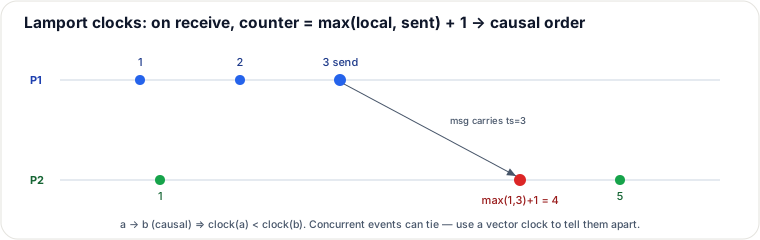
Happens-before: the only ordering you can trust
Event a happens-before b if a could have caused b: same process and earlier, or a is a send and b its receive. (Exactly the happens-before from the concurrency memory model — same idea, now across machines.) Events with no happens-before path either way are concurrent — there is no "true" order, and pretending otherwise is the bug.
Logical clocks
- Lamport clock (a single counter): increment on each event; on send, attach it; on receive, set
max(local, received) + 1. Guarantees a → b ⇒ L(a) < L(b). But the converse fails — equal/ordered counters can't distinguish causal from concurrent. - Vector clock (one counter per node): can detect concurrency — if neither vector dominates
the other, the events are concurrent (a true conflict). This is how Dynamo-style stores detect conflicting
writes instead of silently dropping one.
Micro-trace: replica A stamps a write[1,0]; replica B, not having seen it, stamps its own[0,1]. Component-wise, neither is ≤ the other → provably concurrent → the store keeps both as siblings for the app to merge. Had B seen A's write first, B's would carry[1,1]≥[1,0]— a clean overwrite. That ≤-test is the entire conflict detector.
Between vector clocks and TrueTime sits the Hybrid Logical Clock (HLC) — a single ~64-bit timestamp that is causal like a Lamport clock yet stays within the skew bound of wall time; it is the pragmatic default in CockroachDB and MongoDB. See the deep Time & Clocks page for its update rules.
So how does Spanner order globally?
Google TrueTime faces the clock problem head-on: it exposes time as an interval [earliest, latest] with bounded uncertainty (atomic clocks + GPS), and on commit it waits out the uncertainty so two transactions can't overlap. Buying real ordering costs a deliberate wait — a vivid reminder that distributed time isn't free.
Pitfalls
- Last-write-wins by wall-clock timestamp — clock skew silently discards the "earlier" (by real causality) write. Use logical clocks or version vectors.
- Assuming monotonic time — NTP can step backwards; use a monotonic clock for durations.
- Ignoring concurrency — concurrent writes are a conflict to resolve, not an ordering to guess.
Takeaways
- Wall clocks drift and jump — never order distributed events by timestamp alone.
- Happens-before is the trustworthy order; Lamport gives a consistent total order, vector clocks detect concurrency/conflicts.
- Real global ordering (Spanner TrueTime) costs a commit-wait — time isn't free.
Re-authored for this guide; Lamport-clock diagram hand-authored as SVG. Follows Lamport (1978) and DDIA ch. 8–9. See also: (Concurrency) Memory Model & happens-before, Replication (LWW conflicts), MVCC. Go deeper: Time, Clocks & Ordering — Lamport, Vector Clocks, HLC & TrueTime (the full clock ladder, with the vector-clock trace and commit-wait mechanics).
Which clock for which problem — and how LWW silently loses data
Decision table — which clock for which problem?
| Problem | Use | Never use |
|---|---|---|
| Order events within one process | Monotonic clock | Wall clock |
| Detect causality across nodes | Vector clock / version vector | Lamport clock alone |
| Total order across replicas | Consensus epoch + log offset | Wall-clock timestamp |
| Bound commit wait globally | TrueTime-style interval clock | NTP alone |
Failure trace — last-write-wins silent data loss
- A client sets
x=1; the write is stamped by Node A, whose clock runs 20 ms fast → timestamp10:00:00.030(real time ≈ .010). - 5 ms later (real time ≈ .015) the same client sets
x=2; this write is stamped by Node B, whose clock is accurate → timestamp10:00:00.015. - In real time
x=2happened afterx=1, sox=2is the value the user expects to survive. - Last-write-wins keeps the larger timestamp:
.030(x=1) beats.015(x=2) — so the store keeps the older valuex=1. - The genuinely-later write
x=2is silently discarded: a fast clock on Node A quietly ate the user's most recent update.
Moral: with skewed wall clocks, "largest timestamp" ≠ "happened last." Detect the conflict with a version vector instead of guessing an order — which is exactly what Dynamo-style stores do.
Drill ladder
- L1: Why can NTP make a clock run backwards?
- L2: Two Lamport clocks: L(a)<L(b). Can a and b be concurrent?
- L3: How does Spanner's TrueTime prevent two transactions from overlapping?
Ops signal: watch NTP/chrony offset and clock-step events (a backward step is the moment LWW quietly loses data), the version-vector conflict rate (rising conflicts mean concurrent writes you are silently resolving), and — on Spanner-style systems — the TrueTime commit-wait histogram (that wait is the price of global order).
🤖 Don't fully get this? Learn it with Claude
Stuck on Time, Clocks & Ordering — Why You Can't Trust the Wall Clock? Open Claude, copy a block below, and it'll teach you this exact concept — visually and interactively.
Build the mental picture, not memorization.
I just read a lesson on **Time, Clocks & Ordering — Why You Can't Trust the Wall Clock** (System Design) and want to truly understand it. Explain Time, Clocks & Ordering — Why You Can't Trust the Wall Clock from first principles using ONE vivid real-world analogy and a visual mental model — draw it as ASCII art or a clear step-by-step diagram — with a concrete example using real numbers. Then ask me one question to check I got the mental picture, and wait for my reply. If you're unsure or a claim isn't standard, say so and reason from first principles instead of guessing.
Socratic — adapts to where you're stuck.
Teach me **Time, Clocks & Ordering — Why You Can't Trust the Wall Clock** interactively. Ask me ONE guiding question at a time, wait for my answer, and adapt to my confusion — build the idea with me step by step instead of explaining it all at once. If you're unsure or a claim isn't standard, say so and reason from first principles instead of guessing.
Active recall exposes what you missed.
Quiz me on **Time, Clocks & Ordering — Why You Can't Trust the Wall Clock** with 5 questions, easy to tricky, ONE at a time. Tell me if each answer is right; at the end, explain clearly what I got wrong and why. If you're unsure or a claim isn't standard, say so and reason from first principles instead of guessing.
Intuition + hook + flashcards for long-term memory.
Help me remember **Time, Clocks & Ordering — Why You Can't Trust the Wall Clock** for the long term: give the one-sentence intuition, a memorable hook/mnemonic, a tiny worked example, and 3 active-recall flashcards (Q -> A). If you're unsure or a claim isn't standard, say so and reason from first principles instead of guessing.