Back-pressure & Flow Control — Why Systems Must Push Back
A system must be able to say "slow down"
Whenever a fast producer feeds a slower consumer — an ingestion pipeline, a queue, a socket, a thread pool — the mismatch has to go somewhere. Without back-pressure, the buffer between them grows unbounded until the process runs out of memory and crashes. Back-pressure is the mechanism by which a downstream component tells upstream: "I'm full, slow down."
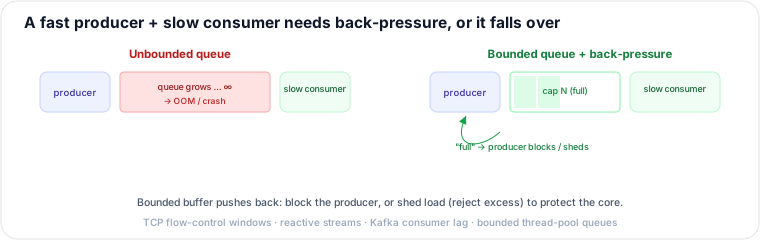
How back-pressure is implemented
- Bounded buffers — the foundational move. A bounded queue, when full, either blocks the producer (it can't outrun the consumer) or rejects (fail fast). An unbounded queue just defers the crash — it's a bug, not a feature.
- Flow control — the consumer advertises how much it can take. TCP does this
with its receive window; Reactive Streams (
request(n)) makes it explicit; gRPC/HTTP-2 have stream-level windows. - Load shedding — when you can't slow the producer (e.g. public traffic), drop the excess early (reject with 429/503) to protect the core, rather than collapse trying to serve everyone. But never silently drop durable work: payments and orders belong in a durable queue with retry, not a best-effort drop. (Ties to Rate Limiting and Designing for Failure.)
Where you'll meet it
A bounded thread-pool queue (the Executors lesson) is back-pressure. Kafka consumer lag is the signal that consumers can't keep up — you scale consumers or shed. A streaming job that can't keep up must pause its source, not buffer forever. The mental check: "where does the mismatch accumulate, and what happens when that buffer is full?" If the answer is "it grows," you have an outage waiting.
Takeaways
- Producer/consumer speed mismatch must be absorbed; unbounded buffering = deferred OOM.
- Back-pressure = bounded buffers that block or reject, plus flow control (TCP window, reactive
request(n)). - When you can't slow the source, shed load to protect the core.
L0 · Back-pressure is the signal a slow consumer sends a fast producer to block, slow, or shed — without it, the speed mismatch just accumulates in an unbounded buffer until memory or latency runs out.
L1 · ② Failure — "A downstream dependency starts timing out under load. Your service queues the calls instead of rejecting them, 'so we never drop a customer request.' Twenty minutes later the box OOMs and takes the whole service down. What's the actual fix?"
Trap: "Just make the buffer bigger so we never have to drop a request." — A bigger unbounded queue doesn't remove the overload, it hides it: memory keeps climbing and latency creeps up invisibly until the crash, which now takes longer to diagnose because nothing looked wrong five minutes earlier.
Bar: Bound the queue and make its "full" state an explicit decision: either block the caller (so the mismatch is visible one hop upstream) or reject fast (503/429) once depth exceeds a cap. An unbounded queue is bufferbloat by another name — it converts a fast, alertable failure into a slow, silent one that ends in the same OOM anyway. circuit breaker / designing for failure
L2 · ① Concurrency — "Good, you bounded the queue. But the producer is your own request-handling thread pool, and it blocks on offer() whenever the queue is full. Under sustained load, every worker thread ends up parked on that internal queue while user connections pile up at the load balancer. Did bounding actually fix anything?"
Trap: "Bounding the queue already solved it — it can't OOM anymore, so we're safe."
Bar: Bounding without propagation just relocates the same failure one hop upstream: an indefinite block on a full queue exhausts the thread pool exactly like an unbounded queue exhausts the heap. Real back-pressure has to travel to something that can actually shed or slow the true source — put a deadline on the enqueue call itself, and on timeout reject at the edge (gateway/load balancer) instead of parking a worker thread forever. thread pools & executors
L3 · ③ Scale — "Between two services you own, Reactive Streams' request(n) throttles beautifully. Now that same pipeline has to feed a third-party HTTP webhook consumer at 10x volume — plain HTTP has no credit protocol. How do you back-pressure across a boundary that can't say 'I'm full'?"
Trap: "Cap the outbound call rate at a fixed number per second and hope it roughly matches their capacity."
Bar: A static rate is a guess; you need a real feedback signal standing in for request(n) — the third party's 429/503 + Retry-After, or your own outbound queue's depth and age, adapted with an AIMD-style scheme (ease up on signals of overload, ramp up slowly on success) the same way TCP's congestion window infers capacity without an explicit grant. Kafka producers do exactly this: consumer lag is the feedback signal when there's no synchronous credit channel. Kafka producer back-pressure & consumer lag
L4 · ⑤ Adversary/Edge — "Your bounded queue rejects with 503 once depth crosses a threshold. An attacker (or a buggy internal client) profiles that threshold and fires bursts timed to always land just under it, holding connections open right at the edge. They stay 'compliant' with your published limit while pinning a disproportionate share of your capacity. Is your back-pressure enough?"
Trap: "We already shed load past the threshold — that's the defense, we're covered."
Bar: Global back-pressure protects the process from overload; it does nothing to stop one client from monopolizing the room left under the threshold. You need per-client isolation — separate bounded queues or a token bucket per tenant/key (bulkheading) — so one caller's burst can't starve the others; global shedding is the safety valve, per-key rate limiting is the fairness mechanism, and you need both. retry storms & load shedding
L5 · ⑥ Cost/Simplicity — "A staff engineer proposes: skip all this credit-propagation plumbing, just size every queue 10x bigger and put an alert on depth. Simpler, cheaper, fewer moving parts. Why not just do that?"
Trap: "Bigger buffers plus an alert are operationally simpler and cheaper than wiring back-pressure through every hop."
Bar: A bigger buffer trades a fast, visible failure for slow, invisible bufferbloat: by Little's Law, latency = queue depth ÷ throughput, so p99 degrades steadily long before the depth alert fires — users feel it minutes before anyone pages. Explicit bounding + shedding costs a little upfront design, but converts a silent latency death into a sharp, alertable signal (429/503 rate spike), which shrinks both blast radius and time-to-diagnose — cheaper in the metric that matters. queueing non-linearity & Little's Law
The floor keeps dropping: now push the same question across a network partition — the consumer that was supposed to say "I'm full" is simply unreachable. Do you fail open (accept and risk the overload you were trying to prevent) or fail closed (reject and lose availability)? You've left flow control and walked straight into CAP.
Self-locate: reached for "bigger buffer" at L1 → mid-level; caught that bounding without propagation just moves the failure (L2) and reasoned through per-tenant isolation (L4) and the bufferbloat cost trade-off (L5) → staff signal.
Facing any new concept? Hit it with the six: concurrent? failing? at 100×? over time? adversarial? worth the cost? — that's the interviewer's whole playbook.
Re-authored for this guide; back-pressure diagram hand-authored as SVG. Follows Reactive Streams, TCP flow control, and the Google SRE overload chapter. See also: Thread Pools & Executors, Rate Limiting, Designing for Failure, Kafka.
🤖 Don't fully get this? Learn it with Claude
Stuck on Back-pressure & Flow Control — Why Systems Must Push Back? Open Claude, copy a block below, and it'll teach you this exact concept — visually and interactively.
Build the mental picture, not memorization.
I just read a lesson on **Back-pressure & Flow Control — Why Systems Must Push Back** (System Design) and want to truly understand it. Explain Back-pressure & Flow Control — Why Systems Must Push Back from first principles using ONE vivid real-world analogy and a visual mental model — draw it as ASCII art or a clear step-by-step diagram — with a concrete example using real numbers. Then ask me one question to check I got the mental picture, and wait for my reply. If you're unsure or a claim isn't standard, say so and reason from first principles instead of guessing.
Socratic — adapts to where you're stuck.
Teach me **Back-pressure & Flow Control — Why Systems Must Push Back** interactively. Ask me ONE guiding question at a time, wait for my answer, and adapt to my confusion — build the idea with me step by step instead of explaining it all at once. If you're unsure or a claim isn't standard, say so and reason from first principles instead of guessing.
Active recall exposes what you missed.
Quiz me on **Back-pressure & Flow Control — Why Systems Must Push Back** with 5 questions, easy to tricky, ONE at a time. Tell me if each answer is right; at the end, explain clearly what I got wrong and why. If you're unsure or a claim isn't standard, say so and reason from first principles instead of guessing.
Intuition + hook + flashcards for long-term memory.
Help me remember **Back-pressure & Flow Control — Why Systems Must Push Back** for the long term: give the one-sentence intuition, a memorable hook/mnemonic, a tiny worked example, and 3 active-recall flashcards (Q -> A). If you're unsure or a claim isn't standard, say so and reason from first principles instead of guessing.