Pattern: Bounded Producer-Consumer & the Web Crawler (Problem 16)
Many producers, many consumers, bounded memory (Problem 16)
The multithreaded web crawler is the producer-consumer pattern at scale: URLs are discovered (produced) and fetched (consumed) concurrently, you must bound in-flight work so memory doesn't explode, and you must dedup visited URLs across threads. It's the shape of every job queue, ingestion pipeline, and task runner.
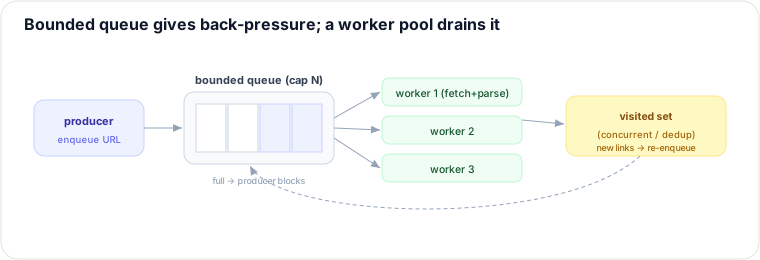
The three pieces
- Bounded blocking queue — gives back-pressure: when full, producers block instead of piling up unbounded work (the OOM failure mode).
- Worker pool — N consumers fetch + parse in parallel; new links feed back into the queue.
- Concurrent visited set —
putIfAbsenton aConcurrentHashMap/ConcurrentHashMap.newKeySet()so each URL is crawled exactly once (a check-then-act done atomically).
BlockingQueue<String> q = new LinkedBlockingQueue<>(10_000);   // bounded
Set<String> seen = ConcurrentHashMap.newKeySet();
for (int i = 0; i < WORKERS; i++) pool.submit(() -> {
    while (running) {
        String url = q.take();                      // blocks if empty
        for (String link : fetchAndParse(url))
            if (seen.add(link)) q.put(link);         // add() is atomic; put blocks if full
    }
});
In Go — channels are the bounded queue
q := make(chan string, 10_000)       // buffered channel = bounded queue
var seen sync.Map
for i := 0; i < workers; i++ {
    go func() {
        for url := range q {
            for _, link := range fetchAndParse(url) {
                if _, dup := seen.LoadOrStore(link, true); !dup { q <- link }
            }
        }
    }()
}
The hard part: knowing when you're done
You can't just close the queue — workers keep adding links. Track in-flight work with an
atomic counter (or a WaitGroup): increment on enqueue, decrement when a URL is fully
processed; when it hits zero, the crawl is complete and you can stop the workers.
Pitfalls
- Unbounded queue → memory blow-up on a large site. Always bound + back-pressure.
- Racy visited check (
if(!seen.contains) seen.add) re-crawls URLs — use one atomicadd/LoadOrStore. - Termination: naive workers block forever on an empty queue; use the in-flight counter or poison-pill sentinels to shut down.
Takeaways
- Bounded blocking queue (back-pressure) + worker pool + concurrent dedup set.
- Dedup must be a single atomic op; termination needs an in-flight counter, not a queue close.
- Go: a buffered channel IS the bounded queue;
sync.Map/LoadOrStorefor dedup.
Re-authored for this guide; pipeline diagram hand-authored as SVG. Covers Problem 16. See also: Thread Pools & Executors, Go Concurrency, Data Parallelism.
🤖 Don't fully get this? Learn it with Claude
Stuck on Pattern: Bounded Producer-Consumer & the Web Crawler (Problem 16)? Open Claude, copy a block below, and it'll teach you this exact concept — visually and interactively.
Build the mental picture, not memorization.
I just read a lesson on **Pattern: Bounded Producer-Consumer & the Web Crawler (Problem 16)** (Concurrency) and want to truly understand it. Explain Pattern: Bounded Producer-Consumer & the Web Crawler (Problem 16) from first principles using ONE vivid real-world analogy and a visual mental model — draw it as ASCII art or a clear step-by-step diagram — with a concrete example using real numbers. Then ask me one question to check I got the mental picture, and wait for my reply. If you're unsure or a claim isn't standard, say so and reason from first principles instead of guessing.
Socratic — adapts to where you're stuck.
Teach me **Pattern: Bounded Producer-Consumer & the Web Crawler (Problem 16)** interactively. Ask me ONE guiding question at a time, wait for my answer, and adapt to my confusion — build the idea with me step by step instead of explaining it all at once. If you're unsure or a claim isn't standard, say so and reason from first principles instead of guessing.
Active recall exposes what you missed.
Quiz me on **Pattern: Bounded Producer-Consumer & the Web Crawler (Problem 16)** with 5 questions, easy to tricky, ONE at a time. Tell me if each answer is right; at the end, explain clearly what I got wrong and why. If you're unsure or a claim isn't standard, say so and reason from first principles instead of guessing.
Intuition + hook + flashcards for long-term memory.
Help me remember **Pattern: Bounded Producer-Consumer & the Web Crawler (Problem 16)** for the long term: give the one-sentence intuition, a memorable hook/mnemonic, a tiny worked example, and 3 active-recall flashcards (Q -> A). If you're unsure or a claim isn't standard, say so and reason from first principles instead of guessing.