Problem 2 Linear Search for All Occurrences
Split the array into one contiguous chunk per thread, have each thread scan its chunk for the key, and merge the per-thread hits at the end — the parallelism is safe because each thread reads a disjoint index range and only the merge step touches shared state.
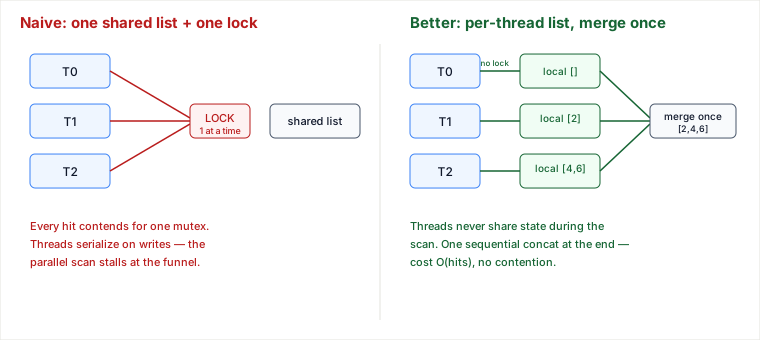
The single design decision that separates a correct-but-slow solution from a fast one is where threads write their results. The naive approach hands every thread a pointer to one shared ArrayList guarded by a single lock; the better approach gives each thread a private list and merges once. Both are correct. Only one scales.
The mechanism: disjoint reads, contended writes
Reading the array needs no synchronization — the input is immutable during the search and every thread owns a non-overlapping [start, end) slice, so two threads can never read-write the same cell. The only shared mutable object is the results collection. Every time a thread finds the key it must record the index somewhere, and that "somewhere" is the hot spot.
An ArrayList is not thread-safe: concurrent add calls can corrupt its internal size counter and backing array, dropping elements or throwing ArrayIndexOutOfBoundsException. So you serialize the writes with one lock. That makes it correct — but now every hit, across every thread, funnels through one mutex.
Worked example: find all 12s in [4, 15, 12, 3, 12, 9, 12]
Array length 7, key = 12, 3 threads. Chunk size = 7 / 3 = 2 (integer division), and the last thread absorbs the remainder, so the slices are not all equal:
| Thread | start | end | slice | scans (index : value) | hits |
|---|---|---|---|---|---|
| T0 | 0 | 2 | [4, 15] | 0:4, 1:15 | — |
| T1 | 2 | 4 | [12, 3] | 2:12 ✓, 3:3 | 2 |
| T2 | 4 | 7 | [12, 9, 12] | 4:12 ✓, 5:9, 6:12 ✓ | 4, 6 |
T0 finds nothing. T1 finds index 2. T2 finds indices 4 and 6. The set of correct answers is {2, 4, 6} — but the order they land in the shared list depends on which thread grabbed the lock first. A run might produce [4, 6, 2] or [2, 4, 6] or [4, 2, 6]. If you need ascending indices, you must sort after the merge — parallel search does not preserve scan order.
Java: the naive version (correct, contended)
This is the version most people write first. It works, and for sparse keys it is fine — but read on for why it does not scale.
import java.util.*;

public class AllOccurrences {
  static final int NUM_THREADS = 4;
  static final Object lock = new Object();
  static final List<Integer> found = new ArrayList<>();

  static void search(int id, int[] arr, int key) {
    int chunk = arr.length / NUM_THREADS;
    int start = id * chunk;
    int end = (id == NUM_THREADS - 1) ? arr.length : start + chunk;
    for (int i = start; i < end; i++) {
      if (arr[i] == key) {
        synchronized (lock) {   // every hit serializes here
          found.add(i);
        }
      }
    }
  }

  public static void main(String[] a) throws InterruptedException {
    int[] arr = {4, 15, 12, 3, 12, 9, 12};
    int key = 12;
    List<Thread> ts = new ArrayList<>();
    for (int i = 0; i < NUM_THREADS; i++) {
      int id = i;
      Thread t = new Thread(() -> search(id, arr, key));
      ts.add(t); t.start();
    }
    for (Thread t : ts) t.join();
    Collections.sort(found);            // restore ascending index order
    System.out.println(found);          // [2, 4, 6]
  }
}
Why the unsynchronized version is wrong: drop the synchronized block and two threads can call found.add simultaneously. ArrayList.add does elementData[size++] = e — a non-atomic read-increment-write of size. Interleaved, both threads read the same size, one overwrites the other's element, and the count ends up wrong. You silently lose indices, or trip an ArrayIndexOutOfBoundsException mid-resize. The bug is intermittent, which is the worst kind.
Java: the better version (per-thread local list, single merge)
Give each thread a private ArrayList it owns exclusively — no lock needed during the scan — then concatenate the lists once on the main thread after join. This is exactly the structure Problem 3 generalizes. Zero lock acquisitions on the hot path.
import java.util.*;
import java.util.concurrent.*;

public class AllOccurrencesFast {
  static final int NUM_THREADS = 4;

  public static void main(String[] a) throws Exception {
    int[] arr = {4, 15, 12, 3, 12, 9, 12};
    int key = 12;
    List<List<Integer>> partials = new ArrayList<>();
    List<Thread> ts = new ArrayList<>();

    for (int i = 0; i < NUM_THREADS; i++) {
      List<Integer> local = new ArrayList<>();   // private to this thread
      partials.add(local);
      int id = i;
      int chunk = arr.length / NUM_THREADS;
      int start = id * chunk;
      int end = (id == NUM_THREADS - 1) ? arr.length : start + chunk;
      Thread t = new Thread(() -> {
        for (int j = start; j < end; j++)
          if (arr[j] == key) local.add(j);     // no lock: sole writer
      });
      ts.add(t); t.start();
    }
    for (Thread t : ts) t.join();

    List<Integer> found = new ArrayList<>();
    for (List<Integer> p : partials) found.addAll(p);  // merge, single-threaded
    Collections.sort(found);                            // if order matters
    System.out.println(found);                          // [2, 4, 6]
  }
}
Each thread is the sole writer to local, and the main thread only reads partials after join — and join establishes a happens-before edge, so the reads see every write with no extra synchronization. Note that iterating partials in thread-index order makes results per-chunk ordered (T0's hits, then T1's, ...) even before sorting, which is often good enough.
Go: the same two designs
Go's idiom replaces the shared lock with a channel, or — closer to the "local list + merge" design — pre-sized per-goroutine slots written without any synchronization. A sync.WaitGroup stands in for the join loop.
package main

import (
	"fmt"
	"sort"
	"sync"
)

func main() {
	arr := []int{4, 15, 12, 3, 12, 9, 12}
	key, numG := 12, 4

	partials := make([][]int, numG) // one slot per goroutine
	var wg sync.WaitGroup

	for g := 0; g < numG; g++ {
		chunk := len(arr) / numG
		start := g * chunk
		end := start + chunk
		if g == numG-1 {
			end = len(arr)
		}
		wg.Add(1)
		go func(g, start, end int) {
			defer wg.Done()
			var local []int // owned by this goroutine
			for i := start; i < end; i++ {
				if arr[i] == key {
					local = append(local, i)
				}
			}
			partials[g] = local // distinct index per goroutine: no race
		}(g, start, end)
	}
	wg.Wait()

	var found []int
	for _, p := range partials {
		found = append(found, p...) // merge after Wait
	}
	sort.Ints(found)
	fmt.Println(found) // [2 4 6]
}
Writing each goroutine's result into its own partials[g] slot is race-free because the indices are distinct and wg.Wait() happens-before the merge read — confirm with go run -race. The channel alternative (hits := make(chan int), each goroutine sends, a collector ranges over it) is more idiomatic when you don't know the result count up front, at the cost of one channel send per hit.
Where the two runtimes differ
- Threads vs goroutines. Each Java
Threadis an OS thread (~1 MB stack, kernel-scheduled). Spawning one per chunk is fine atNUM_THREADS = 4but ruinous at thousands. A goroutine starts at ~2 KB and is multiplexed onto a small pool of OS threads by the Go runtime, so "one goroutine per chunk" scales to far finer granularity. - Lock vs channel. Java's
synchronized/wait/notifyis mutual exclusion over shared memory. Go'schan intmoves the value between goroutines so ownership transfers instead of being shared — "don't communicate by sharing memory; share memory by communicating." Both express the merge; the channel version needs no explicit lock. - Race detection. Go ships
-race, a built-in dynamic detector that flags the unsynchronized-ArrayListclass of bug at runtime. Java has no equivalent in the standard toolchain — you reason about happens-before yourself or reach for tools likejcstress.
Pitfalls
- Unsynchronized shared
ArrayList. The headline bug. Concurrentaddcorruptssizeand the backing array — lost indices orArrayIndexOutOfBoundsException, intermittently. Either lock it, use a thread-safe collection, or (best) avoid sharing entirely. - Lock contention when the key is dense. The single-lock design serializes every match. If the key occurs in half the array, threads spend most of their time queued on the mutex and you can run slower than a single-threaded scan. The per-thread-list design has zero hot-path locking — this is the whole reason to prefer it.
- Assuming the result is sorted. Parallel search returns indices in lock-acquisition order, which is non-deterministic. If a caller expects ascending indices,
Collections.sort/sort.Intsafter the merge — or merge per-chunk slices in thread order, which is already sorted within and across chunks. - Integer-division chunking drops the tail.
7 / 3 = 2covers only indices 0–5; index 6 is lost unless the last thread takesend = arr.length. Always give the final chunk the remainder (both versions above do). - Reusing
CopyOnWriteArrayListas the "easy fix." It is thread-safe but copies the entire backing array on everyadd— O(n) per write, O(n²) total. Catastrophic for a write-heavy collector. It is for read-mostly data, not this.
Takeaways
- The reads are embarrassingly parallel (disjoint slices, immutable input); the only synchronization problem is collecting results.
- One shared list + one lock is correct but serializes every match — fine for sparse keys, a contention disaster for dense ones.
- Per-thread local list + a single post-
joinmerge eliminates hot-path locking entirely. This is the pattern Problem 3 builds on; prefer it by default. - Parallel results are unordered by index — sort after merging if order matters, and always give the last chunk the array's remainder.
Re-authored and deepened for this guide. Mechanism, contention analysis, and the local-list-plus-merge design draw on Brian Goetz et al., Java Concurrency in Practice (happens-before, thread confinement); the Go idioms and the race detector follow Effective Go and the official sync / -race documentation. Worked example traced on [4, 15, 12, 3, 12, 9, 12] searching for 12. Earlier raster screenshots replaced with the authored two-design diagram and a corrected, compiling Java + Go pair.
🤖 Don't fully get this? Learn it with Claude
Stuck on Problem 2 Linear Search for All Occurrences? Open Claude, copy a block below, and it'll teach you this exact concept — visually and interactively.
Progressively stronger hints — you still solve it.
I'm working on the problem **Problem 2 Linear Search for All Occurrences** (Concurrency). Give me a HINT LADDER: start with the tiniest nudge, then wait. Only reveal the next, stronger hint when I ask. Do NOT show the full solution unless I type 'show solution'. Keep me doing the thinking. If you're unsure or a claim isn't standard, say so and reason from first principles instead of guessing.
See the technique, not just code.
Explain the optimal approach to **Problem 2 Linear Search for All Occurrences** with a VISUAL walkthrough: trace it on a small concrete example using ASCII art / a step-by-step diagram, narrate what changes each step, then give time & space complexity with a one-line derivation. If you're unsure or a claim isn't standard, say so and reason from first principles instead of guessing.
Catch bugs, edge cases, sub-optimality.
I'll paste my solution to **Problem 2 Linear Search for All Occurrences**. Review it for correctness, missed edge cases, and time/space complexity, then coach me toward the optimal — don't just rewrite it. Ask me to paste my code now. If you're unsure or a claim isn't standard, say so and reason from first principles instead of guessing.
Lock in recognition with look-alikes.
Give me 2 problems that use the SAME underlying pattern as **Problem 2 Linear Search for All Occurrences**. For each, let me attempt first, then review my answer and name the trigger signal that reveals the pattern. If you're unsure or a claim isn't standard, say so and reason from first principles instead of guessing.