Problem 4 MinMaxSum
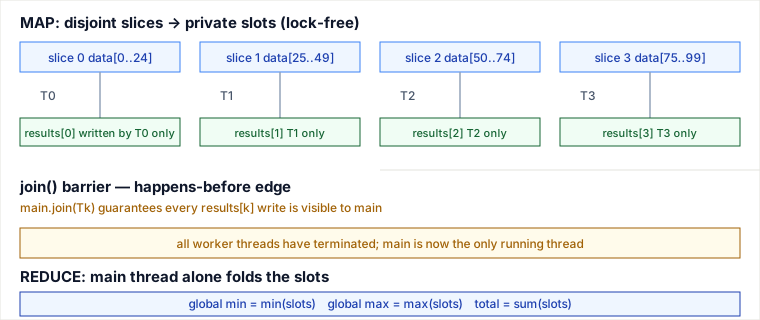
Each worker thread reduces one contiguous slice of the array to three scalars (a partial min, max, and sum) and writes each scalar into its own pre-indexed slot of a shared results array — slot threadId is touched by exactly one thread, so no two threads ever write the same memory cell and no lock is needed; the main thread then does the final combine alone, after join(), which is precisely where it becomes safe to read every slot.
The two-phase structure
Every problem in this family (linear search, π, min/max/sum) is the same shape: a parallel map over disjoint partitions, then a sequential reduce over the partial results. What makes min/max/sum clean is that all three reductions are associative — min(min(a,b),c) = min(a,min(b,c)), same for max and + — so splitting the array and recombining the pieces in any order gives the identical answer a single thread would compute. That algebraic property, not anything about threads, is what licenses the parallelism.
| Phase | Who runs it | Shared state touched | Synchronization |
|---|---|---|---|
| Map (per slice) | N threads in parallel | results[threadId] — disjoint per thread | None needed |
| Reduce (combine) | Main thread, alone | Reads all results[] | join() happens-before |
Why disjoint output slots remove the lock
A data race needs two threads to access the same location with at least one write and no ordering between them. Here the writes are threadResultsSum[threadId] = sum, and threadId is unique per thread. Thread 0 writes only slot 0, thread 1 only slot 1, and so on — the write sets are pairwise disjoint, so the precondition for a race never holds. This is the output partitioning trick: you don't protect a shared accumulator with a mutex; you give each worker its own private mailbox and merge the mailboxes once, single-threaded.
This is strictly cheaper than the naive alternative (one shared totalSum guarded by a lock) because there is zero lock contention on the hot path — each thread runs its whole loop with no cross-thread coordination at all.
Why the reduce step is correct
Two things must hold for the final combine to be right. First, visibility: when main reads threadResultsSum[2], does it see the value thread 2 wrote, or a stale value? The Java Memory Model answers this with Thread.join(). The JMM specifies that all actions in a thread happen-before any other thread successfully returns from join() on it. So after the for (Thread t : threads) t.join(); loop, every slot write is guaranteed visible to main — no volatile, no lock required. Skip the join and you'd be reading slots that may still hold their default 0.
Second, completeness: the union of the slices must be the whole array with no gaps and no overlap. With start = id * (N/T) and end = (id+1) * (N/T), slice boundaries chain end-to-end. (Note the trap below when N isn't divisible by T.)
Worked example: the sum reduce, real values
Take data = [4, 5, 2, 6, 1, 7, 8, 3, 9, 10] with 2 threads. Slices: part0 = [4,5,2,6,1], part1 = [7,8,3,9,10].
| Thread | Slice | Partial min → slot | Partial max → slot | Partial sum → slot |
|---|---|---|---|---|
| T0 | [4,5,2,6,1] | min[0] = 1 | max[0] = 6 | sum[0] = 18 |
| T1 | [7,8,3,9,10] | min[1] = 3 | max[1] = 10 | sum[1] = 37 |
Reduce (main, after join): min(1,3)=1, max(6,10)=10, sum = 18 + 37 = 55. Cross-check serially: 4+5+2+6+1+7+8+3+9+10 = 55. Match — the partition didn't change the answer because addition is associative.
The code, Java and Go side by side
The shipped Java spawns 3 × NUMBER_OF_THREADS threads — a separate thread for each of min, max, sum per slice. That's lock-free and correct (every thread still owns a unique slot in its own result array), but it's wasteful: one pass over a slice can compute all three. The version below fuses them so each slice is read once.
public class MinMaxSum {
  static final int N = 100, T = 4;
  static int[] data = new int[N];
  static int[] pMin = new int[T], pMax = new int[T], pSum = new int[T];

  public static void main(String[] a) throws InterruptedException {
    java.util.Random r = new java.util.Random();
    for (int i = 0; i < N; i++) data[i] = r.nextInt(500);

    Thread[] th = new Thread[T];
    for (int id = 0; id < T; id++) {
      final int tid = id;
      final int start = tid * (N / T);
      // last thread takes the remainder so no element is dropped
      final int end = (tid == T - 1) ? N : (tid + 1) * (N / T);
      th[id] = new Thread(() -> {
        int mn = Integer.MAX_VALUE, mx = Integer.MIN_VALUE, s = 0;
        for (int i = start; i < end; i++) {
          int v = data[i];
          if (v < mn) mn = v;
          if (v > mx) mx = v;
          s += v;
        }
        pMin[tid] = mn; pMax[tid] = mx; pSum[tid] = s; // disjoint slot: no lock
      });
      th[id].start();
    }
    for (Thread t : th) t.join(); // happens-before: all writes now visible

    int min = Integer.MAX_VALUE, max = Integer.MIN_VALUE, sum = 0;
    for (int i = 0; i < T; i++) {
      min = Math.min(min, pMin[i]);
      max = Math.max(max, pMax[i]);
      sum += pSum[i];
    }
    System.out.printf("min=%d max=%d sum=%d%n", min, max, sum);
  }
}
In Go the same shape is idiomatic with goroutines and a sync.WaitGroup as the join barrier. A struct result per slice keeps the three partials together; the slice of results is the disjoint-slot array.
package main

import (
	"fmt"
	"math"
	"math/rand"
	"sync"
)

type partial struct{ min, max, sum int }

func main() {
	const N, T = 100, 4
	data := make([]int, N)
	for i := range data {
		data[i] = rand.Intn(500)
	}

	res := make([]partial, T) // one disjoint slot per goroutine
	var wg sync.WaitGroup
	for id := 0; id < T; id++ {
		wg.Add(1)
		start := id * (N / T)
		end := (id + 1) * (N / T)
		if id == T-1 {
			end = N // remainder to the last goroutine
		}
		go func(id, start, end int) {
			defer wg.Done()
			mn, mx, s := math.MaxInt, math.MinInt, 0
			for i := start; i < end; i++ {
				v := data[i]
				if v < mn {
					mn = v
				}
				if v > mx {
					mx = v
				}
				s += v
			}
			res[id] = partial{mn, mx, s} // slot id: no mutex
		}(id, start, end)
	}
	wg.Wait() // happens-before: goroutine writes visible to main

	min, max, sum := math.MaxInt, math.MinInt, 0
	for _, p := range res {
		if p.min < min {
			min = p.min
		}
		if p.max > max {
			max = p.max
		}
		sum += p.sum
	}
	fmt.Printf("min=%d max=%d sum=%d\n", min, max, sum)
}
Where the two runtimes differ
- Threads vs goroutines. Each Java
Threadis a real OS thread (~1 MB stack, kernel-scheduled). The shipped3×T-thread version costs 12 OS threads for 100 elements — fine here, catastrophic if you scaled the fan-out. Go's goroutines start at a ~2 KB growable stack and are multiplexed onto a small pool of OS threads by the runtime, so the same fan-out is cheap; you'd still partition for cache locality, not to save threads. - Join barrier. Java's
Thread.join()is per-thread and provides the JMM happens-before edge directly. Go has nojoin;sync.WaitGroup.Wait()is the barrier, and the Go memory model guarantees thewg.Done()in each goroutine happens-before theWait()returns. Channels would also work (send apartialper goroutine, receive T of them) but a WaitGroup is leaner when you already have indexed slots. - Same lock-free principle, both languages. Neither version uses a mutex on the hot path. The correctness argument is identical: disjoint writes during map, a memory barrier at the join, then a single-threaded reduce.
Pitfalls
- Dropping the remainder. With
N=100, T=3,N/T = 33and the originalend = (id+1)*33formula gives slices ending at 33, 66, 99 — elementdata[99]is never read, so sum and max silently undercount. Always give the last workerend = N(as above) or distribute the remainder. - Reading partials before
join()/Wait(). Without the barrier you have a data race; main may read a slot still holding its default0, which poisonsmin(since0 < any positive partial min) and undercountssum. The bug is non-deterministic and often hides on a fast laptop, then surfaces under load. - Default-zero initialization corrupting min/max. If a slice is empty (more threads than elements), its slot keeps the default
0, and the reduce folds a bogus0into the global min/max. Either skip empty slices or seed unused slots withMAX_VALUE/MIN_VALUE. - Integer overflow in the sum. Partial sums fit in
inthere, but on a large array of large values either a partial or the final total can overflow. Uselong(Java) /int64(Go) for the accumulators. - False sharing. Packing all partials into one tightly-packed
int[]can put adjacent slots on the same cache line; threads writing neighboring slots ping-pong that line between cores. It's correct but can erase the speedup. Padding slots (or per-thread structs/locals merged at the end) avoids it.
Takeaways
- Min/max/sum parallelize because all three reductions are associative — partition freely, recombine in any order, get the same answer.
- The lock disappears not by luck but by design: disjoint output slots (one per worker) mean no two threads write the same cell, so there's no race to guard.
- The reduce is correct because
join()/WaitGroup.Wait()establishes a happens-before edge that makes every partial write visible to the single thread doing the final combine. - Fuse the three reductions into one pass per slice; spawning
3×Tthreads is correct but wasteful — and in Go, prefer goroutines + a WaitGroup over OS-thread-per-task.
Sources: Brian Goetz et al., Java Concurrency in Practice (happens-before, Thread.join semantics, false sharing); the Java Language Specification §17.4 Memory Model; The Go Memory Model (go.dev/ref/mem) and the sync package docs for WaitGroup ordering; Herlihy & Shavit, The Art of Multiprocessor Programming (map/reduce over disjoint partitions). Re-authored and deepened for this guide: added the disjoint-output-slot correctness argument, the happens-before reasoning for the reduce step, the fused single-pass Java rewrite with the remainder fix, a side-by-side Go version, and the pitfalls a working engineer hits.
🤖 Don't fully get this? Learn it with Claude
Stuck on Problem 4 MinMaxSum? Open Claude, copy a block below, and it'll teach you this exact concept — visually and interactively.
Progressively stronger hints — you still solve it.
I'm working on the problem **Problem 4 MinMaxSum** (Concurrency). Give me a HINT LADDER: start with the tiniest nudge, then wait. Only reveal the next, stronger hint when I ask. Do NOT show the full solution unless I type 'show solution'. Keep me doing the thinking. If you're unsure or a claim isn't standard, say so and reason from first principles instead of guessing.
See the technique, not just code.
Explain the optimal approach to **Problem 4 MinMaxSum** with a VISUAL walkthrough: trace it on a small concrete example using ASCII art / a step-by-step diagram, narrate what changes each step, then give time & space complexity with a one-line derivation. If you're unsure or a claim isn't standard, say so and reason from first principles instead of guessing.
Catch bugs, edge cases, sub-optimality.
I'll paste my solution to **Problem 4 MinMaxSum**. Review it for correctness, missed edge cases, and time/space complexity, then coach me toward the optimal — don't just rewrite it. Ask me to paste my code now. If you're unsure or a claim isn't standard, say so and reason from first principles instead of guessing.
Lock in recognition with look-alikes.
Give me 2 problems that use the SAME underlying pattern as **Problem 4 MinMaxSum**. For each, let me attempt first, then review my answer and name the trigger signal that reveals the pattern. If you're unsure or a claim isn't standard, say so and reason from first principles instead of guessing.