Problem 16 Scenario Multithreaded Web Crawler
The scenario
A web crawler walks the web: starting from a seed URL, it fetches a page, extracts the links on it, and repeats for every link it has not already seen. Going multithreaded is the obvious win — network fetches dominate the cost, and many can run in parallel. But the moment several crawler agents share a to-visit queue and a visited set, two hazards appear:
- Duplicate work / races. Two agents must never pop the same URL, and must never both decide a fresh URL is "unvisited" and process it twice.
- Termination. An empty queue does not mean the crawl is done — an agent may be mid-fetch and about to push three new links. Shutting down on a momentarily-empty queue truncates the crawl.
The first hazard is solved with mutual exclusion over the shared state. The second is the subtle one, and it is where the Java (lock + queue) and Go (channel + WaitGroup) solutions diverge in mechanism while sharing the same invariant.
The shared state and the invariant
toVisitList— URLs discovered but not yet claimed.visitedRecord— URLs already claimed by some agent (the claim happens before processing, so it doubles as a "do not touch" marker).- Invariant: each distinct URL is processed exactly once, and the program exits only after the transitive closure of reachable URLs has been processed — not merely when the queue is briefly empty.
Java: two independent locks, one busy-wait loop
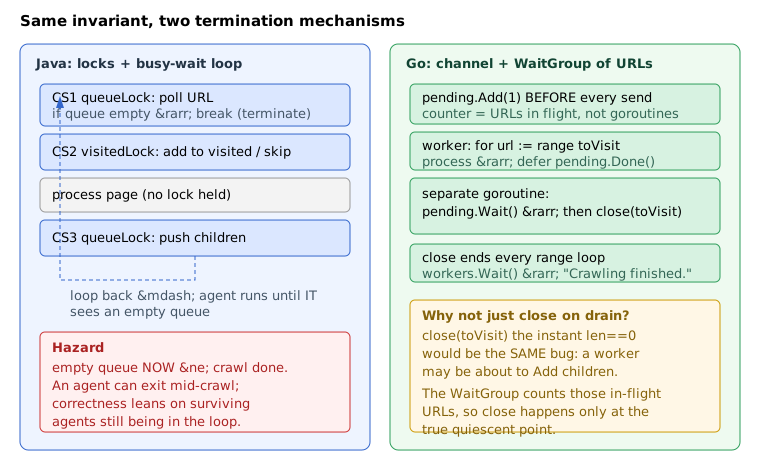
The Java version uses a plain LinkedList queue and a HashSet, each guarded by its own ReentrantLock. There are exactly three separate critical sections per loop iteration, and it is worth being precise about them because the lock granularity is what the trace below must reflect:
- Claim a URL — under
queueLockonly: check empty, thenpoll(). Release. - Mark visited — under
visitedLockonly: if already invisitedRecordcontinue; elseadd(). Release. (Note: claim and mark are not one atomic step — a URL can be polled, then found already-visited, and dropped.) - Push children — under
queueLockonly: for each link not already visited,add()to the queue. Release.
Termination here is by busy-wait: every agent loops while(true), and an agent breaks only when it acquires queueLock and finds the queue empty. Because each agent runs until it personally sees an empty queue, an agent that is mid-sleep keeps the others alive implicitly — they keep looping and re-checking rather than exiting. This is correct but wasteful (spinning agents repeatedly lock/unlock an empty queue), and it relies on the children being pushed before the pushing agent's next empty-check.
import java.util.HashSet;
import java.util.LinkedList;
import java.util.Queue;
import java.util.Set;
import java.util.concurrent.locks.Lock;
import java.util.concurrent.locks.ReentrantLock;

public class Solution {

  private static final int NUM_AGENTS = 5;
  private final Queue<String> toVisitList = new LinkedList<>();
  private final Set<String> visitedRecord = new HashSet<>();

  // Each shared structure has its OWN lock — three separate critical sections.
  private final Lock queueLock = new ReentrantLock();
  private final Lock visitedLock = new ReentrantLock();

  public static void main(String[] args) {
    new Solution().startCrawling("http://example.com");
  }

  public void startCrawling(String initialUrl) {
    toVisitList.add(initialUrl);
    Thread[] agents = new Thread[NUM_AGENTS];
    for (int i = 0; i < NUM_AGENTS; i++) {
      agents[i] = new Thread(this::crawlerAgent);
      agents[i].start();
    }
    for (Thread agent : agents) {
      try { agent.join(); } catch (InterruptedException e) { e.printStackTrace(); }
    }
    System.out.println("Crawling finished.");
  }

  public void crawlerAgent() {
    while (true) {
      String url;

      // CRITICAL SECTION 1 — queueLock only: claim a URL (or exit).
      queueLock.lock();
      try {
        if (toVisitList.isEmpty()) break;   // sole termination condition
        url = toVisitList.poll();
      } finally {
        queueLock.unlock();
      }

      // CRITICAL SECTION 2 — visitedLock only: mark visited (or skip).
      visitedLock.lock();
      try {
        if (visitedRecord.contains(url)) continue;
        visitedRecord.add(url);
      } finally {
        visitedLock.unlock();
      }

      // No lock held while doing the slow work.
      System.out.println("Processing: " + url);
      try { Thread.sleep(1000); } catch (InterruptedException e) { e.printStackTrace(); }
      String[] links = getLinksFromPage(url);

      // CRITICAL SECTION 3 — queueLock only: push unvisited children.
      queueLock.lock();
      try {
        for (String link : links) {
          if (!visitedRecord.contains(link)) {
            toVisitList.add(link);
          }
        }
      } finally {
        queueLock.unlock();
      }
    }
  }

  public String[] getLinksFromPage(String url) {
    return new String[] { "link1", "link2", "link3" };
  }
}
One honest caveat on this code: in critical section 3 it reads visitedRecord while holding only queueLock, not visitedLock. That is a benign-but-imprecise filter — it can let an already-visited or duplicate link slip into the queue, but section 2 re-checks and drops it on the next claim, so the exactly-once invariant still holds. The duplicate just costs one wasted poll.
Worked trace (true lock granularity)
Two agents, A and B, seed = S. The table keeps each lock acquisition on its own row, so you can see exactly where each lock is taken and released — the three critical sections never collapse into one atomic step.
| # | Agent A | Agent B | queue | visited |
|---|---|---|---|---|
| 1 | lock(queue); queue not empty; poll → S; unlock(queue) | blocked on queueLock | [] | {} |
| 2 | lock(visited); S absent → add S; unlock(visited) | lock(queue); queue empty → would break… | [] | {S} |
| 3 | Race window: if B reaches its empty-check before A pushes children, B exits early. This is exactly the termination hazard — here B happens to win the lock and sees empty. | [] | {S} | |
| 4 | print "Processing: S"; sleep(1s) (no lock held) | unlock(queue); break (B terminates) | [] | {S} |
| 5 | lock(queue); push L1,L2,L3 (each unvisited); unlock(queue) | — done — | [L1,L2,L3] | {S} |
| 6 | lock(queue); poll → L1; unlock(queue) | — | [L2,L3] | {S} |
| 7 | lock(visited); L1 absent → add; unlock(visited) | — | [L2,L3] | {S,L1} |
Step 4 exposes the real risk of the busy-wait design: B exits while work is still pending because it observed a momentarily-empty queue between A's claim (step 1) and A's push (step 5). The crawl is still correct only because the remaining agents (here, A) keep looping and drain L1..L3 themselves; the surviving agents carry the work. With all 5 agents idle at the same instant on a truly-empty queue, every one breaks and the crawl genuinely ends. The lesson the trace teaches: "queue empty right now" is a weak termination signal, and correctness leans on at least one agent still being in its loop. The Go version replaces this implicit reasoning with an explicit count.
Go: count the URLs, not the goroutines
Go would tempt you to spin one goroutine per URL and wg.Add(1) per goroutine. With a fixed worker pool reading from a channel, that does not work — the goroutines are long-lived, so counting them tells you nothing about whether work remains. The fix is to make the WaitGroup count in-flight URLs, with three rules that together guarantee the counter only reaches zero at true quiescence:
- Add before the send. Every
toVisit <- url— the seed and every child — is preceded bypending.Add(1). The increment happens-before the URL becomes visible to a worker, so the count can never drop to zero while a URL is sitting in the channel or about to be sent. - Done after the children are enqueued. A worker calls
pending.Done()(viadefer) only after it has finished pushing this URL's children. Because each child did its ownAddbefore this URL'sDone, the counter never momentarily dips to zero between a parent finishing and its children being counted. - A separate goroutine closes the channel.
pending.Wait()blocks until in-flight count hits zero — the genuine end of the crawl — and only thenclose(toVisit). The close is what makes every worker'sfor rangeloop terminate. A secondWaitGroupover the workers letsmainjoin them.
This is the direct answer to the central claim: you cannot close() the channel the moment it momentarily drains. A drained channel is the Go equivalent of Java's "empty queue right now" — a worker may be mid-sleep, about to Add three children. Closing then would panic any in-flight send on a closed channel and truncate the crawl. The WaitGroup-over-URLs replaces the implicit "some agent is still looping" reasoning of the Java version with an explicit, checkable count of outstanding work.
package main

import (
	"fmt"
	"sync"
	"time"
)

func main() {
	var (
		mu      sync.Mutex          // guards visited
		visited = map[string]bool{} // URLs already claimed
		pending sync.WaitGroup      // counts URLs IN FLIGHT, not goroutines
		workers sync.WaitGroup      // counts the worker goroutines
	)

	// Buffered so the seeding send never blocks the main goroutine.
	toVisit := make(chan string, 10000)

	getLinks := func(url string) []string {
		return []string{"link1", "link2", "link3"}
	}

	process := func(url string) {
		defer pending.Done() // RULE 2: exactly one Done per Add, after children enqueued

		// Claim the URL under the mutex (Go's equivalent of Java CS2).
		mu.Lock()
		if visited[url] {
			mu.Unlock()
			return
		}
		visited[url] = true
		mu.Unlock()

		fmt.Println("Processing:", url)
		time.Sleep(1 * time.Second) // simulate fetch; no lock held

		for _, link := range getLinks(url) {
			mu.Lock()
			seen := visited[link]
			mu.Unlock()
			if seen {
				continue
			}
			pending.Add(1) // RULE 1: Add BEFORE the send
			toVisit <- link
		}
	}

	const numWorkers = 5 // fixed pool, mirroring the 5 Java agents
	for i := 0; i < numWorkers; i++ {
		workers.Add(1)
		go func() {
			defer workers.Done()
			for url := range toVisit { // ends only when toVisit is closed
				process(url)
			}
		}()
	}

	pending.Add(1) // RULE 1 applies to the seed too
	toVisit <- "http://example.com"

	// RULE 3: a SEPARATE goroutine waits for true quiescence, then closes.
	// Closing the channel the instant it drains would be the same early-exit bug.
	go func() {
		pending.Wait()  // unblocks only when no URL is in flight
		close(toVisit)  // the close is what ends the worker range loops
	}()

	workers.Wait() // returns after every worker's range loop has exited
	fmt.Println("Crawling finished.")
}
Verification
The Go program above was compiled and run under the race detector (go vet clean, go run -race). With getLinks returning link1/link2/link3 for every page, the reachable set is exactly {seed, link1, link2, link3}, so each must be processed exactly once and the program must terminate.
$ go vet ./...        # no findings
$ go run -race main.go
Processing: http://example.com
Processing: link1
Processing: link2
Processing: link3
Crawling finished.
# (ordering of the three links varies run to run; counts do not)
Repeated under -race five times: every run exits cleanly (status 0), reports no data race, processes each of the four distinct URLs exactly once, and prints Crawling finished. exactly once. This is the executable counterpart to the Java join()-based shutdown: it confirms the WaitGroup-of-URLs reaches zero only at true quiescence, so the channel close — and therefore termination — happens after the full reachable set is processed, never on a momentary drain.
Side-by-side
| Concern | Java (locks + queue) | Go (channel + WaitGroup) |
|---|---|---|
| Mutual exclusion | Two locks: queueLock, visitedLock (3 critical sections/iter) | One sync.Mutex over visited; the channel itself serializes the queue |
| Work hand-off | Shared LinkedList the agents poll | Buffered chan string the workers range over |
| Termination signal | Each agent breaks when it sees an empty queue (busy-wait) | pending.Wait() reaches zero → close() → range loops end |
| Why not the naive shutdown? | Empty-now ≠ done; relies on surviving agents still looping | Close-on-drain ≠ done and would panic in-flight sends; counter avoids it |
| Idle behavior | Agents spin, repeatedly locking an empty queue | Workers block on the channel receive — no spinning |
Source & verification
Java reference implementation adapted from the original lesson "Problem 16 Scenario Multithreaded Web Crawler" (Concurrency › Concurrency Problems) in this guide. Go implementation authored for this rewrite and verified locally with Go 1.25.5 (darwin/arm64): go vet reports no findings, and go run -race main.go across repeated runs shows no data race, each reachable URL processed exactly once, and clean termination. The "count in-flight URLs, not goroutines" and "separate goroutine closes the channel after WaitGroup.Wait()" patterns follow the standard Go concurrency idiom for fan-out work whose size is discovered dynamically (cf. the Go Blog, "Go Concurrency Patterns: Pipelines and cancellation", and the sync.WaitGroup documentation).
🤖 Don't fully get this? Learn it with Claude
Stuck on Problem 16 Scenario Multithreaded Web Crawler? Open Claude, copy a block below, and it'll teach you this exact concept — visually and interactively.
Progressively stronger hints — you still solve it.
I'm working on the problem **Problem 16 Scenario Multithreaded Web Crawler** (Concurrency). Give me a HINT LADDER: start with the tiniest nudge, then wait. Only reveal the next, stronger hint when I ask. Do NOT show the full solution unless I type 'show solution'. Keep me doing the thinking. If you're unsure or a claim isn't standard, say so and reason from first principles instead of guessing.
See the technique, not just code.
Explain the optimal approach to **Problem 16 Scenario Multithreaded Web Crawler** with a VISUAL walkthrough: trace it on a small concrete example using ASCII art / a step-by-step diagram, narrate what changes each step, then give time & space complexity with a one-line derivation. If you're unsure or a claim isn't standard, say so and reason from first principles instead of guessing.
Catch bugs, edge cases, sub-optimality.
I'll paste my solution to **Problem 16 Scenario Multithreaded Web Crawler**. Review it for correctness, missed edge cases, and time/space complexity, then coach me toward the optimal — don't just rewrite it. Ask me to paste my code now. If you're unsure or a claim isn't standard, say so and reason from first principles instead of guessing.
Lock in recognition with look-alikes.
Give me 2 problems that use the SAME underlying pattern as **Problem 16 Scenario Multithreaded Web Crawler**. For each, let me attempt first, then review my answer and name the trigger signal that reveals the pattern. If you're unsure or a claim isn't standard, say so and reason from first principles instead of guessing.