Database Foundations — Data Independence, Codd's Relational Model & When NOT to Use a Database (Deep Dive)
A database is not “organized files.” The mechanism that actually killed the file era is data independence: the guarantee that an application's queries keep working even when the physical storage underneath them changes — a new index, a repartition, a different on-disk layout — and, separately, even when the logical schema grows a column the app doesn't care about. Rows-in-a-table “looking neater” than a CSV is not why databases won. The decoupling is why.
This page supplies that missing conceptual pivot with a concrete, traced failure a flat file makes inevitable, names the exact concurrency bugs a DBMS exists to prevent, and closes with the judgment call working engineers actually have to make: when a full RDBMS is not the answer. For how the DBMS mechanisms named below are implemented step by step (write-ahead log, MVCC, isolation levels), see the sibling page “ACID vs BASE Properties in Databases” — this page does not repeat that mechanism catalog.
The real pivot: data independence, not tidiness
Physical data independence means the application is insulated from how data is stored and accessed at the file/index/storage level. Logical data independence means the application is insulated from changes to the schema that don't affect the columns it actually uses (a new table, a new column elsewhere). In real-world database systems, logical data independence is primary enforced using database views. By presenting views (virtual tables) rather than direct physical tables to the application layer, DBAs can add, rename, or partition columns/tables underneath without modifying application query code. Both flow from one design choice: applications declare what they want, not how to fetch it.
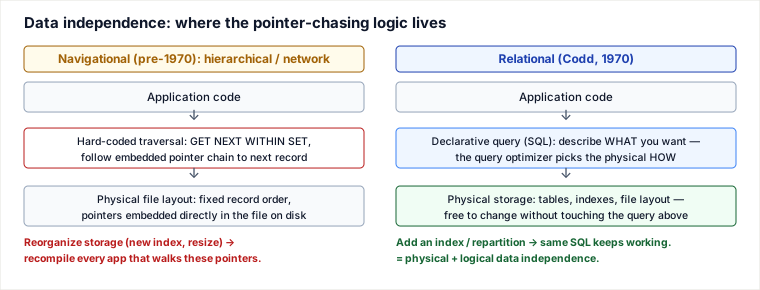
Before 1970, the dominant designs were navigational: IBM's IMS (hierarchical) and CODASYL-style network databases. An application walked the data by literally following pointers baked into the file format — GET NEXT WITHIN SET, follow this record's embedded link to the next one. That pointer-chasing logic lived inside application code, hard-wired to one specific physical layout. Add an index, reorganize storage, or change the record chain, and every program that walked those pointers had to be found and rewritten. The data and the access path were the same thing.
E. F. Codd's 1970 paper, “A Relational Model of Data for Large Shared Data Banks,” broke that coupling. Data is a set of relations (tables); applications manipulate them through a declarative algebra (later standardized as SQL) — SELECT what you want, don't say how to walk to it. A separate piece of system software, the query optimizer, is now responsible for turning that declarative request into a physical access path. That indirection is the entire trick: reorganize the storage underneath, and the same SQL still returns the same answer, because the application never encoded a path through the storage in the first place. This — not aesthetics — is why relational databases actually solved the file-era problem.
The four mechanisms that cash the promise
“A database solves this” is not magic; it is four pieces of engine machinery, briefly named here (the sibling ACID page covers the last two in mechanism-level depth):
- Query optimizer — turns a declarative query into a physical execution plan (index scan vs. sequential scan, join order). This is the software that implements data independence: it is free to change its physical choices under you as storage evolves, with zero change to your SQL.
- Transaction manager — groups a sequence of reads/writes into one atomic, all-or-nothing unit (
BEGIN … COMMIT/ROLLBACK). This is what makes a “read, modify, write” sequence indivisible instead of three separate, interruptible operations. - Concurrency control — locking and/or MVCC, deciding what one transaction is allowed to see and touch while another is mid-flight, so parallel work doesn't corrupt shared data.
- Recovery manager — the write-ahead log (WAL), guaranteeing a committed change survives a crash and an uncommitted one is undone.
The rest of this page traces exactly what breaks when those last two mechanisms — transaction manager and concurrency control — are entirely absent, which is the normal condition of a flat file.
The concrete failure: two programs, one flat file, a lost update
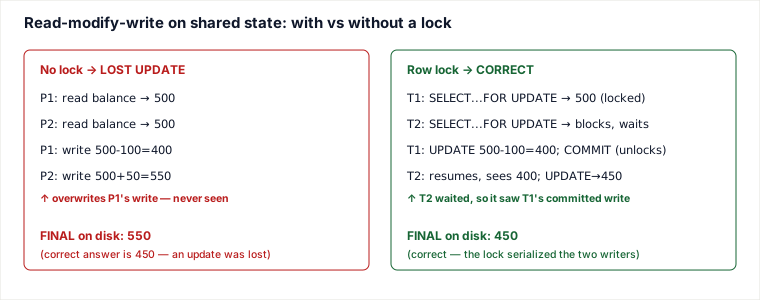
Picture a legacy design: a customer's balance lives as a single number in balance.dat. Two batch programs run at the same time — P1 processes a $100 withdrawal, P2 posts a $50 interest deposit. Neither program coordinates with the other; each just does the obvious thing: open the file, read the number, compute, write the number back, close the file. Starting balance: $500. Correct final balance: 500 − 100 + 50 = $450.
| Time | P1 (withdraw 100) | P2 (deposit 50) | balance.dat on disk |
|---|---|---|---|
| t0 | open + read → 500 | 500 | |
| t1 | open + read → 500 | 500 | |
| t2 | compute 500−100=400; write 400 | 400 | |
| t3 | compute 500+50=550; write 550 | 550 | |
| t4 (final) | process ends | 550 — WRONG (should be 450) | |
P2 never saw P1's write. It had already read its own private copy of 500 into memory at t1, before P1's write at t2 landed on disk. At t3 it computes from that stale number and blindly overwrites the file. P1's $100 withdrawal is gone: the file now reflects only the deposit, computed against a value that was already out of date the moment it was used. There is no concept, at the file level, of “I am modifying this record, wait your turn.” This exact bug has a name: lost update.
The DB fix: the same scenario, wrapped in a transaction
Put the same balance in a row inside a real database and run the two updates as transactions that take a lock (or, in an MVCC engine, that get a write-write conflict check at commit) on the row they touch:
| Time | T1 (withdraw 100) | T2 (deposit 50) | balance row |
|---|---|---|---|
| t0 | BEGIN; SELECT balance FOR UPDATE → 500 (row locked) | 500 | |
| t1 | BEGIN; SELECT balance FOR UPDATE → blocks, waiting on T1's lock | 500 | |
| t2 | UPDATE balance=400; COMMIT (lock released) | 400 | |
| t3 | unblocks, re-reads → 400; UPDATE 400+50=450; COMMIT | 450 | |
| t4 (final) | 450 — correct | ||
The lock forces T2 to wait until T1's write is committed and visible before T2 is allowed to compute its own update. The bug is closed by two named properties working together: atomicity (the read-modify-write is one indivisible unit; nothing else can observe or interleave with its half-finished state) and isolation (concurrent transactions can't interleave their intermediate reads and writes). One precise warning: a naive SELECT then UPDATE — without FOR UPDATE or an atomic UPDATE balance = balance - 100 — can still lose the update even inside a real database at Read Committed isolation, because plain MVCC lets T2's read proceed against a snapshot taken before T1 commits. The database gives you the tool; you still have to use it (see Pitfalls, below).
The second file-era failure: one fact, two places, out of sync
File-era systems also failed a different way: the same fact duplicated across several independent files. A customer's shipping address might be copied into orders.dat, billing.dat, and shipping.dat separately, because each program owned its own file. Update the address in orders.dat and forget shipping.dat, and the package ships to the old address — not because anyone made an arithmetic error, but because there was never a single source of truth to update.
The relational fix is normalization: store the fact once — a customers table holding the address — and every other table references it by foreign key (an orders row points at customer_id, it does not carry its own copy of the address). One UPDATE customers SET address = … fixes every consumer of that fact simultaneously, and a foreign-key constraint stops any row from ever pointing at a customer that doesn't exist. This is a different failure class from the lost update above — it is an integrity/redundancy problem, not a concurrency-timing problem — and normalization, not locking, is the mechanism that closes it.
Naming the concurrency failure modes precisely
“Concurrency bugs” is too vague to reason about or defend in an interview. There are three specific, well-named failure modes, and a specific isolation guarantee that closes each one:
- Lost update — traced above: two writers each read-modify-write the same value, and the second writer's update silently erases the first writer's change because it computed from a stale read. Prevented by atomicity of the read-modify-write unit plus isolation that serializes conflicting writers (row locks, or
SELECT … FOR UPDATE, or a serializable/first-committer-wins MVCC scheme). - Dirty read — a transaction reads a row that another transaction has modified but not yet committed. If the writer then rolls back, the reader has acted on a value that never officially existed. Prevented by isolation at or above Read Committed — never let a reader see another transaction's uncommitted writes.
- Inconsistent analysis (a long-running read across multiple records while other transactions independently update them) — e.g., an auditor sums every account balance while a separate transfer moves $100 from account A to account B. If the sum reads A's post-transfer balance but B's pre-transfer balance, the grand total is wrong even though every individual number the auditor read was, at some instant, real. No single consistent snapshot of the whole database ever actually held those values together. Prevented by isolation at or above Repeatable Read / Snapshot Isolation (ideally Serializable), which pins the reader to one consistent snapshot for the whole transaction instead of a moving target.
Notice the pattern: every one of these is a timing problem between independent read-modify-write sequences, and every fix is a form of atomicity or isolation — exactly the two ACID properties a flat file has no concept of at all.
Pitfalls
- Assuming “it's in a database” is automatically safe. A naive app-level
SELECTthen subtract thenUPDATE, instead ofSELECT … FOR UPDATEor an atomicUPDATE balance = balance - 100, rebuilds the exact flat-file lost-update bug on top of a relational database. The engine offers the tool; it doesn't force you to hold it. - Reintroducing the duplication bug inside the DB. Denormalizing into read-model caches or materialized views without a reconciliation mechanism recreates “same fact, two places, out of sync” — the DB doesn't save you from a redundant copy you added yourself.
- Treating “we used a database” as a substitute for choosing an isolation level. Most engines default to Read Committed (PostgreSQL, Oracle, SQL Server) or Repeatable Read (MySQL/InnoDB); dirty reads are already off by default, but lost updates and inconsistent analysis need you to explicitly ask for stronger isolation or explicit locking.
- Putting a 4 GB video or a 500 MB PDF in a row/BLOB “because it's already ACID.” The WAL, backups, and buffer cache now all have to move that blob around on every touch, for data that was never actually transactional in nature.
- Running a client-server RDBMS for single-process, no-concurrency local state (a desktop app's settings, a mobile app's offline cache) — paying for a lock manager coordinating multiple external clients when there is only ever one client.
Judgment layer — when a database is NOT the answer
A full RDBMS earns its cost (query optimizer + transaction manager + lock manager + WAL) only when you actually need what those mechanisms buy you. Named alternatives, and when each wins:
- Object store (S3, GCS) for large immutable blobs — video, images, backups, model weights. Store the bytes in the object store, keep only the pointer (key/URL) and metadata in the relational database. Object stores are built for cheap, massively parallel, immutable byte storage; they offer no transactions or joins, and a blob you never partially update doesn't need them.
- A file system / append-only log for write-once, strictly sequential data — application logs, audit trails, event streams you only append to and scan in order (or a purpose-built log system like Kafka). An RDBMS's B-tree indexes, MVCC bookkeeping, and lock manager are overhead you don't need when there is no random update and no read/write contention on the same record.
- An embedded database (SQLite) for single-process local state with no concurrent writers — a mobile app, a desktop tool, a CLI's local cache. You still get full ACID transactions and SQL, with no server process, network hop, or DBA, because the “no concurrency” assumption means you only need crash-safety around your own process, not a lock manager coordinating external clients.
- A search engine (Elasticsearch/OpenSearch/Lucene) for full-text / fuzzy search over large text corpora. A relational B-tree index is built for equality and range lookups; ranking free-text relevance, tokenizing, fuzzy matching, and faceting is a different data structure (the inverted index) that a general-purpose RDBMS does poorly when bolted on.
The decision rule: reach for a full RDBMS when multiple clients need to see and modify shared, mutable, structured data with correctness guarantees that span records. The moment any one of “multiple writers,” “shared,” “mutable,” or “cross-record invariant” drops out of the requirement, a cheaper, purpose-built store is probably a better fit than the machinery a full RDBMS carries.
Takeaways
- The database's real advance over files is data independence (Codd, 1970): applications declare what (a query) and the DBMS handles how (physical storage, indexes, access path) — unlike navigational pre-relational systems, where applications hard-coded pointer traversal directly into the physical layout.
- That promise is delivered by four concrete mechanisms — query optimizer, transaction manager, concurrency control, recovery manager — not by tables being inherently different from files. See the ACID sibling page for how the last two are actually built.
- Concurrent read-modify-write on shared mutable state, without those mechanisms, produces three specific, reproducible, named failures — lost update, dirty read, inconsistent analysis — and atomicity plus isolation are the exact properties that close each one.
- A full RDBMS is the right tool only when multiple writers share mutable, structured, cross-record-consistent data; large blobs want an object store, write-once sequences want an append-only log, single-process local state wants an embedded DB, and free text wants a search engine.
Related pages
- ACID vs BASE Properties in Databases — System Design — the mechanism catalog (WAL, MVCC, isolation levels) this page assumes
- Isolation Levels & Anomalies — Databases — the isolation levels that prevent the lost update/dirty read failures traced here
- Introduction to Normalization — Databases — how the fact-duplication failure traced above is fixed structurally
- Relational Model — Keys, FK Integrity, NULL Traps & Modeling Judgment (Deep Dive) — Databases — deeper look at the foreign-key mechanism introduced here
Re-authored/Deepened for this guide. Sources: E. F. Codd, “A Relational Model of Data for Large Shared Data Banks” (Communications of the ACM, 1970); C. J. Date, An Introduction to Database Systems; Gray & Reuter, Transaction Processing: Concepts and Techniques (1993) for the lost update / dirty read / inconsistent analysis terminology; cross-reference the sibling page “ACID vs BASE Properties in Databases” in this guide for WAL and MVCC mechanism detail.
🤖 Don't fully get this? Learn it with Claude
Stuck on Database Foundations — Data Independence, Codd's Relational Model & When NOT to Use a Database (Deep Dive)? Open Claude, copy a block below, and it'll teach you this exact concept — visually and interactively.
Build the mental picture, not memorization.
I just read a lesson on **Database Foundations — Data Independence, Codd's Relational Model & When NOT to Use a Database (Deep Dive)** (Databases) and want to truly understand it. Explain Database Foundations — Data Independence, Codd's Relational Model & When NOT to Use a Database (Deep Dive) from first principles using ONE vivid real-world analogy and a visual mental model — draw it as ASCII art or a clear step-by-step diagram — with a concrete example using real numbers. Then ask me one question to check I got the mental picture, and wait for my reply. If you're unsure or a claim isn't standard, say so and reason from first principles instead of guessing.
Socratic — adapts to where you're stuck.
Teach me **Database Foundations — Data Independence, Codd's Relational Model & When NOT to Use a Database (Deep Dive)** interactively. Ask me ONE guiding question at a time, wait for my answer, and adapt to my confusion — build the idea with me step by step instead of explaining it all at once. If you're unsure or a claim isn't standard, say so and reason from first principles instead of guessing.
Active recall exposes what you missed.
Quiz me on **Database Foundations — Data Independence, Codd's Relational Model & When NOT to Use a Database (Deep Dive)** with 5 questions, easy to tricky, ONE at a time. Tell me if each answer is right; at the end, explain clearly what I got wrong and why. If you're unsure or a claim isn't standard, say so and reason from first principles instead of guessing.
Intuition + hook + flashcards for long-term memory.
Help me remember **Database Foundations — Data Independence, Codd's Relational Model & When NOT to Use a Database (Deep Dive)** for the long term: give the one-sentence intuition, a memorable hook/mnemonic, a tiny worked example, and 3 active-recall flashcards (Q -> A). If you're unsure or a claim isn't standard, say so and reason from first principles instead of guessing.