Grokking the Art of Recursive Problem-Solving
Mechanism
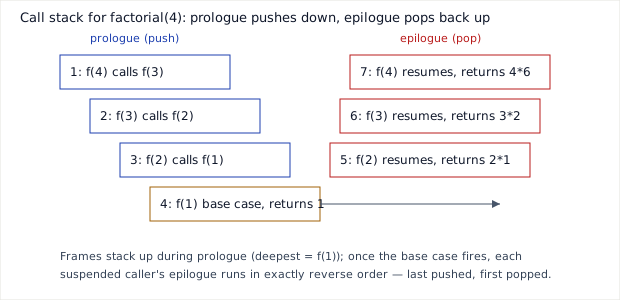
Recursion solves a problem by reducing it to one or more smaller instances of the same problem, plus a rule that combines those smaller results back into the answer for the original input; it works because the call stack automatically remembers each partial computation (the values still "in flight" in the prologue) so that when the smallest instance resolves, every suspended caller can finish its own work in reverse order — exactly like nested Russian dolls opened one at a time and then closed back up.
Concretely: each recursive call pushes a new stack frame holding that call's local variables and its return address. The prologue is everything a call does before making its recursive call (pushing deeper — opening the next doll); the epilogue is everything it does after the recursive call returns (popping back — closing that doll). The frames only start popping once the base case is hit, and they pop in exactly the reverse order they were pushed, which is why the last call made is the first to finish.
Recognize the pattern
- The problem definition mentions itself: "a tree is a node whose children are trees", "a valid sequence is an empty sequence or one valid sequence followed by another".
- You can restate the problem as f(n) in terms of f(n-1), f(n/2), or f(smaller subset), plus O(1) or O(k) extra work.
- The input has a natural nested/self-similar shape: trees, nested brackets, permutations/subsets, divide-and-conquer array splits, backtracking search spaces.
- You keep writing near-duplicate iterative loops with manual stacks to simulate "go deeper, then come back" — that manual stack is exactly the call stack recursion gives you for free.
Brute force vs. optimal shape
Brute force (naive recursion): recompute every subproblem from scratch every time it's needed. For overlapping-subproblem cases like Fibonacci this is exponential — same work is redone repeatedly because the recursion tree branches without remembering prior answers. Cost: O(2^n) time, O(n) space (call-stack depth only).
Optimal (memoized / structurally non-overlapping recursion): either (a) cache each unique subproblem's result the first time it's computed (top-down DP), collapsing the exponential tree into a DAG of distinct nodes, or (b) recognize the subproblems genuinely don't overlap (e.g. merge sort's two halves), in which case plain recursion is already optimal. Cost for memoized Fibonacci: O(n) time, O(n) extra cache + O(n) stack.
Complexity from first principles
Model recursive cost with a recurrence T(n) = (calls made) · T(smaller n) + (work per call).
- Naive Fibonacci — upper bound: T(n) = T(n-1) + T(n-2) + O(1). Every call that isn't a base case spawns exactly 2 more, so the number of calls at least doubles every two levels; a depth-n binary call tree therefore has at most O(2^n) nodes, giving T(n) = O(2^n). Space is only the deepest single root-to-leaf path = O(n) stack frames, since sibling branches don't coexist on the stack.
- Naive Fibonacci — tight bound: the O(2^n) bound is loose; the exact growth rate comes from solving the recurrence directly. Guess a solution of the form T(n) = x^n and substitute into T(n) = T(n-1) + T(n-2): x^n = x^(n-1) + x^(n-2), and dividing through by x^(n-2) gives the characteristic equation x^2 = x + 1, i.e. x^2 - x - 1 = 0. By the quadratic formula, x = (1 ± √5) / 2, whose positive root is φ ≈ 1.618 (the golden ratio). So T(n) grows as O(φ^n) ≈ O(1.618^n) — a strictly tighter bound than O(2^n), and this is the actual exponential base of the naive recursion tree, not merely an asserted number.
- Memoized Fibonacci: each of the n distinct subproblems (0..n) is computed exactly once, O(1) work each (after its two dependents are cached) → T(n) = O(n) time. Space = O(n) for the memo table + O(n) recursion depth = O(n).
- Divide-and-conquer (e.g. merge sort): T(n) = 2T(n/2) + O(n) merge work → by the Master Theorem this resolves to O(n log n) time; space is O(n) for merge buffers plus O(log n) stack depth.
Traced worked example: fib(5) naive vs. memoized
Naive call tree (each node is one call; leaves are base cases fib(0)/fib(1)):
| Call | Expands to | Total calls made |
|---|---|---|
| fib(5) | fib(4)+fib(3) | 1 |
| fib(4) | fib(3)+fib(2) | +1 |
| fib(3) (×2, computed independently) | fib(2)+fib(1) each | +2 |
| fib(2) (×3) | fib(1)+fib(0) each | +3 |
| base cases fib(1)/fib(0) | return 1 or 0 | +8 |
Total: 15 calls for n=5 (grows exponentially, consistent with the O(φ^n) bound derived above). With a memo map, fib(3) and fib(2) are each computed once and reused: exactly 6 unique calls (fib(5)..fib(0)), each O(1) after its dependencies are cached — 9 fewer redundant calls already at n=5, and the gap widens fast as n grows.
Code (memoized recursion, Java)
import java.util.HashMap;
import java.util.Map;

class Fib {
    private final Map<Integer, Long> memo = new HashMap<>();

    long fib(int n) {
        if (n <= 1) return n;              // base case
        Long cached = memo.get(n);
        if (cached != null) return cached; // reuse, single lookup
        long result = fib(n - 1) + fib(n - 2); // recursive case
        memo.put(n, result);                   // cache before returning
        return result;
    }
}
package main

func fib(n int, memo map[int]int64) int64 {
	if n <= 1 {
		return int64(n)
	}
	if v, ok := memo[n]; ok {
		return v
	}
	result := fib(n-1, memo) + fib(n-2, memo)
	memo[n] = result
	return result
}
Recursion Safety in Production: Stack vs. Heap
In theoretical computer science, recursion and iteration are computationally equivalent. In production software engineering, they are fundamentally different because of how the operating system and runtime manage memory:
- The Thread Call Stack: Each thread is allocated a private, fixed-size call stack (e.g., JVM default is 1MB, C++ is typically 2MB–8MB, and Python has a default limit of 1,000 frames). Every recursive call pushes a stack frame containing local variables, parameters, CPU registers, and the return address. If the recursion depth exceeds the stack limit (typically 5,000–10,000 frames in Java), the runtime throws a
StackOverflowError(or segfaults) and crashes the process. - The Process Heap: The heap is shared across the entire process and bounded only by physical RAM (typically gigabytes). Explicit data structures (like arrays, stacks, and queues) are allocated on the heap.
Stack-to-Heap Migration: To make a recursive algorithm safe for arbitrary input sizes in production, you must convert the implicit recursion into an iterative loop that manages an explicit, heap-allocated stack (such as Deque<Integer> stack = new ArrayDeque<>() in Java). This moves the memory overhead from the thread stack to the heap, where it can scale to millions of elements safely.
Worked comparison: DFS traversal
Recursive DFS (unsafe on deep linear graphs of N ≥ 10,000):
void dfsRecursive(int node, List<List<Integer>> adj, boolean[] visited) {
    visited[node] = true;
    for (int next : adj.get(node)) {
        if (!visited[next]) dfsRecursive(next, adj, visited); // pushes a new call frame
    }
}
Iterative DFS (production-safe, stack allocated on the heap):
void dfsIterative(int start, List<List<Integer>> adj, int n) {
    boolean[] visited = new boolean[n];
    Deque<Integer> stack = new ArrayDeque<>(); // heap-allocated stack
    stack.push(start);
    while (!stack.isEmpty()) {
        int node = stack.pop();
        if (visited[node]) continue;
        visited[node] = true;
        List<Integer> neighbors = adj.get(node);
        for (int i = neighbors.size() - 1; i >= 0; i--) {
            int next = neighbors.get(i);
            if (!visited[next]) stack.push(next); // push to heap-allocated stack
        }
    }
}
Pitfalls
- Missing or unreachable base case → infinite recursion → StackOverflowError; always write the base case first and verify every recursive call strictly shrinks toward it.
- Prologue/epilogue order confusion — printing/mutating before vs. after the recursive call flips output order (pre-order vs. post-order traversal); trace one small example by hand before trusting it.
- Mutable shared state across branches (e.g. a shared list in backtracking) not being undone on the way back out — forgetting to "un-choose" corrupts sibling branches.
- Ignoring overlapping subproblems — using naive recursion where memoization was needed turns a linear problem into an exponential one.
- Deep recursion on large n — languages without guaranteed tail-call optimization (Java, Go, Python) will blow the stack; an iterative or explicit-stack rewrite is needed for very deep inputs.
When to use / when not — vs. iteration
Use recursion when the data or problem is naturally self-similar (trees, graphs via DFS, divide-and-conquer, backtracking/combinatorial search) — the code mirrors the problem definition and stays far more readable than a hand-rolled stack.
Prefer iteration when: the recursion is simple tail recursion over a linear structure (a plain loop is O(1) space vs. recursion's O(n) stack, and avoids stack-overflow risk on large n); performance-critical hot paths where function-call overhead matters; or when the language doesn't optimize tail calls. Trade-off in one line: recursion trades stack space and call overhead for code that directly expresses the problem's self-similar structure — iteration trades that clarity for constant-space control.
Takeaways
- Every correct recursive function needs a base case that is actually reachable and a recursive case that provably shrinks toward it.
- The call stack is what makes recursion work: prologue pushes frames going deeper, the base case turns the stack around, and epilogues pop in exactly reverse order — nested dolls opened then closed.
- Recursion cost = (number of distinct subproblems) × (work per subproblem); overlapping subproblems without memoization is what turns polynomial into exponential — and for Fibonacci specifically, solving the recurrence's characteristic equation gives the exact O(φ^n) growth rate, not just a loose O(2^n) bound.
- Recursion depth = extra space; when depth can be large or the recursion is simple tail recursion over a list, an iterative loop is usually the safer, cheaper choice.
Recall: Why does naive recursive Fibonacci take exponential (φ^n) time while memoized Fibonacci takes linear time, in terms of the recursion tree and the call stack?
Synthesized from Educative's "Grokking the Art of Recursive Problem-Solving" course material, extended with first-principles complexity derivation (including the characteristic-equation solution for Fibonacci) and a Java/Go worked comparison.
🤖 Don't fully get this? Learn it with Claude
Stuck on Grokking the Art of Recursive Problem-Solving? Open Claude, copy a block below, and it'll teach you this exact concept — visually and interactively.
Build the mental picture, not memorization.
I just read a lesson on **Grokking the Art of Recursive Problem-Solving** (DSA) and want to truly understand it. Explain Grokking the Art of Recursive Problem-Solving from first principles using ONE vivid real-world analogy and a visual mental model — draw it as ASCII art or a clear step-by-step diagram — with a concrete example using real numbers. Then ask me one question to check I got the mental picture, and wait for my reply. If you're unsure or a claim isn't standard, say so and reason from first principles instead of guessing.
Socratic — adapts to where you're stuck.
Teach me **Grokking the Art of Recursive Problem-Solving** interactively. Ask me ONE guiding question at a time, wait for my answer, and adapt to my confusion — build the idea with me step by step instead of explaining it all at once. If you're unsure or a claim isn't standard, say so and reason from first principles instead of guessing.
Active recall exposes what you missed.
Quiz me on **Grokking the Art of Recursive Problem-Solving** with 5 questions, easy to tricky, ONE at a time. Tell me if each answer is right; at the end, explain clearly what I got wrong and why. If you're unsure or a claim isn't standard, say so and reason from first principles instead of guessing.
Intuition + hook + flashcards for long-term memory.
Help me remember **Grokking the Art of Recursive Problem-Solving** for the long term: give the one-sentence intuition, a memorable hook/mnemonic, a tiny worked example, and 3 active-recall flashcards (Q -> A). If you're unsure or a claim isn't standard, say so and reason from first principles instead of guessing.