Demystifying Recursion
How Recursion Actually Works
Recursion works because every function call — recursive or not — gets its own private stack frame: a slab of memory holding that call's parameters, local variables, and a return address. When f(n) calls f(n-1), the runtime doesn't overwrite anything; it pushes a brand-new frame on top of the call stack, suspends the caller mid-execution, and runs the callee. Only when the callee returns does control resume in the caller's frame, exactly where it left off. A recursive function is really just N independent frames of the same code, stacked and unwound in LIFO order. The base case is the condition that stops new pushes — without one (or if it is unreachable), frames pile up until the stack overflows.
Recognize the Pattern
- The problem of size
ncan be expressed in terms of the same problem on a strictly smaller size (n-1,n/2, a shorter list, a smaller subtree). - There is a natural, cheaply-testable stopping condition (empty list,
n == 0, null node, single element). - The domain is itself recursively defined: trees, linked lists, nested brackets, permutations, backtracking search spaces, divide-and-conquer splits.
- You catch yourself thinking "do X, then do the same thing to the rest."
Prologue vs Epilogue — Same Recursion, Different Order
Where you place work relative to the recursive call flips the execution order, even though the code looks almost identical.
// EPILOGUE: work happens on the way back up (unwinding)
static void printAsc(int n) {
    if (n < 0) return;      // base case
    printAsc(n - 1);        // descend first
    System.out.println(n);  // then act
}
// prints 0 1 2 3 for n=3

// PROLOGUE: work happens on the way down (diving)
static void printDesc(int n) {
    if (n < 0) return;
    System.out.println(n);  // act first
    printDesc(n - 1);       // then descend
}
// prints 3 2 1 0 for n=3
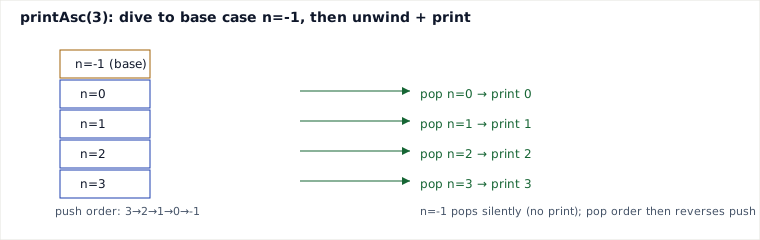
Every recursive call has a diving phase (pushing frames toward the base case) and an unwinding phase (popping frames back to the root). Code before the recursive call runs during diving, in call order; code after it runs during unwinding, in reverse call order. Note that printAsc's base case is n < 0, not n == 0 — so printAsc(3) still dives one call past 0, down to n = -1, before anything unwinds. That extra frame matters below.
Brute Force vs Optimal: Recursion Is Not Automatically Efficient
Naive recursion re-solves overlapping subproblems from scratch. Classic example — Fibonacci:
// Naive: recomputes fib(2), fib(1) many times over
static long fibNaive(int n) {
    if (n <= 1) return n;
    return fibNaive(n - 1) + fibNaive(n - 2);
}

// Memoized: each subproblem solved once, cached
static long fibMemo(int n, long[] memo) {
    if (n <= 1) return n;
    if (memo[n] != 0) return memo[n];
    return memo[n] = fibMemo(n - 1, memo) + fibMemo(n - 2, memo);
}fibNaive's call tree is not balanced: every node spawns an n-1 child and an n-2 child, and the n-1 child's subtree is always one level deeper than the n-2 child's. That asymmetry (worked out below) is exactly why the true growth rate is Θ(φ^n), φ ≈ 1.618, strictly slower than a genuinely balanced binary tree's 2^n. fibMemo collapses this to O(n) calls because each of the n distinct subproblems is computed once and reused. Recursion gives you a correct brute force almost for free (mirror the problem's own definition); turning it into something optimal usually means either memoizing overlapping subproblems, converting to bottom-up iteration (removing the call-stack cost entirely), or restructuring into a divide-and-conquer split with non-overlapping subproblems.
Complexity, Derived From First Principles
Time — printAsc. Draw the recursion tree and count nodes, not just leaves. printAsc(n) makes exactly one recursive call per invocation, so the tree is a single chain: calls for n, n-1, …, 0, and one final call at n=-1 that hits the base case and returns without recursing. That's T(n) = T(n-1) + O(1), a chain of length n+2 — O(n) total work.
Time — fibNaive, derived not asserted. fibNaive(n) makes two calls per invocation: T(n) = T(n-1) + T(n-2) + O(1). Upper bound by substitution: since T(n-2) ≤ T(n-1), T(n) ≤ 2·T(n-1), and unrolling that gives T(n) ≤ 2^n·T(0) — so T(n) = O(2^n) is a valid but loose ceiling, because it pretends both children are as heavy as the larger one. Solving the recurrence exactly (characteristic equation x² = x + 1, root φ = (1+√5)/2 ≈ 1.618) gives the tight closed form T(n) = Θ(φ^n). The gap between the two is precisely the tree's asymmetry: the n-1 branch is one level taller than the n-2 branch at every node, so the tree is systematically lighter than a balanced 2^n tree of the same depth. Use O(2^n) as a quick loose bound in conversation; cite Θ(φ^n) ≈ Θ(1.618^n) as the accurate one.
Space. Space is the maximum simultaneous depth of the call stack, not the total number of calls — sibling frames from finished calls are popped before their siblings are pushed. printAsc(n) and fibNaive(n) both have call-stack depth O(n) even though their call counts differ wildly (n vs φ^n), because at any instant only one root-to-leaf path of frames is alive.
Traced Worked Example: printAsc(3), the Actual Code Above
| Step | Action | Stack (bottom→top) |
|---|---|---|
| 1 | call printAsc(3) | [3] |
| 2 | call printAsc(2) | [3,2] |
| 3 | call printAsc(1) | [3,2,1] |
| 4 | call printAsc(0) | [3,2,1,0] |
| 5 | call printAsc(-1) | [3,2,1,0,-1] |
| 6 | n=-1 < 0: base case hits, return immediately, no print; frame -1 pops | [3,2,1,0] |
| 7 | print(0); frame 0 pops | [3,2,1] → output: 0 |
| 8 | print(1); frame 1 pops | [3,2] → output: 0 1 |
| 9 | print(2); frame 2 pops | [3] → output: 0 1 2 |
| 10 | print(3); frame 3 pops | [] → output: 0 1 2 3 |
Five frames pushed (3, 2, 1, 0, -1), five popped, but only four print statements execute — the n=-1 frame is pure overhead from the base-case check. Max depth 5 for input 3 (n+2), still linear in n — confirming O(n) depth, and matching the real base case if (n < 0) return; from the code above.
Step Through a Branching Recursion
The trace above follows a linear recursion (printAsc, one call per frame). The debugger below animates the branching case — naive fib(n) — so you can watch the call tree explode, the call stack grow then unwind, and the repeated subtrees (red-dashed) that memoization would collapse. Press Play and at each call predict whether it hits the base case or recurses into two children.
Pitfalls
- Missing or unreachable base case — infinite recursion, StackOverflowError. Always verify every recursive call strictly shrinks toward the base case.
- Overlapping subproblems without memoization — exponential blowup (naive Fibonacci, naive subset-sum) that looks fine on small test inputs and dies on larger ones.
- Assuming tail-call optimization — Java (and most mainstream JVM/CPython runtimes) does not eliminate tail calls, so even a "tail-recursive" function still consumes O(n) stack frames and can overflow for large n.
- Mutable shared state across calls — passing mutable collections by reference without copying/backtracking corrupts sibling calls' views of the data.
When to Use / When Not — vs Iteration
Use recursion when the data or problem is naturally recursive (trees, graphs via DFS, divide-and-conquer, backtracking) — the code mirrors the problem's own definition and stays far more readable than the manual-stack equivalent.
Prefer iteration when depth can be large (risk of stack overflow), when the recursion is a simple linear reduction with no branching (a plain loop does the same work with O(1) space instead of O(n)), or in performance-critical hot paths where function-call overhead per frame matters. Iteration with an explicit stack/queue gives the same correctness as recursion for tree/graph traversal while trading code clarity for control over memory (heap-allocated stack, no fixed depth limit, tunable).
Takeaways
- Recursion = one function, many independent stack frames, unwound in LIFO order; prologue code runs during the dive, epilogue code runs during the unwind, in reverse order.
- A recursion tree's node count gives time complexity; its maximum root-to-leaf depth gives space complexity — these can differ by orders of magnitude (O(n) depth vs Θ(φ^n) nodes for fibNaive).
- An asymmetric recursion tree (fibNaive's n-1 branch is always one level deeper than its n-2 branch) is why the tight bound is Θ(φ^n) ≈ Θ(1.618^n), not the looser O(2^n) you get from a naive substitution bound.
- Naive recursion is a correct brute force, not an efficient one — check for overlapping subproblems before shipping it.
Recall: For fibNaive(5), is the call-stack space complexity O(n) or Θ(φ^n), and why does it differ from the time complexity?
Synthesized from standard recursion/call-stack pedagogy (recursion trees, stack-frame model, recurrence-relation analysis via substitution and characteristic-equation solving) for this study guide.
🤖 Don't fully get this? Learn it with Claude
Stuck on Demystifying Recursion? Open Claude, copy a block below, and it'll teach you this exact concept — visually and interactively.
Build the mental picture, not memorization.
I just read a lesson on **Demystifying Recursion** (DSA) and want to truly understand it. Explain Demystifying Recursion from first principles using ONE vivid real-world analogy and a visual mental model — draw it as ASCII art or a clear step-by-step diagram — with a concrete example using real numbers. Then ask me one question to check I got the mental picture, and wait for my reply. If you're unsure or a claim isn't standard, say so and reason from first principles instead of guessing.
Socratic — adapts to where you're stuck.
Teach me **Demystifying Recursion** interactively. Ask me ONE guiding question at a time, wait for my answer, and adapt to my confusion — build the idea with me step by step instead of explaining it all at once. If you're unsure or a claim isn't standard, say so and reason from first principles instead of guessing.
Active recall exposes what you missed.
Quiz me on **Demystifying Recursion** with 5 questions, easy to tricky, ONE at a time. Tell me if each answer is right; at the end, explain clearly what I got wrong and why. If you're unsure or a claim isn't standard, say so and reason from first principles instead of guessing.
Intuition + hook + flashcards for long-term memory.
Help me remember **Demystifying Recursion** for the long term: give the one-sentence intuition, a memorable hook/mnemonic, a tiny worked example, and 3 active-recall flashcards (Q -> A). If you're unsure or a claim isn't standard, say so and reason from first principles instead of guessing.