Recursive Algorithm Strategies
A recursive algorithm strategy is a family of trade-offs about when to split a problem, whether subproblems overlap, and whether a previously computed answer can be reused instead of recomputed — the choice of strategy (divide & conquer, dynamic programming, backtracking, greedy-recursion) follows directly from answering those three questions before you write a single line of code.
Recognize the pattern
- Problem naturally splits into independent halves/parts (sort, search, matrix) whose solutions combine with a cheap merge step → divide & conquer.
- Same exact subproblem (same parameters) gets asked for repeatedly as recursion unfolds → dynamic programming (memoize or tabulate).
- You must explore all valid configurations / need to enumerate or search a decision tree, abandoning a path as soon as it violates a constraint → backtracking.
- A locally-optimal recursive choice provably leads to a globally optimal one, no need to explore alternatives → greedy recursion.
Brute force vs optimal
Take Fibonacci as the running example because it cleanly exposes the difference between divide & conquer applied naively and dynamic programming.
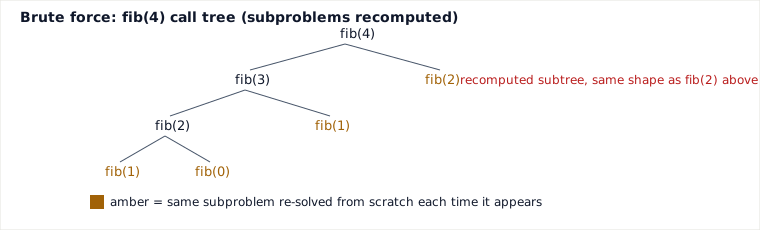
Brute-force recursion (naive divide & conquer, no reuse): fib(n) = fib(n-1) + fib(n-2). Each call spawns two more, and fib(n-2) is recomputed independently inside both the fib(n-1) branch and directly — the subproblems overlap but nothing remembers that. Cost: exponential time, O(n) space (call stack depth).
Optimal (DP): cache each fib(k) the first time it is computed; every later request for fib(k) is an O(1) lookup. Cost: linear time, O(n) space (cache + stack, or O(1) with iterative bottom-up).
Complexity, derived
Brute force: let T(n) be the number of calls to compute fib(n). T(n) = T(n-1) + T(n-2) + 1, same recurrence shape as Fibonacci itself, so T(n) grows as φn where φ ≈ 1.618 → O(φn) time, O(n) space for the deepest call stack.
Memoized DP: there are only n+1 distinct subproblems (fib(0)..fib(n)); each is computed exactly once doing O(1) work beyond its two recursive lookups → O(n) time, O(n) space (memo table + recursion stack).
General divide & conquer recurrence (non-overlapping subproblems, e.g. merge sort): T(n) = a·T(n/b) + f(n). By the Master Theorem, if f(n) = O(nlogba), T(n) = O(nlogba log n). Merge sort: a=2, b=2, f(n)=O(n) → T(n) = O(n log n), space O(n) for merge buffers + O(log n) stack. Binary search is the degenerate case with a=1: T(n) = T(n/2) + O(1) → Θ(log n) — divide & conquer where one half is discarded instead of solved.
Traced worked example: fib(5)
| Call | Brute force: times evaluated | Memoized: computed or lookup? |
|---|---|---|
| fib(5) | 1 | computed |
| fib(4) | 1 | computed |
| fib(3) | 2 | computed once, then lookup |
| fib(2) | 3 | computed once, then lookup ×2 |
| fib(1) | 5 | base case, lookup after first |
| fib(0) | 3 | base case, lookup after first |
Brute force makes 15 total calls for n=5 (growing exponentially); memoized DP makes exactly 6 distinct computations plus O(1) lookups for every repeat request.
Java: brute force vs memoized vs bottom-up
class Fib {
    // Brute force divide & conquer: O(phi^n) time, O(n) space
    static long fibBrute(int n) {
        if (n <= 1) return n;
        return fibBrute(n - 1) + fibBrute(n - 2);
    }

    // Top-down DP (memoized recursion): O(n) time, O(n) space
    // Entry point: the memo MUST be seeded with -1. A bare new long[n+1]
    // defaults to 0, so the guard below would treat every slot as "already
    // computed" and silently return 0 for all n >= 2.
    static long fib(int n) {
        long[] memo = new long[n + 1];
        java.util.Arrays.fill(memo, -1);   // -1 = "not computed yet"
        return fibMemo(n, memo);
    }

    static long fibMemo(int n, long[] memo) {
        if (n <= 1) return n;
        if (memo[n] != -1) return memo[n];
        memo[n] = fibMemo(n - 1, memo) + fibMemo(n - 2, memo);
        return memo[n];
    }

    // Bottom-up DP (tabulation, no recursion): O(n) time, O(1) space
    static long fibIter(int n) {
        if (n <= 1) return n;
        long prev2 = 0, prev1 = 1;
        for (int i = 2; i <= n; i++) {
            long cur = prev1 + prev2;
            prev2 = prev1;
            prev1 = cur;
        }
        return prev1;
    }
}
Pitfalls
- Assuming overlap without checking: memoizing a problem whose subproblems never repeat (e.g. merge sort's ranges) wastes memory and a hashmap lookup for nothing.
- Wrong memo key: memoizing on a subset of the parameters that actually determine the answer silently returns stale results for a different state.
- Stack overflow: deep recursion (n ~ 105+) on a non-tail-optimized language like Java blows the call stack; convert to bottom-up iteration for large n.
- Backtracking without pruning: exploring the full decision tree without early constraint checks turns exponential-but-prunable into actually-exponential.
- Divide & conquer overhead: combine step costlier than expected (e.g. naive concatenation instead of a linear merge) silently degrades the Master Theorem bound.
When to use / when not, vs alternatives
| Strategy | Use when | Avoid when | Named alternative |
|---|---|---|---|
| Divide & conquer | subproblems independent, combine step is cheap | subproblems overlap heavily (redundant work) | Dynamic programming |
| Dynamic programming | overlapping subproblems, optimal substructure | no repeated subproblems, or state space too large to store | Divide & conquer / greedy |
| Backtracking | need all/feasible solutions, constraints prune early | problem has a known greedy or DP closed form (backtracking wastes time) | DP (if optimal substructure exists) or greedy |
| Greedy recursion | local optimal choice provably yields global optimum | greedy-choice property unproven (may give wrong answer) | Dynamic programming (guarantees correctness by exploring all choices) |
Takeaways
- Before coding a recursive algorithm, answer: how do I divide, how do I combine, and do subproblems repeat?
- Overlapping subproblems + optimal substructure is the exact signal to switch from divide & conquer to dynamic programming.
- The same recurrence that describes the problem (T(n) = T(n-1) + T(n-2)) also describes the brute-force call count — recognize this to derive complexity without a trace.
- Memoization trades space for time by turning repeated computation into O(1) lookups.
Recall: Why does naive recursive Fibonacci take exponential time while the recursion for merge sort (also two recursive calls) takes only O(n log n)?
Sources: CLRS (Cormen, Leiserson, Rivest, Stein), Introduction to Algorithms, ch. 4 & 15; original page content on recursive algorithm strategies.
🤖 Don't fully get this? Learn it with Claude
Stuck on Recursive Algorithm Strategies? Open Claude, copy a block below, and it'll teach you this exact concept — visually and interactively.
Build the mental picture, not memorization.
I just read a lesson on **Recursive Algorithm Strategies** (DSA) and want to truly understand it. Explain Recursive Algorithm Strategies from first principles using ONE vivid real-world analogy and a visual mental model — draw it as ASCII art or a clear step-by-step diagram — with a concrete example using real numbers. Then ask me one question to check I got the mental picture, and wait for my reply. If you're unsure or a claim isn't standard, say so and reason from first principles instead of guessing.
Socratic — adapts to where you're stuck.
Teach me **Recursive Algorithm Strategies** interactively. Ask me ONE guiding question at a time, wait for my answer, and adapt to my confusion — build the idea with me step by step instead of explaining it all at once. If you're unsure or a claim isn't standard, say so and reason from first principles instead of guessing.
Active recall exposes what you missed.
Quiz me on **Recursive Algorithm Strategies** with 5 questions, easy to tricky, ONE at a time. Tell me if each answer is right; at the end, explain clearly what I got wrong and why. If you're unsure or a claim isn't standard, say so and reason from first principles instead of guessing.
Intuition + hook + flashcards for long-term memory.
Help me remember **Recursive Algorithm Strategies** for the long term: give the one-sentence intuition, a memorable hook/mnemonic, a tiny worked example, and 3 active-recall flashcards (Q -> A). If you're unsure or a claim isn't standard, say so and reason from first principles instead of guessing.