Synchronous vs Asynchronous Communication
"Synchronous vs asynchronous" is not one decision but two independent ones stacked together, and confusing them is the source of most production incidents in this area: the I/O model (does a thread physically park inside a blocking system call, or does one thread multiplex thousands of connections through an event loop?) and the interaction pattern (does the caller wait for the reply before proceeding, or hand the work off and move on?). The first governs how many threads and how much memory you burn to hold requests in flight; the second governs coupling, failure semantics, and whether you can absorb a downstream outage.
The two axes, kept separate
- I/O model — blocking (thread-per-request) vs non-blocking (event loop / epoll). A resource question.
- Interaction pattern — request–response (caller waits) vs message hand-off (caller returns, worker finishes later). A coupling question.
They are orthogonal. You can run synchronous-looking await client.get(...) code on a fully non-blocking event loop, and you can build an asynchronous message-queue system on top of old-fashioned blocking threads. Treat them as one knob and you will reach for a message broker when all you needed was non-blocking sockets.
Layer 1 — the I/O model: who waits, and how
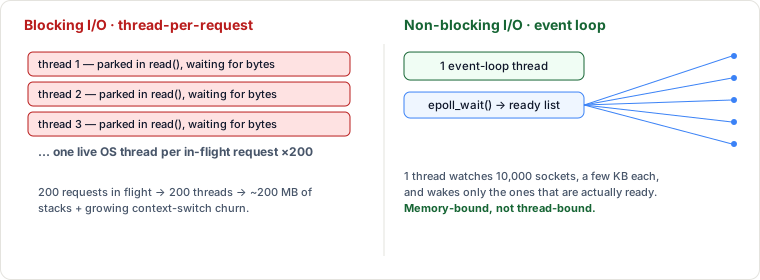
At the OS level a call like read() on a socket is blocking by default: if no bytes have arrived, the kernel takes the calling thread off the run queue and parks it until data is ready. Simple to reason about, but it means one in-flight request pins one OS thread for the request's entire duration — including all the time it spends idle waiting on the network.
Non-blocking I/O inverts this. Sockets are set O_NONBLOCK, and a single event-loop thread asks the kernel — via epoll on Linux, kqueue on BSD/macOS, IOCP on Windows — "which of these thousands of sockets are readable/writable right now?" and only touches those. One thread drives many connections; the work is expressed as callbacks, futures, or async/await that resume when a file descriptor becomes ready. The cost per connection drops from a whole thread stack (~1 MB) to a few KB of buffers.
Layer 2 — the interaction pattern: request–response vs hand-off
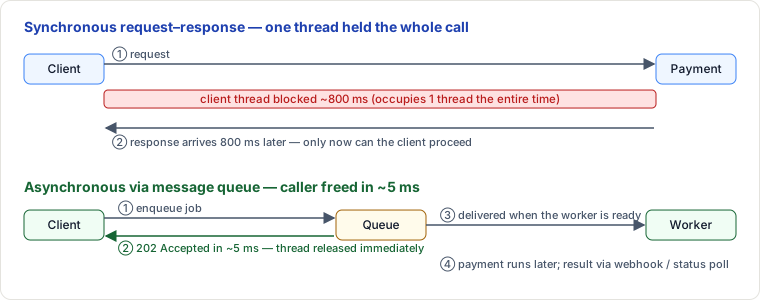
Request–response (synchronous interaction): the caller sends and waits for the reply before doing anything else — an HTTP call, a gRPC unary call, a SQL query. The two parties are coupled in time: both must be up simultaneously, and the caller's failure semantics are immediate — it gets a result, an error, or hits a timeout. Composition is trivial ("read this, then decide"), which is why it dominates.
Message hand-off (asynchronous interaction): the caller writes the work to a broker (Kafka, SQS, RabbitMQ) and returns straight away; a consumer picks it up later. Producer and consumer are decoupled in time, the queue buffers load spikes, and delivery is typically at-least-once — duplicates are normal, so consumers must be idempotent. The price is that the result is no longer in-band: the caller learns the outcome via a webhook, a status record it polls, or a follow-up event.
Worked example: the same 1,000 req/s under a downstream slowdown
An order API fronts a payment service. Watch how the two layers behave when the payment service degrades. The tool here is Little's Law: the number of requests concurrently in flight is L = λ × W (arrival rate × time each one takes).
- Arrival rate
λ = 1,000 req/s. Normal payment latencyW = 0.20 s. - In flight:
L = 1000 × 0.20 = 200requests concurrently. - Blocking model: 200 concurrent requests = 200 busy OS threads ≈ 200 MB of stacks. Fine.
- Incident: payment p99 jumps to
W = 2.0 s. NowL = 1000 × 2.0 = 2,000in flight. - Thread pool capped at 400 → 1,600 requests queue for a thread → that wait stacks on top of the 2 s → effective latency spirals, the pool never drains, and new requests time out or are rejected. This is textbook thread-pool exhaustion / cascading failure.
- Event loop (still synchronous semantics): those 2,000 in-flight requests are 2,000 non-blocking sockets watched by ~4 loop threads. Cost is per-connection buffers (KB), not thread stacks. Latency degrades toward 2 s but the box stays up.
- Message queue (async interaction): the API enqueues and returns
202in ~5 ms; ingest rate is decoupled from payment latency. The 2 s spike becomes queue depth, drained by consumers at their own pace. Cost: the caller no longer learns the payment result in-band.
| Design | Cost to hold 200 in flight | When payment p99 → 2 s |
|---|---|---|
| Blocking, thread-per-request | 200 threads (~200 MB) | Needs 2,000 threads; pool exhausts → queueing → cascade → possible OOM |
| Non-blocking event loop (sync semantics) | ~4 threads + 200 socket buffers | Holds 2,000 sockets; latency ≈ 2 s but stays alive |
| Async message queue | Enqueue + return; no held threads | Ingest unaffected (~5 ms); spike absorbed as queue depth |
The lesson: event loops fix a resource problem (holding many slow calls cheaply); message queues fix a coupling problem (surviving a downstream that is slow or down). They are not substitutes.
Pitfalls
- Blocking call inside an event loop — the cardinal sin. One synchronous JDBC query or
Thread.sleepon a Node.js / Netty / asyncio loop thread stalls every connection that thread is serving, not just the one request. Push blocking work to a dedicated thread pool (loop.run_in_executor, a bounded worker pool). - No timeout on a synchronous call. A downstream that hangs forever will hold your thread forever. Always set connect and read timeouts, and add a bulkhead / circuit breaker so one sick dependency can't consume the whole pool.
- Unbounded async queues. An in-memory queue with no limit turns a traffic spike into an OOM, and latency grows without bound (a full queue just means requests wait longer). Bound the queue and apply backpressure: block or reject the producer, or shed load. "Async" is not "infinite capacity."
- Retrying non-idempotent messages. At-least-once delivery + a naive retry = double charges. Attach an idempotency key and dedupe on the consumer.
- Fake async.
await-ing each item in a sequential loop is just synchronous code with extra syntax — you get zero concurrency. To overlap, start the operations first, then await them together (e.g.Promise.all,asyncio.gather). - Assuming ordering across a queue. Partitioned/sharded brokers only order within a partition. If you need per-entity order, key the messages so one entity lands on one partition.
- Silent failures in fire-and-forget. Without acknowledgements and a dead-letter queue, dropped or poison messages vanish. Monitor queue depth and DLQ size as first-class signals.
When to use it / when NOT to
Decision signals for synchronous request–response. The caller genuinely needs the answer to continue (read-then-decide, validation, auth checks); you want read-after-write / strong consistency; the call is fast and the dependency is reliable; fan-out is low; and you value dead-simple debugging (one stack trace, one request ID).
Decision signals for asynchronous message hand-off. The work can complete later (email, thumbnails, indexing, ledger postings); you must absorb bursts far above steady-state throughput; you need to keep serving even while a dependency is down; the producer and consumers scale or deploy independently; or one event must fan out to many consumers.
Trade-off vs the named alternative — synchronous REST/gRPC call vs a Kafka/SQS hand-off. Going async gains temporal decoupling, spike buffering, independent scaling, and isolation from downstream outages. It costs eventual consistency (the result is not in-band), distributed-tracing and debugging difficulty, and mandatory extra machinery: idempotent consumers, a dead-letter queue, retry/backoff policy, and queue-depth monitoring. A synchronous call has none of that overhead but couples the caller's fate and latency to the callee's.
And within the synchronous world — thread-per-request vs event loop. Thread-per-request is simpler, debugs beautifully, and is plenty for CPU-bound or low-concurrency services; it falls over when you must hold many slow I/O-bound calls at once (the C10k regime). The event loop wins on I/O concurrency and memory but punishes any accidental blocking call and makes stack traces harder to read.
Choose synchronous when the caller cannot proceed without the answer and the dependency is fast and dependable; reach for a non-blocking event loop when it's still synchronous but you're holding thousands of slow I/O calls; prefer an async message queue when you can honestly return "accepted" now and finish the work later, or when you must survive a downstream that is slow or offline.
Takeaways
- Separate the two axes: the I/O model (blocking threads vs event loop) is a resource decision; the interaction pattern (wait vs hand-off) is a coupling decision. They are orthogonal.
- Little's Law (
L = λ × W) predicts the blowup: a slow downstream multiplies the concurrency you must hold — cheap on an event loop, fatal for a fixed thread pool. - Event loops let you hold many slow calls cheaply; message queues let you not hold them at all and survive the outage. Different problems.
- Async is not free: bound your queues (backpressure), always timeout synchronous calls, and make consumers idempotent with a DLQ — or the flexibility becomes an outage.
Sizing the blocking worker pool
When you must offload blocking work, size the pool from measured wait time, not from vibes. The Goetz formula is:
N_threads = N_cpu * U_cpu * (1 + W/C)N_cpu is available cores, U_cpu is target CPU utilization, W is average wait time, and C is average compute time. Example: an 8-core service targets 80% CPU, each request spends 45 ms waiting on a database and 5 ms on CPU. N_threads = 8 * 0.8 * (1 + 45/5) = 6.4 * 10 = 64. A 64-thread pool can keep CPU busy while most threads are parked on I/O; a CPU-bound handler with W=0 would instead want about 8 * 0.8 = 6-7 threads.
Now align the pool with the dependency it waits on. If those 64 workers all issue JDBC calls but HikariCP has only 20 database connections, 44 workers will simply queue for a connection while still occupying app threads. If HikariCP has 200 connections but the database can only handle 80 active queries, the app pushes the bottleneck downstream. The worker count, database connection pool size, and database concurrency budget must be designed together: usually cap workers at or near the DB pool for DB-bound tasks, then use backpressure/rejection before the waiting queue becomes your outage.
Re-authored and deepened for this guide. Sources: Dan Kegel, "The C10K Problem"; the Linux epoll(7) and BSD kqueue(2) manuals; Martin Kleppmann, Designing Data-Intensive Applications (async messaging, delivery guarantees, backpressure); Michael Nygard, Release It! (timeouts, bulkheads, circuit breakers, cascading failure); Marc Brooker / the Amazon Builders' Library on timeouts, retries, and backpressure; and Little's Law from queueing theory.
🤖 Don't fully get this? Learn it with Claude
Stuck on Synchronous vs Asynchronous Communication? Open Claude, copy a block below, and it'll teach you this exact concept — visually and interactively.
Build the mental picture, not memorization.
I just read a lesson on **Synchronous vs Asynchronous Communication** (System Design) and want to truly understand it. Explain Synchronous vs Asynchronous Communication from first principles using ONE vivid real-world analogy and a visual mental model — draw it as ASCII art or a clear step-by-step diagram — with a concrete example using real numbers. Then ask me one question to check I got the mental picture, and wait for my reply. If you're unsure or a claim isn't standard, say so and reason from first principles instead of guessing.
Socratic — adapts to where you're stuck.
Teach me **Synchronous vs Asynchronous Communication** interactively. Ask me ONE guiding question at a time, wait for my answer, and adapt to my confusion — build the idea with me step by step instead of explaining it all at once. If you're unsure or a claim isn't standard, say so and reason from first principles instead of guessing.
Active recall exposes what you missed.
Quiz me on **Synchronous vs Asynchronous Communication** with 5 questions, easy to tricky, ONE at a time. Tell me if each answer is right; at the end, explain clearly what I got wrong and why. If you're unsure or a claim isn't standard, say so and reason from first principles instead of guessing.
Intuition + hook + flashcards for long-term memory.
Help me remember **Synchronous vs Asynchronous Communication** for the long term: give the one-sentence intuition, a memorable hook/mnemonic, a tiny worked example, and 3 active-recall flashcards (Q -> A). If you're unsure or a claim isn't standard, say so and reason from first principles instead of guessing.