Microservices vs Serverless Architecture
These two words are not on the same axis, and treating them as either/or is the mistake most people make. Microservices is an architectural decision — how you cut a system into independently deployable services. Serverless (specifically FaaS: Functions-as-a-Service like AWS Lambda) is a runtime and billing decision — how one unit of code is hosted, scaled, and charged for. The real trade-off an engineer weighs is how each service runs: as an always-on managed container that you keep warm and scale by adding replicas, versus an on-demand function that the provider spins up per request and bills per millisecond. You can, and people routinely do, implement a microservice on serverless — the checkout service is a set of Lambda functions. So the honest question is never "microservices or serverless"; it is "for this service, do I want warm capacity I manage, or per-invocation capacity the cloud manages?"
The mechanism: warm replicas vs per-invocation instances
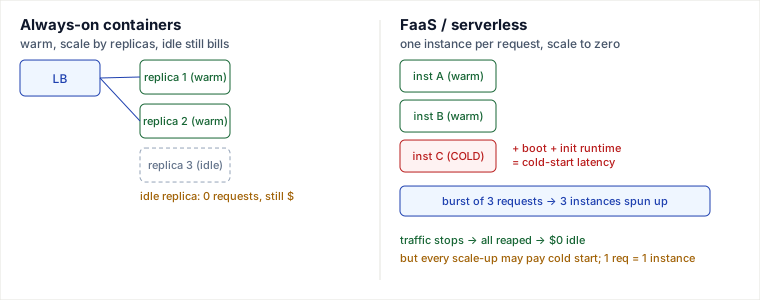
Always-on container. Your process boots once, holds a DB connection pool, JIT-warms, and sits behind a load balancer waiting for traffic. Concurrency comes from the request-handling threads/goroutines inside each replica; you scale by running more replicas. Idle replicas still cost money because the CPU/RAM is reserved for you whether or not a request arrives.
FaaS / serverless. There is no long-lived process you own. When a request arrives, the platform finds a warm micro-VM (on AWS, a Firecracker microVM) that already has your code loaded and hands it the event; if none is free, it provisions a fresh one — download code, start the runtime, run your init code — and only then handles the request. That provisioning delay is the cold start. Crucially, one instance handles one request at a time: 500 concurrent requests means 500 concurrent instances. When traffic stops, instances are reaped and you scale to zero — you pay nothing. Billing is GB-seconds of wall-clock execution plus a per-request fee.
That single sentence — you pay only while code runs, but each request may pay a cold-start tax and there is a hard ceiling on how long/big one invocation can be — drives every trade-off below.
Worked example: an image-resize endpoint, both ways
Same service — resize an uploaded image. Each call uses 512 MB of memory and runs for 200 ms. We cost it on AWS Lambda (us-east-1 x86: $0.0000166667 per GB-second + $0.20 per 1M requests) versus a warm container fleet on Fargate (approximately $0.04048 per vCPU-hour + $0.004445 per GB-hour on-demand; a 1 vCPU / 2 GB task ≈ $0.0494/hour ≈ $36/month running 24×7). One warm worker at 200 ms/request handles ~5 req/s.
Per-invocation Lambda cost: 0.5 GB × 0.2 s = 0.1 GB-s × $0.0000166667 = $0.00000166667 compute, plus $0.0000002 request fee = $0.00000186667 per call.
| Monthly traffic | Pattern | Lambda (FaaS) | Warm Fargate fleet | Cheaper |
|---|---|---|---|---|
| 100 K calls | spiky, mostly idle | ≈ $0.19 | 1 task, 24×7 ≈ $36 | Lambda (~190×) |
| 2 M calls | bursty daytime | ≈ $3.73 | 1 task ≈ $36 | Lambda |
| 50 M calls | steady ≈ 19 req/s | ≈ $93 | ~4 tasks ≈ $144 | Lambda at list price |
| 300 M calls | steady ≈ 116 req/s | ≈ $560 | ~24 tasks + headroom ≈ $870–950 on-demand (but reserved/Spot slashes it) | Lambda at list; container with reserved/Spot |
The crossover trace (why): Lambda cost is a straight line through the origin — N calls × $0.00000187. The container line is a step function that starts high (you pay for the first idle task) but the marginal cost of the next request is ~$0 until a worker saturates. The honest comparison is at full utilisation: a 1 vCPU / 2 GB Fargate task costs ≈ $0.0494/hr and at 200 ms/request serves ~5 req/s = 18,000 req/hr, i.e. ≈ $0.00000274 per request — roughly 45–50% above Lambda's $0.00000187. So:
- At 100 K calls the container fleet is ~99% idle capacity you paid for; Lambda's pay-per-use crushes it (≈ $0.19 vs ≈ $36).
- On published on-demand rates the two per-request lines never cross — a 100%-busy on-demand task ($0.00000274/req) is still ~47% dearer than Lambda ($0.00000187/req). That is why the 50M and 300M rows are a clear Lambda win at list price; the naive "containers just get cheaper at scale" is false at on-demand pricing.
- The container's real edge at steady high volume comes from levers Lambda does not give you: reserved capacity / Savings Plans / Spot at a 40–70% discount (dropping a fully-utilized task to ≈ $0.0000008–0.0000016/req), amortising heavyweight startup, and not having to buy provisioned concurrency to tame the cold-start tail. Apply a ~50% Savings-Plan discount and a fully-utilized container falls to ≈ $0.0000014/req — about 25–30% under Lambda; on Spot (~70% off) it is ≈ $0.0000008/req, less than half Lambda's rate. But the discount only wins if the fleet stays busy: the discounted container undercuts Lambda exactly when (1 − discount) ÷ utilization < ≈0.68 (i.e. $0.0494 × (1 − d) ÷ (18,000 × u) < $0.00000187) — a 50%-discounted fleet needs >~73% sustained utilization, a 70%-off Spot fleet needs >~44%. That discounted, well-utilized line, not the on-demand one, is the crossover that matters in practice.
Sensitivity — where does the crossover move? The comparison is really lambda_unit_cost vs container_hourly_rate ÷ (utilization × capacity), and two levers dominate. Duration: Lambda bills wall-clock per invocation with one request per execution environment, so tripling the handler to 600 ms triples the Lambda line (≈ $0.0000052/call vs $0.00000187). What it does to the container line depends on why the handler is slow: if it is waiting on I/O (a downstream API, S3), one container serves many requests concurrently through the wait, its per-request cost barely moves, and long I/O-bound handlers pull the crossover sharply toward containers; if it is CPU-bound, tripling duration also cuts a worker's throughput to a third (5 → ~1.7 req/s), so both lines triple together and the ~47% on-demand gap persists. Utilization: the container's per-request cost is (hourly rate ÷ achieved req/hr) — at 40% fleet utilization it is 2.5× the full-utilization figure (≈ $0.0000069/req vs ≈ $0.0000027 at the verified rates), pulling the crossover back toward Lambda. Idle-heavy fleets and I/O-heavy Lambdas are the two configurations where the folk intuition inverts.
Note the numbers ignore the cold-start tax: at 100 K spiky calls, a meaningful fraction of requests hit a cold instance and see +100 ms to +3 s of extra latency the container fleet never pays.
The hard limits FaaS imposes (and containers don't)
- Cold-start latency. First request to a new instance pays init. A slim Go/Node function is ~100–400 ms; a JVM/.NET function with a fat classpath is often 1–5 s. Lands directly in your p99 tail. Mitigations — provisioned concurrency, SnapStart — cost money and partly defeat scale-to-zero.
- Max execution time. AWS Lambda caps at 15 minutes per invocation; a long ETL, video transcode, or big report will be killed mid-run. A container has no such wall.
- Memory / CPU ceiling. Lambda tops out at 10 GB RAM (CPU scales with memory, ~6 vCPU max). Bigger models or in-memory joins won't fit.
- Payload & ephemeral disk. 6 MB synchronous / 256 KB async event payload;
/tmpis 512 MB by default (configurable to 10 GB). Large file work must stream via object storage. - Enforced statelessness. No sticky in-memory session, no local write-behind cache survives across invocations — every instance is disposable. State must live in Redis / DynamoDB / S3, which adds a network hop and cost.
- Vendor lock-in. Your code binds to the provider's event shapes, IAM, triggers, and limits. Moving Lambda + API Gateway + DynamoDB to another cloud is a rewrite, not a redeploy. Containers (OCI images on Kubernetes) are far more portable.
When to choose which
Signals that point to serverless (FaaS):
- Traffic is spiky or unpredictable and often near zero — you refuse to pay for idle warm capacity.
- Work is event-driven and short: react to an S3 upload, a queue message, a webhook, a cron tick; finishes well under 15 min.
- You want zero ops — no fleet, no autoscaler, no patching — and can tolerate a cold-start tail.
- Glue and integration code where per-request latency isn't user-facing.
Signals that point to always-on containers (microservice on ECS/Kubernetes):
- Steady, high throughput — the fleet stays busy, so pay-per-use is pure overhead and reserved capacity is cheaper.
- Tight, predictable latency requirements — you can't accept cold-start jitter in p99.
- Long-running work, big memory, GPUs, persistent connections (WebSockets, DB pools), or heavyweight startup you want to amortise.
- You need portability across clouds or strict control over the runtime.
Choose FaaS when load is intermittent and latency-tolerant and you value zero idle cost and zero ops above tail-latency and portability. Prefer always-on containers when load is steady and high, latency must be tight, or a job outgrows FaaS's time/memory limits — you trade some ops and always-on cost for control and no cold starts. And remember the framing: a mature system is usually both — steady core services as containers, spiky edges and event handlers as functions, all under one microservices decomposition. A named middle ground is worth knowing: container-on-serverless platforms (Google Cloud Run, AWS App Runner, Fargate with scale-to-zero via KEDA) run your OCI image but scale it per-request and to zero — you keep portability and longer runtimes while regaining pay-for-what-you-use, at the price of a lighter cold start than a fresh VM but heavier than a warm fleet.
Pitfalls
- Treating the choice as system-wide. It's per-service, sometimes per-endpoint. Forcing everything onto Lambda strands your steady, latency-sensitive services on a bad cost/latency curve; forcing everything onto a cluster makes you pay for idle everywhere.
- Ignoring downstream connection storms. A traffic burst to 500 Lambda instances opens 500 DB connections at once and topples a database sized for a small warm pool. Containers naturally cap this; with FaaS you need RDS Proxy / a connection proxy or reserved concurrency.
- Chatty function-to-function calls. Splitting a workflow into many synchronous Lambdas stacks cold starts and network hops, inflating latency and cost. Prefer async event chains or a single function doing the step.
- Forgetting the request fee at volume. At hundreds of millions of calls, the $0.20/1M fee alone becomes real money — and it's exactly where containers pull ahead.
- Assuming "serverless = cheaper" always. It's cheaper for idle-heavy load; for sustained load a discounted, well-utilized container fleet undercuts it — the crossover is real and you must estimate it (with your discount and utilization plugged in), not assume it.
Takeaways
- Microservices is how you decompose; serverless is how a unit runs and is billed — different axes, not competitors. A microservice can run on serverless.
- The real decision is warm managed capacity (containers) vs on-demand per-invocation capacity (FaaS); it's made per service, and mixing both is normal.
- FaaS trades away cold-start latency, a 15-min/10-GB ceiling, enforced statelessness, and portability in exchange for scale-to-zero, zero ops, and pay-per-use.
- Cost curves cross: FaaS wins on spiky/idle load; containers win on steady/high load only via discounted (reserved/Spot), well-utilized capacity — at on-demand list price the lines never cross, so estimate the crossover before committing.
Serverless database connections: RDS Proxy and HTTP data APIs
FaaS concurrency can create a database connection storm: 2,000 warm Lambda environments can each try to hold its own TCP connection, while a relational database may only tolerate a few hundred active sessions. RDS Proxy mitigates this by keeping a managed pool of database connections and multiplexing many Lambda invocations onto fewer backend sessions. The function connects to the proxy endpoint; the proxy reuses existing database sessions, performs health checks, and can fail over faster than every function reconnecting independently.
The important caveat is connection pinning. If a function uses session state such as temporary tables, user variables, explicit transactions, prepared statements with session semantics, or settings that must persist on one backend connection, the proxy cannot safely multiplex that invocation across arbitrary sessions. It pins the client to one database connection, reducing pooling efficiency. RDS Proxy helps most when functions issue short, stateless SQL calls and return quickly.
Another way to sidestep the TCP pool bottleneck is to use an HTTP-based database API. DynamoDB already exposes an HTTP API rather than client-held database sockets; Aurora Data API similarly lets callers send SQL over HTTPS while AWS manages the database connection layer. These APIs trade some latency and feature limitations for a serverless-friendly operational shape: invocations do not each own a persistent TCP connection to the database.
Operationally, a FaaS service is watched on a different dashboard than a container fleet. The signals that catch its specific failure modes are cold-start p99 (the tail the container never pays), function timeout rate (jobs bumping the 15-min wall), concurrency-throttle count (the account/reserved-concurrency limit clipping a burst), the database's active-connection count against max_connections (the fan-out storm above), and a cost/invocation anomaly — a runaway recursive invoke (a function that writes to the bucket that triggers it) can bill unbounded before anyone notices. A container fleet instead alerts on the opposite tell: sustained low CPU, i.e. idle capacity you are paying for.
Re-authored and deepened for this guide. Sources: AWS Lambda Developer Guide and pricing (execution limits, cold starts, provisioned concurrency, GB-second billing); AWS Fargate pricing; Sam Newman, Building Microservices, 2nd ed. (decomposition vs deployment); Martin Fowler, "Serverless Architectures" (martinfowler.com); the CNCF Serverless Whitepaper. Cost figures use published us-east-1 rates and are illustrative — verify current pricing for your region and workload (Fargate on-demand vCPU/GB rates re-checked against the AWS Fargate pricing page 2026-08).
Drill ladder: decomposition vs runtime
- L1: Microservices = decompose; serverless = run/bill unit — orthogonal.
- L2: 2k Lambdas → DB connections without proxy — what breaks first?
- L3: Pinning on RDS Proxy — which session features cause it?
- L4: Cost crossover: steady 24/7 vs spiky — which wins?
- L5: When WebSocket hub cannot be pure FaaS.
🤖 Don't fully get this? Learn it with Claude
Stuck on Microservices vs Serverless Architecture? Open Claude, copy a block below, and it'll teach you this exact concept — visually and interactively.
Build the mental picture, not memorization.
I just read a lesson on **Microservices vs Serverless Architecture** (System Design) and want to truly understand it. Explain Microservices vs Serverless Architecture from first principles using ONE vivid real-world analogy and a visual mental model — draw it as ASCII art or a clear step-by-step diagram — with a concrete example using real numbers. Then ask me one question to check I got the mental picture, and wait for my reply. If you're unsure or a claim isn't standard, say so and reason from first principles instead of guessing.
Socratic — adapts to where you're stuck.
Teach me **Microservices vs Serverless Architecture** interactively. Ask me ONE guiding question at a time, wait for my answer, and adapt to my confusion — build the idea with me step by step instead of explaining it all at once. If you're unsure or a claim isn't standard, say so and reason from first principles instead of guessing.
Active recall exposes what you missed.
Quiz me on **Microservices vs Serverless Architecture** with 5 questions, easy to tricky, ONE at a time. Tell me if each answer is right; at the end, explain clearly what I got wrong and why. If you're unsure or a claim isn't standard, say so and reason from first principles instead of guessing.
Intuition + hook + flashcards for long-term memory.
Help me remember **Microservices vs Serverless Architecture** for the long term: give the one-sentence intuition, a memorable hook/mnemonic, a tiny worked example, and 3 active-recall flashcards (Q -> A). If you're unsure or a claim isn't standard, say so and reason from first principles instead of guessing.