Heartbeat
A heartbeat lets a monitor infer that a process is alive not by asking it, but by requiring it to keep proving liveness — the process emits a tiny "I'm still here" message on a fixed interval, and the monitor concludes failure only from the absence of those messages past a timeout, because over an asynchronous network you can never positively distinguish a crashed node from a slow or partitioned one — you can only wait and give up.
That single fact — you detect failure by waiting, not by observing it — drives every design decision. Two knobs control the mechanism: the interval Δt (how often a beat is sent, e.g. 1 s) and the timeout T (how long silence is tolerated, usually a small multiple of Δt, e.g. 3·Δt). Shrink them and you detect crashes faster but wrongly accuse healthy-but-slow nodes; grow them and you stop the false accusations but a truly dead node keeps receiving traffic longer. This is the core detection-time vs. accuracy trade-off, formalised by Chandra & Toueg as completeness (every real crash is eventually detected) versus accuracy (no live node is wrongly suspected) — no timeout-based detector can maximise both.
Two topologies exist. Centralized: every node beats to one monitor (simple, but the monitor is a bottleneck and single point of failure). Kubernetes is the canonical centralized example: every kubelet heartbeats a Lease object (in the kube-node-lease namespace, renewed every ~10 s) to the API server, and a central node controller convicts the node after a grace period — the monitor bottleneck is mitigated by making it an HA control plane rather than by gossip. Peer / gossip: each node beats to a random subset of peers and suspicion spreads epidemically (no central bottleneck, scales to thousands, but membership state is only eventually consistent). Cassandra, Akka Cluster and Consul (via Serf/SWIM) use variants of the peer model.
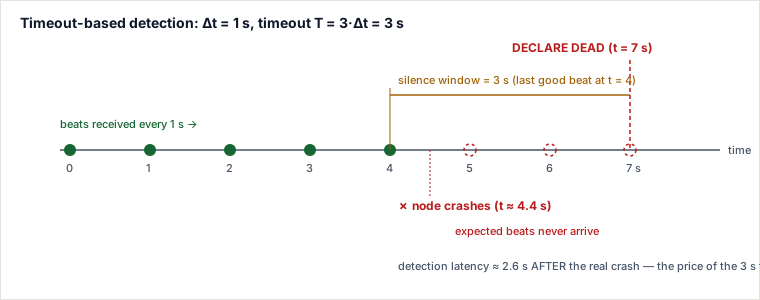
Worked trace: one node, one monitor
Monitor M watches node S. Δt = 1 s, timeout T = 3 s (declare dead after 3 s of silence). S beats at t = 0,1,2,3,4 then crashes at t ≈ 4.4 s. M keeps a lastSeen timestamp and, on its own clock, checks now − lastSeen > T.
| Wall clock | Event | M.lastSeen | now − lastSeen | M's verdict |
|---|---|---|---|---|
| 0–4 s | beats arrive on schedule | updated each beat | ≤ 1 s | ALIVE |
| 4.4 s | S crashes (M can't see this) | 4.0 | 0.4 s | ALIVE |
| 5.0 s | beat #5 missed | 4.0 | 1.0 s | ALIVE |
| 6.0 s | beat #6 missed | 4.0 | 2.0 s | ALIVE (suspicious) |
| 7.0 s | beat #7 missed → timeout crossed | 4.0 | 3.0 s | DEAD → reroute / start replacement |
Note the two costs baked in: detection latency is ≈ 2.6 s (crash at 4.4, detected at 7.0), and traffic sent to S between 4.4 and 7.0 is silently lost or must be retried elsewhere.
Why the naive version is wrong. A tempting simplification is "missed one beat ⇒ dead" (T = Δt). But real inter-arrival times jitter from network queueing, TCP retransmits and scheduler stalls. A single delayed packet then evicts a perfectly healthy node, triggering a needless failover — and if the node is a shard leader, a spurious leader election. That is why T is always a multiple of Δt, and why the better answer below stops using a hard threshold at all.
The GC-pause false positive, and the φ-accrual fix
The classic killer of fixed timeouts: a JVM (or Go runtime) stop-the-world garbage-collection pause of 2–4 s freezes everything, including the heartbeat sender thread. The node is perfectly healthy — it just couldn't emit a beat — yet a 3 s timeout convicts it. Under load these pauses cluster, so the whole cluster can start flapping (nodes marked down, marked up, rebalancing, marked down again). A hard binary threshold has no way to say "this silence is a bit unusual but not yet alarming."
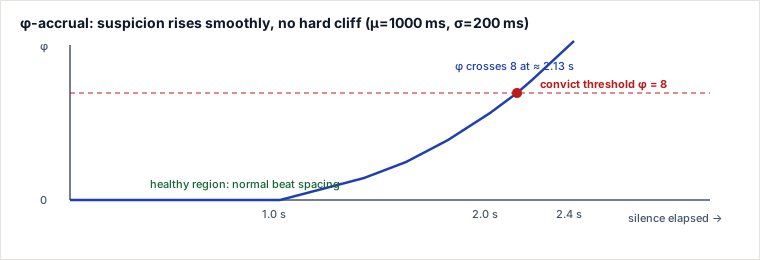
The φ-accrual failure detector (Hayashibara et al., 2004; used by Cassandra and Akka) replaces the yes/no timeout with a continuously rising suspicion level φ. It records the recent history of inter-arrival times, fits a distribution (mean μ, std σ), and reports
φ(now) = −log₁₀( P(next beat arrives later than the elapsed silence) )
φ = 1 means ~10% chance the silence is normal; φ = 8 means ~10⁻⁸. The application picks a threshold (Cassandra's default phi_convict_threshold = 8) and — crucially — φ self-tunes: on a jittery WAN link where beats are naturally late, μ and σ grow, so a 2 s gap yields a low φ and no conviction; on a rock-steady LAN the same 2 s gap yields a high φ and fast conviction. Same code, adapts to each link.
Worked numbers, μ = 1000 ms, σ = 200 ms (modelled normal):
| Silence elapsed | z = (t−μ)/σ | P(later) | φ | vs. threshold 8 |
|---|---|---|---|---|
| 1200 ms | 1 | 0.159 | 0.80 | alive |
| 1600 ms | 3 | 1.3×10⁻³ | 2.87 | alive |
| 2000 ms | 5 | 2.9×10⁻⁷ | 6.54 | alive (rising fast) |
| ≈2130 ms | 5.65 | 10⁻⁸ | 8.0 | convict |
Pitfalls
- Timeout tuned tighter than your worst GC/scheduler pause. A 3 s timeout with 4 s STW pauses guarantees false positives under load. Rule of thumb: T ≥ (max realistic pause) + a few RTTs, or use φ-accrual and let it adapt.
- The heartbeat succeeds while the real work is broken. A lightweight liveness ping keeps flowing from a dedicated thread even though the request-serving thread pool is deadlocked or the disk is full. Prefer a shallow health check that touches the real path (accept a connection, touch the DB) over a bare "process is running" beat — the distinction between liveness and readiness (Kubernetes) exists precisely for this.
- Symmetric partition ⇒ both sides declare the other dead. If A and B can't hear each other, each may promote itself. Heartbeats alone give you failure suspicion, not agreement — you still need a quorum/fencing token (ZooKeeper, Raft) before acting, or you get split-brain and double writes.
- Sender and monitor clocks / the sender's own timer drift. Compare elapsed time on the monitor's single clock (
now − lastSeen); never trust a timestamp inside the beat across machines without NTP discipline. - Beat storms at scale. N nodes all beating a central monitor is O(N) load on one box and O(N²) in naive all-to-all peer mode. Gossip/SWIM bounds this to O(1) messages per node per period.
- Cascading rebalances. One false conviction of a data node can trigger re-replication of terabytes, whose extra load slows other nodes into their timeouts. Add hysteresis / a suspicion state before hard conviction.
When to use it — and when to reach for something else
Reach for a heartbeat when nodes need continuous, low-latency liveness signals about each other — leader/follower health, shard-owner tracking, load-balancer backend pools, session keep-alive. Concrete signal: you must detect a dead peer within seconds and take automated action (reroute, fail over, re-replicate), and you control both ends of the connection.
Binary timeout vs. φ-accrual. Binary is trivial to implement and reason about — choose it on a controlled LAN with predictable latency and tolerant timeouts. Choose φ-accrual when link quality varies (WAN, cloud AZs, GC-heavy runtimes) and false positives are expensive; you pay a little history-tracking state and lose the crisp "dead at exactly T" guarantee in exchange for adaptivity.
Centralized vs. gossip/SWIM. Centralized monitoring is fine up to a few dozen nodes and when you already have a coordinator. Past that, prefer gossip-style peer heartbeats (SWIM: ping + indirect ping via k relays) — it removes the single monitor, spreads load evenly, and scales to thousands, at the cost of only eventually consistent membership and harder debugging.
Named alternatives and the trade-off
- ZooKeeper / etcd ephemeral nodes (session + lease). Instead of you polling, the coordinator holds a session with its own heartbeat; when it lapses, the ephemeral znode vanishes and watchers fire. Gain: failure detection plus consensus and fencing in one primitive — no split-brain. Cost: a whole coordination service to run, extra hop of latency, and everyone now depends on ZK's availability. Choose this when a failure must trigger a coordinated decision (leader election, lock release), not just a local reroute.
- TCP keepalive. Free, built into the socket. Cost: OS defaults are ~2 hours and coarse; it detects a dead connection, not a dead application (a hung process holds the socket open). Fine as a backstop; useless for second-scale application-level failure detection.
- Request-driven / lazy detection (detect failure only when a call fails, e.g. circuit breakers). Gain: zero background traffic, no idle cost. Cost: you learn of the failure only at the moment a user request hits the dead node — too late for proactive rerouting. Pair a circuit breaker with heartbeats; don't replace one with the other.
Choose a heartbeat when you need proactive, sub-10-second liveness and you own the endpoints; prefer ZooKeeper/etcd leases when the detection must drive cluster-wide agreement; prefer gossip/SWIM when N is large; fall back to TCP keepalive / circuit breakers when failures are rare and reactive detection is acceptable.
Takeaways
- Heartbeats detect failure by the absence of expected messages — in an async system that is the only signal available, so detection is always "wait then give up," never instantaneous.
- The interval/timeout pair is a direct detection-time vs. accuracy dial: faster detection buys more false positives, and no timeout detector escapes this (Chandra–Toueg completeness vs. accuracy).
- Fixed timeouts break under GC/scheduler pauses and variable-latency links; φ-accrual replaces the hard threshold with an adaptive suspicion level and is the production default (Cassandra, Akka).
- Heartbeats give suspicion, not agreement: combine with quorum/fencing (ZooKeeper, Raft) before acting, or a symmetric partition turns into split-brain.
Re-authored / deepened for this guide. Sources: Grokking the System Design Interview (Design Gurus) heartbeat pattern; Naohiro Hayashibara et al., "The φ Accrual Failure Detector" (SRDS 2004) and Apache Cassandra's FailureDetector / phi_convict_threshold; Tushar Chandra & Sam Toueg, "Unreliable Failure Detectors for Reliable Distributed Systems" (JACM 1996) for completeness vs. accuracy; Das, Gupta & Motivala, "SWIM: Scalable Weakly-consistent Infection-style Membership" (DSN 2002); Wei Chen et al. on the quality of service of failure detectors; and Kubernetes liveness/readiness probe semantics.
🤖 Don't fully get this? Learn it with Claude
Stuck on Heartbeat? Open Claude, copy a block below, and it'll teach you this exact concept — visually and interactively.
Build the mental picture, not memorization.
I just read a lesson on **Heartbeat** (System Design) and want to truly understand it. Explain Heartbeat from first principles using ONE vivid real-world analogy and a visual mental model — draw it as ASCII art or a clear step-by-step diagram — with a concrete example using real numbers. Then ask me one question to check I got the mental picture, and wait for my reply. If you're unsure or a claim isn't standard, say so and reason from first principles instead of guessing.
Socratic — adapts to where you're stuck.
Teach me **Heartbeat** interactively. Ask me ONE guiding question at a time, wait for my answer, and adapt to my confusion — build the idea with me step by step instead of explaining it all at once. If you're unsure or a claim isn't standard, say so and reason from first principles instead of guessing.
Active recall exposes what you missed.
Quiz me on **Heartbeat** with 5 questions, easy to tricky, ONE at a time. Tell me if each answer is right; at the end, explain clearly what I got wrong and why. If you're unsure or a claim isn't standard, say so and reason from first principles instead of guessing.
Intuition + hook + flashcards for long-term memory.
Help me remember **Heartbeat** for the long term: give the one-sentence intuition, a memorable hook/mnemonic, a tiny worked example, and 3 active-recall flashcards (Q -> A). If you're unsure or a claim isn't standard, say so and reason from first principles instead of guessing.