Importance of Discussing Tradeoffs
Importance of Discussing Tradeoffs
In a system design interview, there is almost never a single correct architecture. Every meaningful decision buys you something and costs you something else. Adding a cache buys read latency but costs you consistency and a new failure mode. Sharding buys write throughput but costs you cross-shard joins and transactions. The senior signal an interviewer is hunting for is not "can this candidate name a technology" but "does this candidate understand what that technology costs, and can they justify paying it for this problem."
This is why discussing tradeoffs is not a soft, filler activity you sprinkle on top of a real answer. It is the answer. The design is just the visible artifact of a chain of tradeoff decisions. Interviewers grade the chain, not the artifact.
Why the skill exists: there is no free lunch
Real distributed systems are governed by hard constraints that force choices. The CAP theorem says under a network partition you must sacrifice either consistency or availability. The PACELC extension adds that even with no partition, you trade latency against consistency. Physics adds its own: a cross-continent round trip is ~150ms no matter how good your code is, so a synchronous replica in another region will add that to every write. Amdahl's law caps how much parallelism buys you. These are not opinions; they are ceilings.
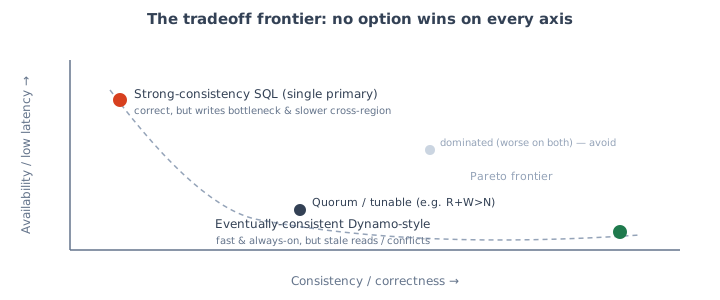
Because the ceilings are real, every design lives on a Pareto frontier: to gain on one axis (latency, throughput, cost, consistency, operational simplicity) you must give up ground on another. A candidate who says "I'll add Redis" without naming what they are trading has revealed they do not see the frontier. A candidate who says "I'll add a read-through cache, accepting up to 60s of staleness on the product catalog because merchandising can tolerate it, in exchange for cutting p99 read latency from 40ms to 2ms and shedding 80% of DB read load" has demonstrated exactly the judgment the role requires.
How to actually do it: the tradeoff loop
Good tradeoff reasoning follows a repeatable structure. Make it explicit out loud so the interviewer can follow your thinking.
- State the axes that matter for THIS problem. Derive them from the requirements you gathered: consistency, read/write latency, throughput, availability/durability, cost, and operational complexity. Not every axis matters equally — a bank ledger weights consistency; a news feed weights availability and latency.
- Name at least two viable options. "SQL vs. NoSQL," "synchronous vs. asynchronous replication," "cache-aside vs. write-through." A decision with only one option isn't a decision.
- Map each option onto the axes, with rough numbers where possible.
- Anchor the choice to a requirement. "Because we need read-your-writes for the user's own profile, I'll route their reads to the primary; everyone else can read replicas."
- State what you'd change if the assumption flipped. This shows the decision is conditional, not dogmatic.
The last step is the mark of seniority: "If write volume 10×'d and this became write-bound, I'd revisit and shard by user_id, accepting the loss of cross-user transactions."
Worked scenario: read path for an e-commerce product page
Requirements: 50,000 QPS of product-detail reads at peak, 500 writes/sec (price/inventory updates), p99 read latency target < 20ms, and the business explicitly says a price shown up to ~30s stale is acceptable but overselling inventory is not.
Straw-man: serve every read from Postgres. At 50k QPS with a working set that doesn't fit in the buffer pool, you're looking at disk-bound reads of 5–15ms each and a primary that saturates well before 50k QPS, forcing you into many read replicas — expensive and still latency-variable.
Tradeoff-driven design: put a cache-aside layer (Redis) in front for the product description and price fields, TTL 30s. At a 95% hit rate you offload ~47,500 QPS to Redis (sub-millisecond, ~0.5ms) and leave only ~2,500 QPS + 500 writes/sec hitting Postgres, which it handles comfortably. You pay for this with: 30s of price staleness (explicitly allowed), cache-stampede risk on TTL expiry (mitigate with request coalescing/jitter), and a new component to operate. Crucially, inventory count is NOT cached the same way — because overselling is unacceptable, the "add to cart" path reads/decrements the authoritative store with a conditional update. Same page, two different consistency choices, each justified by its own requirement. That last sentence is what wins the interview.
Trade-offs, and when to use vs. when NOT
Discussing tradeoffs is itself a technique with limits — apply it with judgment:
- USE it on every non-trivial decision: datastore choice, replication mode, caching, partitioning key, sync vs. async processing, push vs. pull, consistency level. These are where interviewers probe and where real systems break.
- USE numbers to disambiguate close calls. "Kafka vs. RabbitMQ" is fuzzy until you say "we need to replay 7 days of events and fan out to 5 consumer groups at 200k msgs/sec — that's Kafka's log model, not a classic broker's queue."
- Do NOT bikeshed trivial choices. Debating JSON vs. Protobuf for a 10 QPS admin endpoint wastes the interviewer's time and signals poor prioritization. Spend the tradeoff budget where load and blast radius are highest.
- Do NOT present false binaries. "SQL vs. NoSQL" is often a lazy framing; the real axes are consistency, query flexibility, and scale-out. Many systems use both (polyglot persistence). Naming a hybrid when appropriate beats picking a tribe.
- Do NOT enumerate tradeoffs without deciding. Listing pros and cons and then not committing is a classic mid-level failure. Always land the plane: state the choice, tied to a requirement.
Weight the decision by how hard it is to undo
Not every tradeoff deserves equal airtime, and the axis that decides how much rigor to spend is reversibility — Amazon's framing of Type-1 ("one-way door") vs Type-2 ("two-way door") decisions.
- A two-way door decision is cheap to reverse later: a cache TTL, an instance size, a load-balancer algorithm, a retry budget, a queue's batch size. If it turns out wrong you change a config value and move on. Pick a reasonable option and keep going — deep analysis here is wasted motion.
- A one-way door decision is expensive or effectively impossible to reverse: the shard / partition key, the core data model, synchronous-vs-asynchronous at a service seam, a public API contract, or a multi-region topology. Reversing one means a data renumber/backfill, a client migration, or a re-architecture. These demand the full tradeoff loop, explicit numbers, and a written rationale.
This reversibility axis is the principle behind the "don't bikeshed trivial choices" rule above. JSON-vs-Protobuf on a 10-QPS admin endpoint is a two-way door — swap it in an afternoon, so debating it burns budget you should spend elsewhere. Choosing user_id vs order_id as the shard key is a one-way door — get it wrong and you are re-sharding a live fleet. Same "which encoding / which key" shape of question; opposite amounts of rigor warranted, purely because one is reversible and the other is not. In the interview, say which kind each decision is ("this is a two-way door, I'll pick X and revisit if needed" vs "this is a one-way door, so let me be careful"): it proves you are spending judgment where it compounds instead of treating every choice as equally weighty.
| One-way door (irreversible → high rigor) | Two-way door (reversible → decide and move) |
|---|---|
| Shard / partition key | Cache TTL |
| Core data model / schema shape | Instance size / node count |
| Sync-vs-async at a service seam | Load-balancer algorithm |
| Public API contract; multi-region topology | Retry budget / timeout value |
Pitfalls an interviewer probes
- The buzzword drop. Saying "we'll use eventual consistency" or "just add Kafka" with no discussion of the cost. Expect the follow-up: "What breaks when you do that?" If you can't answer, the whole design is suspect.
- Ignoring the failure axis. Most candidates optimize the happy path. "What happens when the cache node dies? When the network partitions? When a write succeeds on the primary but fails to replicate?" Availability and durability are tradeoff axes too.
- Dogma over context. "NoSQL doesn't scale" or "never use joins." Interviewers push back to see if your position is conditional. The correct answer form is "it depends, and here's what it depends on."
- No numbers. Tradeoffs without magnitude are hand-waving. "Faster" means nothing; "2ms vs. 40ms at p99, at 50k QPS" means everything. Do a back-of-envelope estimate before committing.
- Not revisiting when constraints change. A strong interviewer will change a requirement mid-stream ("now it's 10× write-heavy") specifically to see whether you re-examine the tradeoff or cling to the original design.
Key takeaways
- Every architecture decision sits on a Pareto frontier — gaining on one axis (latency, throughput, consistency, availability, cost, operability) costs you another. There is no free lunch, so the tradeoff discussion IS the design, not decoration.
- Follow the loop: name the axes that matter for this problem → list ≥2 real options → map them with rough numbers → commit, anchored to a requirement → say what you'd change if the constraint flipped.
- Different parts of the same system can make different choices (cache the stale-tolerant price, but keep inventory strongly consistent) — justify each locally rather than picking one global dogma.
- Interviewers probe for buzzword-dropping, ignored failure modes, missing numbers, and dogmatic absolutes; the winning register is always "it depends, and here is precisely what it depends on."
Common trade-off axes (quick reference)
The same few axes show up in almost every interview. Naming them with numbers keeps the discussion from sliding into buzzwords.
| Axis | Favor the left side when... | Favor the right side when... | Typical example |
|---|---|---|---|
| Latency vs. Consistency | stale reads are acceptable (product catalog, recommendations) | a wrong answer causes real harm (inventory decrement, account balance) | CDN edge cache (30 s stale) vs. strong-consistency ledger |
| Availability vs. Consistency | downtime is the expensive failure (feeds, presence, shopping cart) | correctness is non-negotiable (payments, locks, leader election) | Dynamo-style cart vs. Spanner-style ledger |
| Throughput vs. Latency | you can batch or queue work (analytics, log ingestion) | user-facing p99 is the SLA (search, ad serving) | Kafka log aggregation vs. synchronous API call |
| Cost vs. Durability | data is reconstructible and tiered storage is fine (metrics, logs) | loss is irreversible or regulated (orders, medical records) | S3 Glacier for backups vs. multi-region sync replication |
| Simplicity vs. Scalability | load is modest and the team is small (monolith, single DB) | load dominates and you can pay the operational tax (sharded microservices) | Rails monolith vs. independently scaled checkout service |
| Operational complexity vs. Feature velocity | on-call bandwidth is the bottleneck | automation, SRE, and observability can absorb the tax | Managed queue vs. self-hosted Kafka cluster |
The senior move is not to memorize the table but to pick one cell per decision and justify it with a requirement: "We accept 30 seconds of catalog staleness because the merchandising team told us price updates can lag, but inventory is strongly consistent because overselling is a real revenue loss."
Related pages
- Tradeoffs in CAP Theorem — the partition-forced C-vs-A fork
- System Design Tradeoffs in Interviews — how to say the trade-offs out loud
- System Design Trade-offs — Partitioning Strategy, Monolith-vs-Microservices & Sync-vs-Async/Streaming — architectural trade-offs in decomposition
- System Design Trade-offs II — Retry Storms, Rate-Limiter Coordination, Sticky-Session Rehash & HA≠Lossless — operational trade-offs at the seams
- Scalable Systems (Advanced Topics) — deeper treatments of idempotency, replication, and exactly-once
- System Design Problems — canonical designs where these trade-offs are decided
Back-of-envelope cache sizing: closing the numbers
Return to the e-commerce product page. The objects are not abstract keys — each product record (description, price, image URL, metadata) averages about 4 KB. The business tells you the hot catalog is roughly 1 million SKUs deep. The Redis memory you actually need is:
cache_memory = 4 KB × 1,000,000 SKUs ≈ 4 GB
# add Redis key overhead (~64 bytes/key) + protocol overhead → budget ~5 GB
A single Redis node on modest hardware holds 5 GB comfortably and serves 50k QPS at sub-millisecond latency. At a 95% hit rate the residual load on Postgres is:
cache_misses = 50,000 QPS × (1 - 0.95) = 2,500 reads/sec
plus writes = 500 writes/sec
total_db_load ≈ 3,000 ops/sec
A Postgres read replica can sustain ~10k random IOPS with a reasonable cache-hit ratio, so 3k ops/sec leaves plenty of headroom. In other words, one read replica is enough for the normal case.
Now stress the assumption. At a 90% hit rate, misses double to 5k reads/sec and the replica is busier but still viable. At 80%, misses jump to 10k reads/sec — you are at the replica’s knee and need a second replica or a bigger instance. The interview lesson: the cache hit rate is not a detail; it drives your database fleet size.
Plan for failure too. If the cache node restarts, all 50k QPS fall through to Postgres until the cache warms. Without headroom, the database dies and the site dies. A hot standby Redis replica and over-provisioned DB replicas are part of the cache design, not afterthoughts.
Interview trap: "we'll just add a cache"
The four words that expose a shallow answer. A cache is not a silver bullet; it is a consistency trade-off with three sharp edges.
| Trap | Why it breaks | What to say instead |
|---|---|---|
| No invalidation strategy | Price drops or inventory changes stay stale until TTL, causing oversell or angry merchants | "Cache-aside with 30 s TTL for price; inventory bypasses the cache and reads the authoritative store." |
| Ignoring hot keys | A single viral product can concentrate millions of reads on one Redis node, saturating CPU or network | "Shard by product_id and use replica reads; pre-warm the hot key across shards." |
| No failover plan | Cache restart = cache stampede to the database, which is sized for 5% load, not 100% | "Keep a Redis replica, size DB replicas for cache-miss traffic, and use request coalescing on cold starts." |
Adding these three sentences to your answer moves you from "I named Redis" to "I own the trade-off."
🤖 Don't fully get this? Learn it with Claude
Stuck on Importance of Discussing Tradeoffs? Open Claude, copy a block below, and it'll teach you this exact concept — visually and interactively.
Build the mental picture, not memorization.
I just read a lesson on **Importance of Discussing Tradeoffs** (System Design) and want to truly understand it. Explain Importance of Discussing Tradeoffs from first principles using ONE vivid real-world analogy and a visual mental model — draw it as ASCII art or a clear step-by-step diagram — with a concrete example using real numbers. Then ask me one question to check I got the mental picture, and wait for my reply. If you're unsure or a claim isn't standard, say so and reason from first principles instead of guessing.
Socratic — adapts to where you're stuck.
Teach me **Importance of Discussing Tradeoffs** interactively. Ask me ONE guiding question at a time, wait for my answer, and adapt to my confusion — build the idea with me step by step instead of explaining it all at once. If you're unsure or a claim isn't standard, say so and reason from first principles instead of guessing.
Active recall exposes what you missed.
Quiz me on **Importance of Discussing Tradeoffs** with 5 questions, easy to tricky, ONE at a time. Tell me if each answer is right; at the end, explain clearly what I got wrong and why. If you're unsure or a claim isn't standard, say so and reason from first principles instead of guessing.
Intuition + hook + flashcards for long-term memory.
Help me remember **Importance of Discussing Tradeoffs** for the long term: give the one-sentence intuition, a memorable hook/mnemonic, a tiny worked example, and 3 active-recall flashcards (Q -> A). If you're unsure or a claim isn't standard, say so and reason from first principles instead of guessing.