Problem 2 Linear Search for All Occurrences
Overview
Linear search, in its basic form, identifies the position of a target element in a given array or list. When extended to find all occurrences, it retrieves every index where the target element appears. Given large arrays, this can be time-consuming. Therefore, utilizing the capabilities of modern multicore processors with multithreading can significantly expedite the search by examining multiple parts of the list concurrently.
Multithreading in Linear Search for All Occurrences
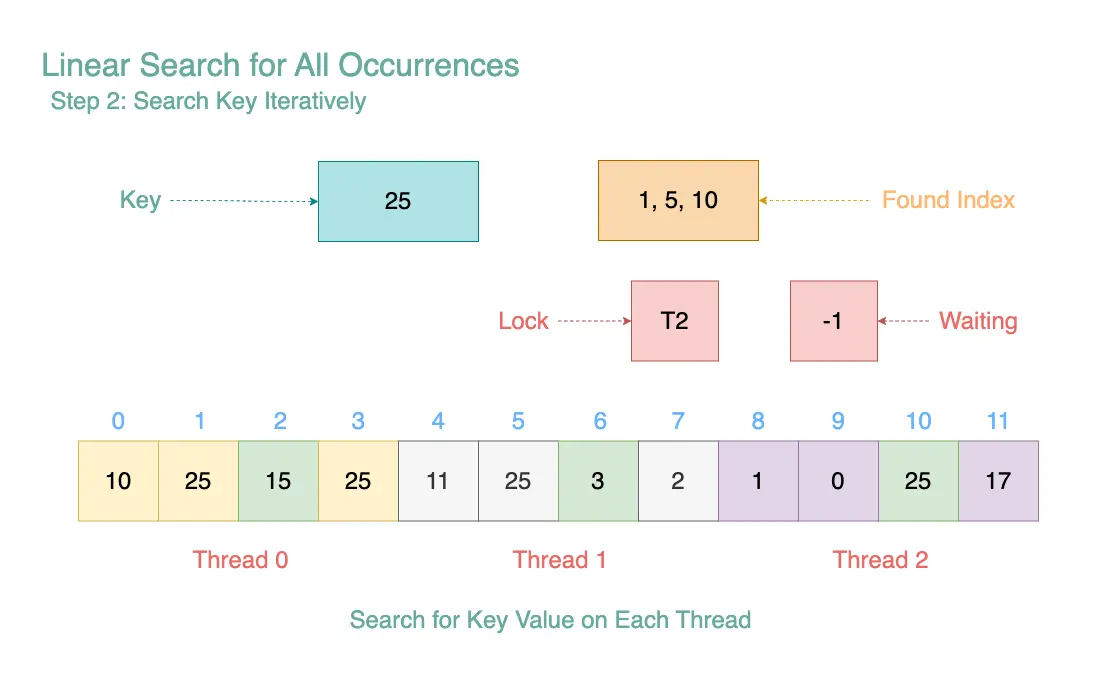
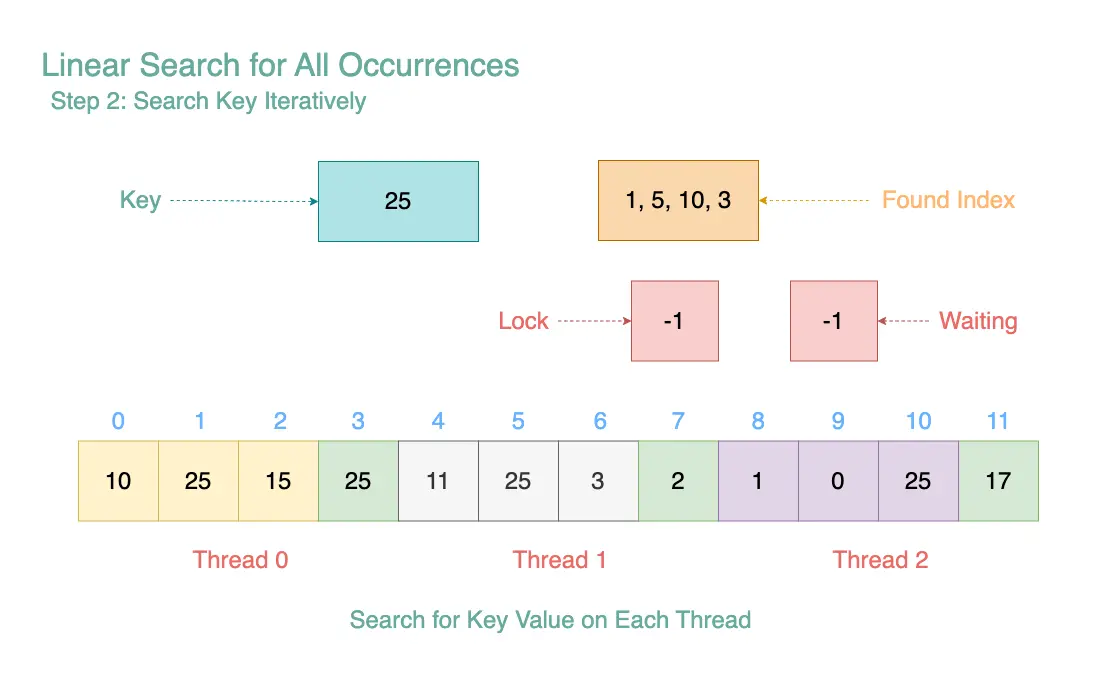
Using multithreading for searching all occurrences of an element introduces unique challenges. As multiple threads can find multiple occurrences simultaneously, we need a way to collect these indices efficiently.
- Divide the Work: As before, split the array into smaller segments or "chunks." Each thread will have its distinct portion of the array to search through.
- Concurrent Execution: Each thread will independently search its assigned chunk for the target element. Due to simultaneous searches, the overall search time often reduces for large arrays.
- Collecting Results: Rather than a single shared variable, we'll use a shared collection (like a list) where threads can append indices of found occurrences. Synchronization mechanisms are essential to ensure thread-safe updates to this shared collection.
Step-by-step Algorithm
- Make a list of numbers (let's call it arr) and decide on the number you want to find (let's call it key).
- Make a shared list (let's call it found_places) where threads will add the places where the number shows up.
- Start several threads, each one assigned to look through a specific part of the list.
- When a thread finds the number, it adds the place to the found_places list.
- Wait for all the threads to finish.
- Check the found_places list:
- If it’s empty, the number was not found.
- If it has places in it, the number was found, and the list shows where.
Algorithm Walkthrough
Let’s imagine we have a list [4, 15, 12, 3, 12, 9, 12], and we want to find all the places of the number 12.
- We decide to use 3 threads to speed things up. We also have a shared list (
found_places) to store where we find12. At first, it's empty. - We create a function
FindAllPlacesfor the threads to use:- a. The function knows which part of the list to check based on the thread's number.
- b. It looks through its assigned numbers. If it finds
12, it adds the place tofound_places.
- We start our 3 threads. The first thread checks
[4, 15], the second checks[12, 3], and the third checks[12, 9, 12]. - The threads work at the same time. The second and third threads find
12. - They add the places of
12(2, 4, and 6) tofound_places. They use locks to make sure they don’t add to the list at the same time. - All threads are done. We check
found_placesand see2, 4, 6. We print “Number found at places: 2, 4, 6”. - We’re done, and we found all places of
12quicker by looking in three parts simultaneously.
Below are various implementations:
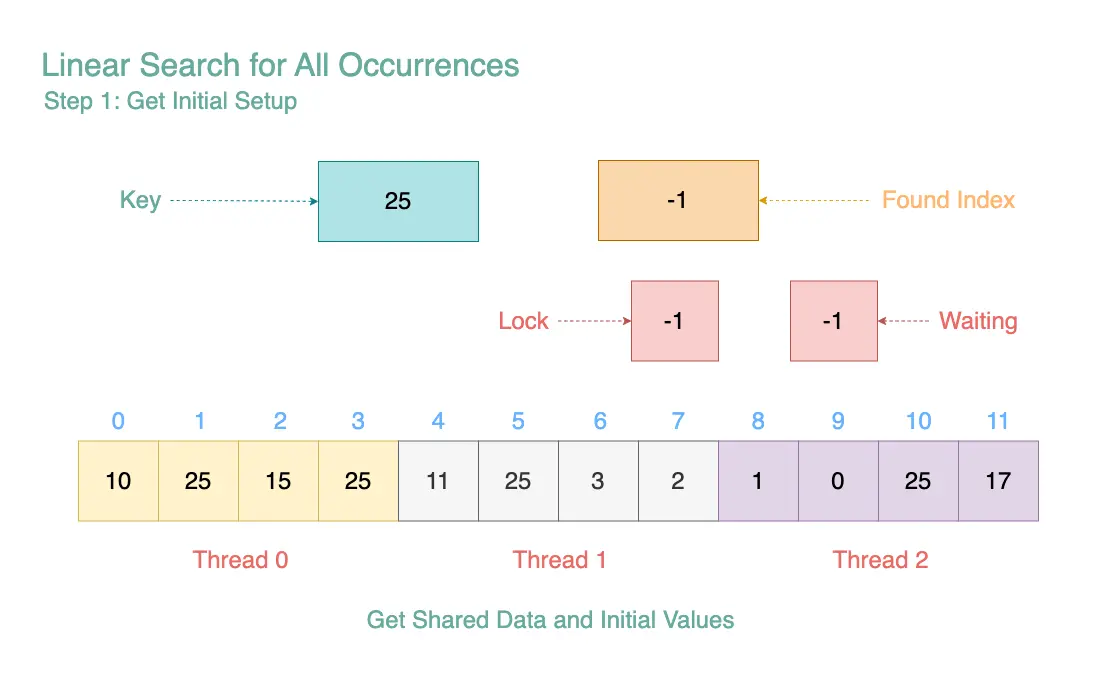
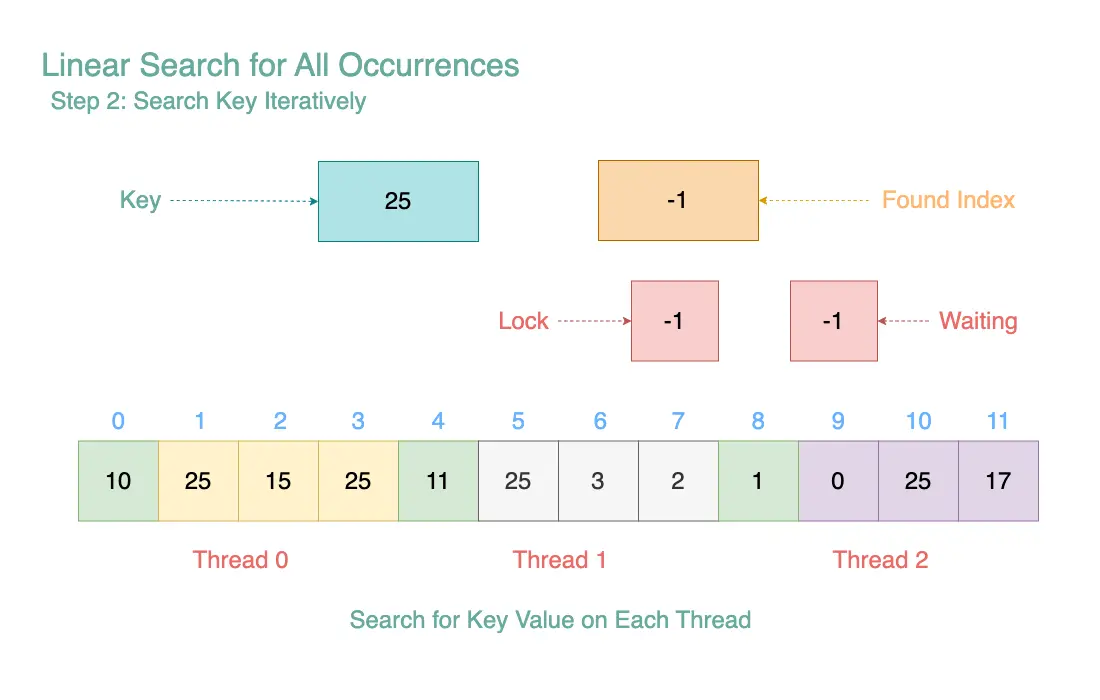
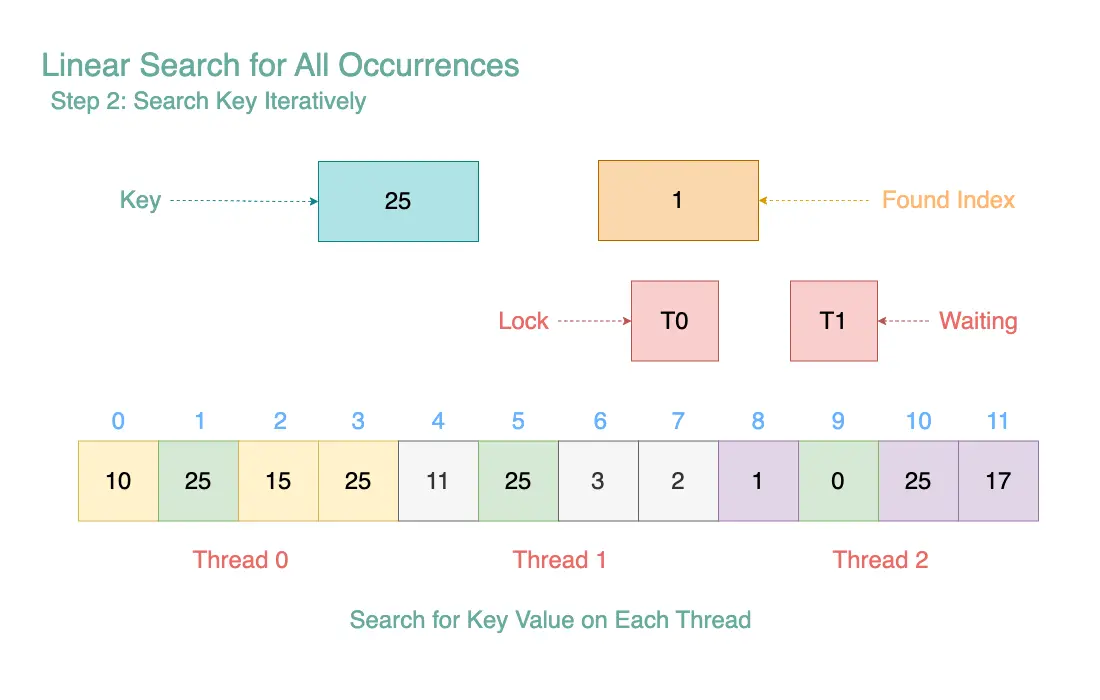
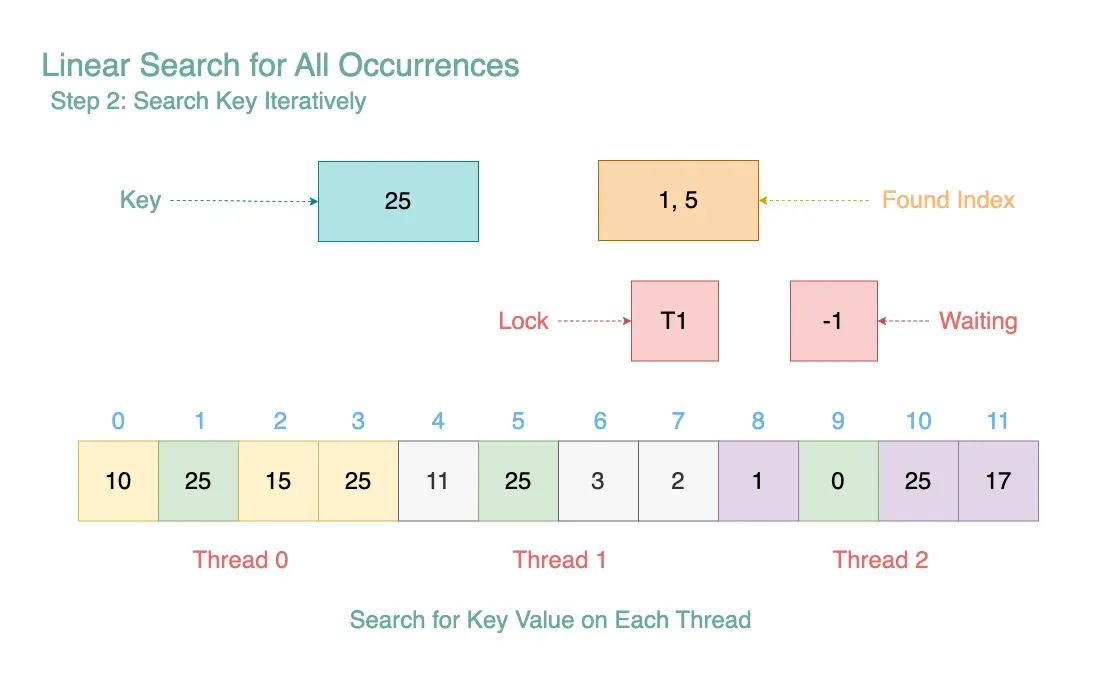
import java.util.ArrayList;
import java.util.List;
import java.util.Random;

public class Solution {

  private static final int SIZE = 4000;
  private static final int NUM_THREADS = 4;

  // Mutex for controlling access to foundPlaces
  private static final Object lockObj = new Object();
  private static List<Integer> foundPlaces = new ArrayList<>();

  private static void linearSearch(int threadId, int[] arr, int key) {
    int chunkSize = arr.length / NUM_THREADS;
    int start = threadId * chunkSize;
    int end = (threadId == NUM_THREADS - 1) ? arr.length : start + chunkSize;

    for (int i = start; i < end; ++i) {
      if (arr[i] == key) {
        synchronized (lockObj) { // Lock when modifying foundPlaces
          foundPlaces.add(i); // Append the index to foundPlaces
        }
      }
    }
  }

  public static void main(String[] args) {
    // Create an array and fill it with random numbers between 0 and 99
    int[] arr = new int[SIZE];
    Random random = new Random();
    for (int i = 0; i < SIZE; ++i) {
      arr[i] = random.nextInt(100);
    }

    List<Thread> threads = new ArrayList<>(); // List to hold the threads
    int key = 19; // Element to find

    // Start the threads
    for (int i = 0; i < NUM_THREADS; ++i) {
      int threadId = i;
      Thread thread = new Thread(() -> linearSearch(threadId, arr, key));
      threads.add(thread);
      thread.start();
    }

    // Join the threads with the main thread
    for (Thread thread : threads) {
      try {
        thread.join();
      } catch (InterruptedException e) {
        e.printStackTrace();
      }
    }

    // Display the result
    if (foundPlaces.isEmpty()) {
      System.out.println("Element not found in the array.");
    } else {
      System.out.print("Element found at indices: ");
      synchronized (lockObj) { // Lock when reading from foundPlaces
        for (int index : foundPlaces) {
          System.out.print(index + " ");
        }
      }
      System.out.println();
    }
  }
}
🤖 Don't fully get this? Learn it with Claude
Stuck on Problem 2 Linear Search for All Occurrences? Open Claude, copy a block below, and it'll teach you this exact concept — visually and interactively.
Progressively stronger hints — you still solve it.
I'm working on the problem **Problem 2 Linear Search for All Occurrences** (Concurrency). Give me a HINT LADDER: start with the tiniest nudge, then wait. Only reveal the next, stronger hint when I ask. Do NOT show the full solution unless I type 'show solution'. Keep me doing the thinking. If you're unsure or a claim isn't standard, say so and reason from first principles instead of guessing.
See the technique, not just code.
Explain the optimal approach to **Problem 2 Linear Search for All Occurrences** with a VISUAL walkthrough: trace it on a small concrete example using ASCII art / a step-by-step diagram, narrate what changes each step, then give time & space complexity with a one-line derivation. If you're unsure or a claim isn't standard, say so and reason from first principles instead of guessing.
Catch bugs, edge cases, sub-optimality.
I'll paste my solution to **Problem 2 Linear Search for All Occurrences**. Review it for correctness, missed edge cases, and time/space complexity, then coach me toward the optimal — don't just rewrite it. Ask me to paste my code now. If you're unsure or a claim isn't standard, say so and reason from first principles instead of guessing.
Lock in recognition with look-alikes.
Give me 2 problems that use the SAME underlying pattern as **Problem 2 Linear Search for All Occurrences**. For each, let me attempt first, then review my answer and name the trigger signal that reveals the pattern. If you're unsure or a claim isn't standard, say so and reason from first principles instead of guessing.