Session vs Token Auth — Traced (Cookies & JWTs)
After you log in, how does the server remember you?
HTTP is stateless, so after one password check, how does request #2 know it’s you? Two mechanisms: a server-side session (the server remembers you in a store) or a signed token / JWT (the server verifies a cryptographic signature and trusts the claims inside).
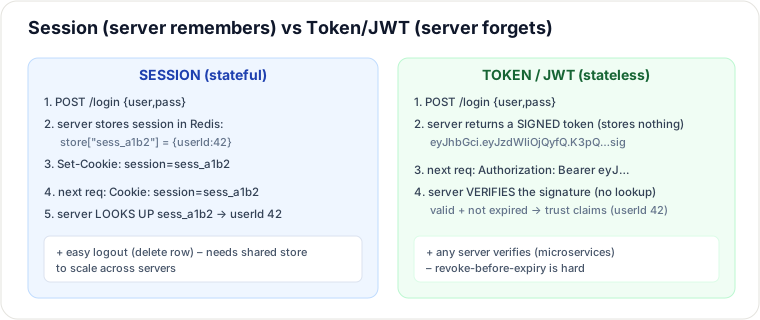
Session vs JWT, traced
Both start the same way: the client POSTs credentials and the server checks the password hash once. After that the paths diverge.
Session (cookie) flow
- Server creates a high-entropy session ID and stores
{userId, role, expiresAt}in Redis. - Server replies
Set-Cookie: session=abc123; HttpOnly; Secure; SameSite=Lax. - Every request sends the cookie automatically; the server looks up
session:abc123in Redis. - Logout = delete the Redis key. The next request is anonymous.
JWT flow
- Server signs a token containing claims such as
{"sub":42,"role":"user","exp":1719003600}. - Client stores it (preferably in an
HttpOnlycookie, or a short-lived header) and sends it back. - Server verifies the signature with
SECRET_KEYand checksexp. - Logout is harder: the token is valid until
exp. You must keep lifetimes short or maintain a denylist.
 header.payload.signature
 header : {"alg":"HS256","typ":"JWT"}
 payload: {"sub":42,"role":"user","exp":1719003600}        ← readable claims
 signature: HMAC_SHA256(base64url(header)+"."+base64url(payload), SECRET_KEY)
Anyone can read the payload; only the server (with SECRET_KEY) can forge a valid signature, so tampering is rejected.
Comparison
| Session (cookie) | Token (JWT) | |
|---|---|---|
| Server stores state? | Yes (session store) | No — verifies signature |
| Scale across servers | Needs shared store or sticky sessions | Any server verifies |
| Revoke before expiry | Easy (delete session) | Hard (needs denylist) |
| Theft vector | CSRF (mitigate with SameSite + anti-CSRF token) | XSS if in localStorage (prefer HttpOnly cookie) |
When to use which
- Session: same-origin web apps, admin consoles, or any place where instant logout / ban / role change must take effect immediately.
- JWT: microservices, mobile/SPAs on separate origins, or SSO where many services need to verify the same caller without a shared session store.
Takeaways
- Session: server stores a session, hands a cookie; lookup per request; easy logout. Stateful.
- JWT: server hands a signed claim and forgets; verifies signature each request — stateless/scalable, revocation harder.
- “Log out everywhere”: with sessions, delete every key under the user index; with JWTs, bump a
tokenVersionclaim you compare on verify (or denylist eachjtiuntilexp) — the stateless model has no built-in way to kill all live tokens without reintroducing this state. - Third-party login builds on these via OAuth/OIDC.
Re-authored from-scratch; diagram hand-authored (SVG) for this guide.
Side-by-side trace: login → logout
| Step | Session (cookie) | JWT |
|---|---|---|
| 1. Login | POST /login with credentials | POST /login with credentials |
| 2. Server creates | Random session id, stores state in Redis | Signed token with claims + expiry |
| 3. Server returns | Set-Cookie: session=abc123; HttpOnly; Secure; SameSite=Lax | Token in HttpOnly cookie or Authorization header |
| 4. Request #N | Cookie sent automatically; server looks up Redis | Token sent manually; server verifies signature + exp |
| 5. Logout | Delete Redis key instantly anonymous | Token still valid until exp; add to denylist or wait |
| 6. Scale note | Needs shared Redis or sticky sessions | Any server can verify with public/secret key |
The session path keeps authority in a store you control; the JWT path pushes authority into a signed, time-bounded credential you cannot easily retract.
When to use which: decision table
| Scenario | Pick | Why | Latency / ops impact |
|---|---|---|---|
| Same-origin web app; instant ban/logout required | Session | Delete Redis row = immediate revocation | ~1–2 ms Redis lookup per request; shared store to operate |
| Microservices / mobile / cross-origin SPA | JWT access token | Each service verifies signature locally; no cross-service session store | ~0.5 ms HMAC verify per service; revocation delayed until expiry |
| High-security flows where revocation must be instant and cross-domain | Reference / opaque token | Token is just an id; introspection endpoint checks store | Introspection adds 1–3 ms hop and a dependency; scales with cache |
| Long-lived SSO session across many apps | Short JWT + refresh token | Access token stays short; refresh token can be revoked centrally | Refresh rotation adds writes but limits theft window |
🪜 Drill ladder: session vs token follow-ups
L1 · Revocation trap: “A user clicks logout. How fast are they actually logged out in each model?”
Trap: “Both are instant.”
Bar: Sessions are instant because the server deletes the lookup key. JWTs remain valid until exp unless you keep a denylist (reintroduces state) or use very short lifetimes plus refresh rotation. The “logout” UX is immediate, but the cryptographic authority is not.
L2 · CSRF trap: “Why does a session cookie need SameSite/anti-CSRF tokens while a JWT in localStorage does not?”
Trap: “JWTs are immune to CSRF.”
Bar: Cookies are sent automatically by the browser, so a malicious site can forge a state-changing request; SameSite and anti-CSRF tokens close that hole. JWTs in localStorage must be attached by JavaScript, so CSRF does not apply — but XSS does, and XSS is harder to mitigate. Prefer HttpOnly cookies for tokens whenever you can.
L3 · Scaling trap: “Sessions don’t scale; use JWTs for scale. True or false?”
Trap: “True — stateful sessions are the bottleneck.”
Bar: A Redis-backed session cluster handles millions of QPS and adds ~1 ms. The real trade-off is operational: sessions couple you to a shared store; JWTs couple you to revocation semantics and key rotation. Neither is “more scalable” in the abstract.
L4 · Token theft trap: “A JWT access token with a 15-minute expiry is stolen. How much damage?”
Trap: “Rotate the signing key to kill it.”
Bar: Rotating the signing key invalidates every issued token, not just the stolen one, which logs out all users. Use short access-token lifetimes and revoke the refresh token; the thief’s window is bounded to the remaining access-token lifetime.
L5 · Refresh rotation trap: “Why rotate refresh tokens on every use?”
Trap: “It prevents replay.”
Bar: Rotation primarily detects parallel use of the same refresh token (a sign of theft or cloning). When the server sees a used refresh token again, it revokes the whole family. This is detection + containment, not prevention.
🤖 Don't fully get this? Learn it with Claude
Stuck on Session vs Token Auth — Traced (Cookies & JWTs)? Open Claude, copy a block below, and it'll teach you this exact concept — visually and interactively.
Build the mental picture, not memorization.
I just read a lesson on **Session vs Token Auth — Traced (Cookies & JWTs)** (System Design) and want to truly understand it. Explain Session vs Token Auth — Traced (Cookies & JWTs) from first principles using ONE vivid real-world analogy and a visual mental model — draw it as ASCII art or a clear step-by-step diagram — with a concrete example using real numbers. Then ask me one question to check I got the mental picture, and wait for my reply. If you're unsure or a claim isn't standard, say so and reason from first principles instead of guessing.
Socratic — adapts to where you're stuck.
Teach me **Session vs Token Auth — Traced (Cookies & JWTs)** interactively. Ask me ONE guiding question at a time, wait for my answer, and adapt to my confusion — build the idea with me step by step instead of explaining it all at once. If you're unsure or a claim isn't standard, say so and reason from first principles instead of guessing.
Active recall exposes what you missed.
Quiz me on **Session vs Token Auth — Traced (Cookies & JWTs)** with 5 questions, easy to tricky, ONE at a time. Tell me if each answer is right; at the end, explain clearly what I got wrong and why. If you're unsure or a claim isn't standard, say so and reason from first principles instead of guessing.
Intuition + hook + flashcards for long-term memory.
Help me remember **Session vs Token Auth — Traced (Cookies & JWTs)** for the long term: give the one-sentence intuition, a memorable hook/mnemonic, a tiny worked example, and 3 active-recall flashcards (Q -> A). If you're unsure or a claim isn't standard, say so and reason from first principles instead of guessing.