hard Session & Cookie Security
Session & Cookie Security
After login the browser holds a credential on every subsequent request, so two questions decide the security of the whole session: can a script steal that credential, and can another site trigger requests that carry it. Cookie flags and where you store the token are precisely the levers for those two questions — and they trade off against each other, so you must pick which attack you are structurally blocking.
Part A — cookie flags and the XSS-vs-CSRF trade-off
Three flags on the session cookie each shut a specific door:
- HttpOnly — the cookie is invisible to JavaScript (
document.cookiecan't read it). This means an XSS payload running on your page cannot read and exfiltrate the session token. It does not stop XSS from acting within the session, but it stops token theft. - Secure — the cookie is sent only over HTTPS, so it can't leak over a plaintext connection.
- SameSite — controls whether the cookie is attached on cross-site requests.
Strictnever sends it cross-site;Laxsends it only on top-level GET navigations (a good default);Nonealways sends it (and thenSecureis required). This is the primary CSRF mitigation, because CSRF depends on the browser auto-attaching your cookie to a request forged by another site.
The trade-off is unavoidable and worth stating precisely:
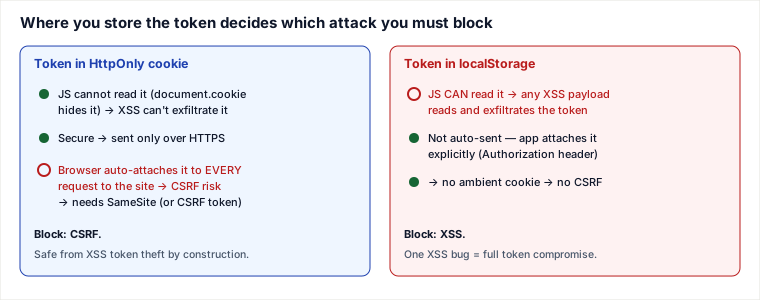
- Token in an HttpOnly cookie: safe from XSS reading the token (JS can't touch it), but because the browser attaches it automatically to every same-site request, you are exposed to CSRF and must add SameSite and/or an anti-CSRF token.
- Token in localStorage: not sent automatically (the app adds an
Authorizationheader explicitly), so there is no CSRF surface — but it is readable by any JavaScript, so a single XSS bug exfiltrates the token outright.
Neither is "more secure" in the abstract: an HttpOnly cookie moves your must-fix from XSS-token-theft to CSRF; localStorage moves it from CSRF to XSS. The common senior default is the HttpOnly + Secure + SameSite cookie, because it removes token theft (the higher-impact loss) by construction and CSRF is well understood to defend; localStorage keeps token theft one XSS bug away and XSS is very common.
Traced: one cookie, two attacks
The server issues Set-Cookie: sid=abc123; HttpOnly; Secure; SameSite=Lax. Now trace three requests:
- XSS attempt — injected script runs
document.cookie;sidis absent because of HttpOnly, so the script cannot read or exfiltrate the session id. - CSRF attempt — a page on
evil.comauto-submits a POST tobank.com/transfer. Because of SameSite=Lax the browser does not attachsidto that cross-site POST, so the request reaches the server unauthenticated and is rejected. - Legitimate request — the user navigates on
bank.com; the same-site request carriessidover HTTPS (Secure) and is authenticated.
Part B — the session store as a hard dependency (SPOF)
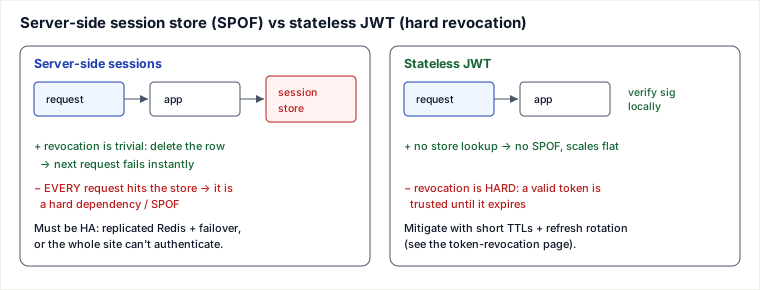
Server-side sessions store the real session state centrally (Redis, a DB) and give the browser only an opaque id. That makes revocation trivial — delete the row and the next request is unauthenticated — but it means every authenticated request performs a lookup against that store. The store is now on the critical path of all traffic: if it is down or partitioned, nobody can authenticate. It is a single point of failure and must be run HA: replicated Redis with failover (or a clustered/quorum store), sized for the full request QPS, not just login QPS.
Stateless JWT: the opposite trade-off
A stateless JWT carries its claims and a signature, so the app verifies it locally with no store lookup — no SPOF, and it scales horizontally without a shared session tier. The cost is the mirror image: revocation is hard. A validly signed token is trusted until it expires, so a logout or a compromise can't be enforced immediately without reintroducing state (a deny-list) — which partly gives back the very statelessness you chose it for. The practical resolution is short-lived access tokens + refresh-token rotation, pushing the revocation check to the refresh moment; that is developed on the Authorization — PKCE, Multi-Tenancy, Zanzibar & Revocation page.
Pitfalls
- SameSite is not a complete CSRF defense.
Laxstill allows top-level GET navigations, so state-changing GETs are exposed; keep state changes on POST and use an anti-CSRF token for sensitive actions and forSameSite=None. - HttpOnly does not stop XSS from acting as the user (the script can just make authenticated requests in-page). Fix XSS at the source (output encoding, CSP); HttpOnly only stops token exfiltration.
- Treating the session store as best-effort. If it is on every request's path, an outage is a full auth outage — size and replicate it as tier-1 infrastructure.
- Not rotating the session id on login/privilege change → session fixation (see Account Recovery & Login Hardening).
- Long-lived JWTs because "revocation is hard" — that just widens the window a stolen token stays valid. Keep access-token TTLs short.
When to use which — the judgment layer
- Server-side sessions when instant revocation and central control matter (banking, admin, anything where "log everyone out now" must be real) and you can run the store HA. Cost: the store is a SPOF on the hot path and a scaling constraint.
- Stateless JWT when you need to scale verification without a shared store or verify across services/edges. Cost / why not: revocation is hard, so it is a poor fit where immediate logout/compromise-response is a hard requirement — unless paired with short TTLs + refresh rotation.
- Named middle ground: a stateless access token for speed plus a small revocation deny-list checked cheaply (bloom filter / short-TTL cache) — you buy back revocation for the rare revoked case without a lookup on every request.
- When NOT a cookie at all: a pure native mobile client has no browser cookie jar and no ambient
CSRF surface, so a cookie buys you nothing there — carry an OAuth bearer token in the OS secure keystore
(iOS Keychain / Android Keystore) and reserve
HttpOnlycookies for browser origins. Whatever the storage, session ids must be high-entropy (128+ bits of CSPRNG output) and rotated on login and privilege change.
Takeaways
- HttpOnly stops XSS from stealing the token; Secure forces HTTPS; SameSite is the primary CSRF mitigation.
- Storage picks your poison: HttpOnly cookie → must defend CSRF; localStorage → must defend XSS (token theft). Cookie + SameSite is the common default.
- Server-side sessions give easy revocation but the store is a hot-path SPOF that must be HA.
- Stateless JWT removes the store but makes revocation hard — mitigate with short TTLs + refresh rotation, or a deny-list middle ground.
Content-Security-Policy example
A strict CSP is the XSS backstop. It tells the browser where scripts, styles, and other resources may come
from and explicitly forbids inline execution. The header below blocks both <script>alert(1)</script>
and <img src=x onerror=alert(1)> because it omits 'unsafe-inline' and restricts
script-src to the same origin:
Set-Cookie: __Host-sid=abc123; Path=/; HttpOnly; Secure; SameSite=Lax
Content-Security-Policy:
  default-src 'self';
  script-src 'self';
  style-src 'self';
  img-src 'self' data:;
  object-src 'none';
  base-uri 'self';
  frame-ancestors 'none';
The __Host- prefix on the session cookie works hand-in-hand with CSP: it forces the cookie to be
origin-bound (Secure, Path=/, no Domain attribute), so a subdomain cannot
overwrite it and a man-in-the-middle cannot downgrade it to plaintext.
Cookie attribute hardening checklist
| Attribute / prefix | What it blocks | When to relax |
|---|---|---|
HttpOnly | JavaScript cannot read the cookie via document.cookie
or XMLHttpRequest headers, stopping XSS token exfiltration. | Never on a session token. |
Secure | Browser sends the cookie only over TLS, blocking passive network sniffing and protocol-downgrade attacks. | Only on localhost with no TLS; never in prod. |
SameSite=Lax (good default)SameSite=Strict | Blocks cross-site POSTs
(the CSRF sweet spot). Strict also blocks top-level cross-site GET navigations carrying the
cookie. | Use None only for embedded or OAuth callback flows, and only with
Secure plus an explicit anti-CSRF token. |
__Host- prefix | Requires Secure, Path=/, and no
Domain attribute. The cookie is tied to the exact origin and cannot be overwritten from a
subdomain. | Only if you genuinely need the session across subdomains; then prefer
__Secure- (still requires Secure) or scope a separate cookie per subdomain. |
Traced: session hijack and fixation
Even perfect cookie flags do not help if the attacker can convince the server that a stolen or pre-shared session id belongs to the victim.
| Attack | How it works | Mitigation |
|---|---|---|
| Session hijacking | Attacker steals sid (XSS, network sniffing,
malware) and replays it. The server sees a valid id and treats the request as the victim. |
HttpOnly + Secure, short session TTL, server-side revocation, rotate on privilege
change, and bind the session to a device fingerprint or TLS session where practical. |
| Session fixation | Attacker obtains a pre-auth session id
attacker-sid and tricks the victim into logging in with it. If the server simply promotes the
pre-auth id to an authenticated session, the attacker now owns the victim's session. | Issue a fresh, cryptographically random session id immediately after authentication; ignore any client-supplied id before login; mark pre-auth tokens as unauthenticated. |
Fixation walk-through. (1) Attacker visits the site and receives
sid=attacker-sid. (2) Attacker sends the victim a login link that sets that cookie.
(3) Victim logs in. A vulnerable server says "user is now authenticated for sid=attacker-sid."
(4) Attacker refreshes the same id and is logged in as the victim. The fix is one step: after credential
validation, destroy the old id and issue a new one, e.g., sid=victim-new-random.
Related pages
- Account Recovery & Login Hardening — session fixation and rotation guidance.
- Authorization — PKCE, Multi-Tenancy, Zanzibar & Revocation — revocation architecture for stateless tokens.
- TLS & mTLS — The Handshake, Step by Step — the transport layer that protects the cookie in transit.
Sources: OWASP Session Management & CSRF Cheat Sheets, MDN Set-Cookie / SameSite docs, RFC 6265bis, and DDIA (Kleppmann) on stateful vs stateless tiers. Re-authored/Deepened for this guide.
🤖 Don't fully get this? Learn it with Claude
Stuck on Session & Cookie Security? Open Claude, copy a block below, and it'll teach you this exact concept — visually and interactively.
Build the mental picture, not memorization.
I just read a lesson on **Session & Cookie Security** (System Design) and want to truly understand it. Explain Session & Cookie Security from first principles using ONE vivid real-world analogy and a visual mental model — draw it as ASCII art or a clear step-by-step diagram — with a concrete example using real numbers. Then ask me one question to check I got the mental picture, and wait for my reply. If you're unsure or a claim isn't standard, say so and reason from first principles instead of guessing.
Socratic — adapts to where you're stuck.
Teach me **Session & Cookie Security** interactively. Ask me ONE guiding question at a time, wait for my answer, and adapt to my confusion — build the idea with me step by step instead of explaining it all at once. If you're unsure or a claim isn't standard, say so and reason from first principles instead of guessing.
Active recall exposes what you missed.
Quiz me on **Session & Cookie Security** with 5 questions, easy to tricky, ONE at a time. Tell me if each answer is right; at the end, explain clearly what I got wrong and why. If you're unsure or a claim isn't standard, say so and reason from first principles instead of guessing.
Intuition + hook + flashcards for long-term memory.
Help me remember **Session & Cookie Security** for the long term: give the one-sentence intuition, a memorable hook/mnemonic, a tiny worked example, and 3 active-recall flashcards (Q -> A). If you're unsure or a claim isn't standard, say so and reason from first principles instead of guessing.