hard Traffic Amplification: Fan-out & Retry Storms
The frontend QPS you estimated is a floor, not the real number
A single user-facing request is answered by many internal calls, and under stress those calls
retry — so backend load is never just "users × requests-per-user." The real number is
frontend QPS × fan-out × (1 + retry load), and the retry term does not stay a gentle
multiplier: once a dependency degrades, retries feed the very slowness that triggered them, and the multiplier can
run away. This is the single biggest reason capacity plans built off "naive user QPS" fall over in production.
Multiplier #1 — fan-out: one request, many backends
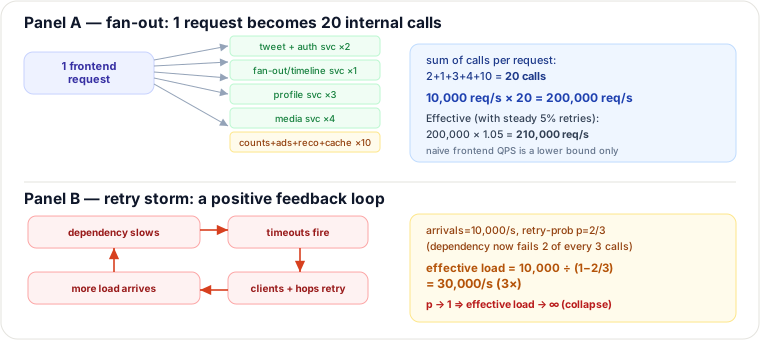
Almost nothing is served by one service. Opening a social timeline touches auth, the tweet store, the fan-out/ timeline service, per-author profile lookups, media, like/retweet counts, ads, recommendations, feature flags, and a handful of cache shards — a typical page issues on the order of 20 internal API calls for a single request the user experiences as one action.
| Call group | Calls per request |
|---|---|
| tweet fetch + auth | 2 |
| fan-out / timeline assembly | 1 |
| author profile lookups | 3 |
| media (images/video) | 4 |
| counts, ads, recommendations, cache shards | 10 |
| Total fan-out factor | 20 |
Backend QPS = frontend QPS × fan-out factor.
10,000 req/s (frontend) × 20 (fan-out) = 200,000 req/s hitting internal services.
A capacity plan sized off the 10,000 req/s a user-facing dashboard reports is 20× under before a single retry happens.
Multiplier #2 — retries: a linear cost until it becomes a feedback loop
Clients retry timeouts. Load balancers retry failed upstreams. Services retry their own downstream calls. Under normal, low-failure conditions this is a small, steady tax:
Effective QPS ≈ frontend × fan-out × (1 + retry_rate).
At a steady 5% retry rate: 200,000 × 1.05 = 210,000 req/s.
That (1 + retry_rate) formula is only a safe approximation for small retry rates. The exact
mechanism is a feedback loop, not a flat tax: retries are traffic hitting the same struggling dependency,
so they add to the arrival rate that the dependency has to serve, which increases queueing and the chance the
next call also times out. If p is the probability a call to that dependency needs a retry, the
steady-state load actually reaching it is:
effective load = arrivals ÷ (1 − p)
For small p this is close to arrivals × (1 + p) (the first-order approximation
above) — but as p grows, the two formulas diverge sharply, because 1/(1-p) is not
linear: it blows up as p → 1.
Tracing a retry storm
Take one hop — say the counts service's backing store, which normally takes 10,000 req/s with retries near zero. A GC pause or a hot shard slows it down, so requests start timing out.
| Step | State | Arithmetic |
|---|---|---|
| 1 | Baseline, healthy | 10,000 req/s arrive, p ≈ 0, effective load = 10,000/s |
| 2 | Dependency slows → timeouts | retry-probability rises to p = 2/3 (two of every three calls now time out and get retried) |
| 3 | Retries add to arrivals | effective load = 10,000 ÷ (1 − 2/3) = 10,000 ÷ (1/3) = 30,000 req/s (3× the baseline) |
| 4 | The loop closes | the extra 20,000 req/s queues at the same already-slow store → latency rises further → p climbs toward 1 → effective load → ∞ |
Step 4 is the retry storm: a positive feedback loop where retries are not a response to the outage, they are part of the outage. The brief GC pause that started it can be over, but the system does not recover on its own — the retry backlog itself is now the bottleneck. This is sometimes called congestion collapse or a metastable failure: a stable, degraded state that persists even after the original trigger clears, because the traffic pattern (not the original cause) is now what's keeping the dependency overloaded.
Pitfalls
- Sizing capacity off frontend QPS alone. Provisioning for 10,000 req/s of user traffic when the internal fan-out is actually pushing 200,000 req/s at your services means the "healthy at 100% frontend load" number was never actually tested.
- Unbounded retries at every hop, compounding across hops. If a client retries once, its load balancer retries once, and the service it calls retries its own downstream once, a single user action can turn into several multiplied attempts stacked across the call chain — the retries are multiplicative across hops, not additive.
- Synchronized retries with no jitter → thundering herd. If every client that fails at t=0 backs off the same fixed interval, they all retry at the same instant — the retry wave itself becomes a load spike, in lockstep, that can re-trigger the same failure on a healthy dependency.
- Retrying non-idempotent operations blindly. A timeout does not tell you whether the original request already executed server-side before the response was lost. Retrying a bare "charge card" or "increment counter" on timeout risks double-charging or double-counting unless the operation is made idempotent (e.g. an idempotency key) first.
Judgment layer — choosing your defenses
Retry budget vs. unlimited retries. Unlimited retries maximize any single caller's chance of
riding out a transient blip — fine for rare, isolated, cheap calls. But at scale, many callers share the same
dependency, and unlimited retries are exactly the arrivals/(1-p) blow-up above: they actively starve
the dependency of the headroom it needs to recover. A retry budget (Google SRE's convention: cap
retries to roughly 10% of the request rate over a rolling window) bounds effective load to about
1.1× arrivals no matter how bad p gets — at the cost of occasionally failing a
request fast that one more retry would have saved. Trade-off: unlimited retries optimize one caller's success
probability; a retry budget optimizes the survival of the shared dependency, which protects everyone's aggregate
success. At scale, the budget is the correct default.
Where the circuit breaker goes. Put it on the caller side, wrapping the outbound call, not inside the callee. The point of a breaker is to stop the caller from even attempting the call — and therefore stop generating its retries — once the callee's error rate crosses a threshold. A breaker embedded in the callee can only shed load after the network hop and connection cost already happened, and does nothing to stop the caller's own retry loop; it just relocates the pile-up (a 503 that itself gets retried). Named alternative: server-side load shedding (reject when queue depth exceeds X) is complementary, not a substitute — the breaker protects callers from wasting time on a known-bad dependency; load shedding protects the callee from callers that don't have a breaker yet.
Fan-out-on-write vs. fan-out-on-read. The amplification does not disappear when you redesign around it — it moves. Fan-out-on-write (push: one tweet write becomes N inbox writes at publish time) keeps reads at O(1) but amplifies writes badly for accounts with huge followings. Fan-out-on-read (pull: posting stays O(1), but every timeline read fans out across everyone the user follows) keeps writes cheap but amplifies reads for users who follow many accounts. Trade-off: push pays the amplification cost at write time in exchange for cheap reads (good when reads ≫ writes and follower counts are bounded); pull pays it at read time (good for celebrity-scale write fan-out). Production systems (Twitter's timeline) use a hybrid: fan-out-on-write for ordinary accounts, fan-out-on-read for celebrities — choosing, per entity, which side absorbs the cost.
Takeaways
- Naive frontend QPS is a lower bound, not a capacity number: real backend load = frontend × fan-out (10,000 × 20 = 200,000 req/s here) before a single retry.
- Retries turn that linear multiplier into a feedback loop — effective load = arrivals ÷ (1 − p) — which is a gentle tax at low p (200,000 × 1.05 = 210,000) but triples load at p=2/3 (10,000 → 30,000) and diverges as p → 1: the retry storm / congestion collapse.
- Caller discipline alone doesn't bound this — retry budgets, capped exponential backoff with jitter, circuit breakers, and idempotency are the structural caps that actually work.
- Amplification can be moved (fan-out-on-write vs. on-read, where the breaker sits) but not wished away — the judgment call is which side of the system should absorb the cost.
Re-authored for this guide; fan-out and retry-storm diagrams hand-authored as SVG. Retry-budget and fast-fail model follow the Google SRE Book, "Addressing Cascading Failures" (Ch. 22), and the Google SRE Workbook's retry guidance; capped exponential backoff with jitter follows the AWS Architecture Blog, "Timeouts, retries, and backoff with jitter" (Marc Brooker). See also: Tail Latency & Fan-out Amplification, Back-pressure & Flow Control, Circuit Breaker — The State Machine.
🤖 Don't fully get this? Learn it with Claude
Stuck on Traffic Amplification: Fan-out & Retry Storms? Open Claude, copy a block below, and it'll teach you this exact concept — visually and interactively.
Build the mental picture, not memorization.
I just read a lesson on **Traffic Amplification: Fan-out & Retry Storms** (System Design) and want to truly understand it. Explain Traffic Amplification: Fan-out & Retry Storms from first principles using ONE vivid real-world analogy and a visual mental model — draw it as ASCII art or a clear step-by-step diagram — with a concrete example using real numbers. Then ask me one question to check I got the mental picture, and wait for my reply. If you're unsure or a claim isn't standard, say so and reason from first principles instead of guessing.
Socratic — adapts to where you're stuck.
Teach me **Traffic Amplification: Fan-out & Retry Storms** interactively. Ask me ONE guiding question at a time, wait for my answer, and adapt to my confusion — build the idea with me step by step instead of explaining it all at once. If you're unsure or a claim isn't standard, say so and reason from first principles instead of guessing.
Active recall exposes what you missed.
Quiz me on **Traffic Amplification: Fan-out & Retry Storms** with 5 questions, easy to tricky, ONE at a time. Tell me if each answer is right; at the end, explain clearly what I got wrong and why. If you're unsure or a claim isn't standard, say so and reason from first principles instead of guessing.
Intuition + hook + flashcards for long-term memory.
Help me remember **Traffic Amplification: Fan-out & Retry Storms** for the long term: give the one-sentence intuition, a memorable hook/mnemonic, a tiny worked example, and 3 active-recall flashcards (Q -> A). If you're unsure or a claim isn't standard, say so and reason from first principles instead of guessing.