The Architecture of the Strangler Pattern
A Layered Approach
The Strangler Pattern adopts a layered approach in its architecture. Imagine peeling an onion layer by layer, with each layer representing a part of the legacy system being replaced by the new system.
Facade Interface: The Gatekeeper
The central component in the Strangler Pattern's architecture is the Facade Interface. This is the gatekeeper that decides whether a request should be handled by the new system or the legacy system. Let's think of it as a traffic controller at an intersection, guiding cars (or in our case, requests) down the correct road.
When a request arrives, the Facade Interface checks if the requested functionality has been migrated to the new system. If it has, the request is directed to the new system. If not, the request continues to be handled by the legacy system.
Phased Migration: One Step at a Time
The migration from the legacy system to the new system doesn't happen all at once. It happens in a step-by-step process.
The migration starts by identifying a piece of functionality that can be easily isolated and redirected from the legacy system to the new system. This piece of functionality is then rebuilt in the new system.
Once it's fully tested and ready to go live, the Facade Interface starts redirecting requests for this functionality to the new system, while still sending the remaining requests to the legacy system. This gradual shift of responsibilities from the old system to the new one forms the crux of the Strangler Pattern.
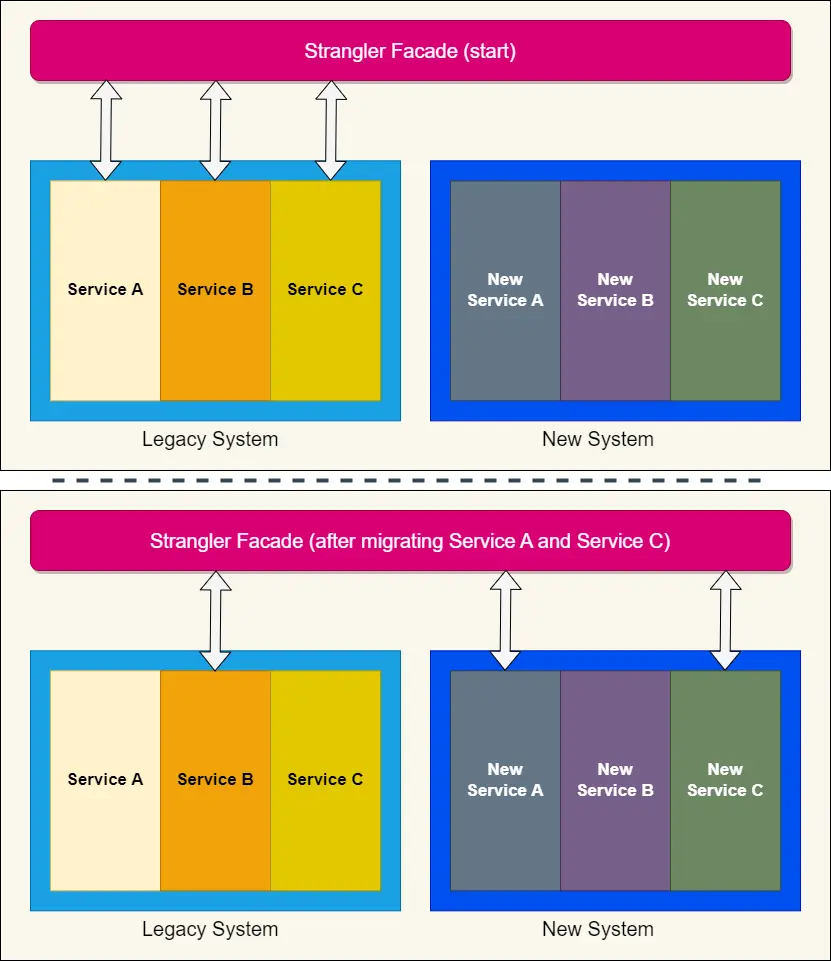
Strangler Fig: An Example: Imagine we have an old system for user management and we want to replace the "getUserDetails" function with a new service. We might use a simple router to decide which service to use:
class UserServiceRouter:

    def getUserDetails(self, userID):
        if self.useNewService(userID):
            return NewUserService().getUserDetails(userID)
        else:
            return OldUserService().getUserDetails(userID)

    def useNewService(self, userID):
        # Logic to decide which service to use.
        # For simplicity, let's say we use the new service for even userIDs.
        return userID % 2 == 0

class OldUserService:
    def getUserDetails(self, userID):
        # Old way of fetching user details
        pass

class NewUserService:
    def getUserDetails(self, userID):
        # New, improved way of fetching user details
        pass
As we become confident in NewUserService, we can adjust useNewService logic to send more traffic to the new service until OldUserService is no longer used.
🤖 Don't fully get this? Learn it with Claude
Stuck on The Architecture of the Strangler Pattern? Open Claude, copy a block below, and it'll teach you this exact concept — visually and interactively.
Build the mental picture, not memorization.
I just read a lesson on **The Architecture of the Strangler Pattern** (System Design) and want to truly understand it. Explain The Architecture of the Strangler Pattern from first principles using ONE vivid real-world analogy and a visual mental model — draw it as ASCII art or a clear step-by-step diagram — with a concrete example using real numbers. Then ask me one question to check I got the mental picture, and wait for my reply. If you're unsure or a claim isn't standard, say so and reason from first principles instead of guessing.
Socratic — adapts to where you're stuck.
Teach me **The Architecture of the Strangler Pattern** interactively. Ask me ONE guiding question at a time, wait for my answer, and adapt to my confusion — build the idea with me step by step instead of explaining it all at once. If you're unsure or a claim isn't standard, say so and reason from first principles instead of guessing.
Active recall exposes what you missed.
Quiz me on **The Architecture of the Strangler Pattern** with 5 questions, easy to tricky, ONE at a time. Tell me if each answer is right; at the end, explain clearly what I got wrong and why. If you're unsure or a claim isn't standard, say so and reason from first principles instead of guessing.
Intuition + hook + flashcards for long-term memory.
Help me remember **The Architecture of the Strangler Pattern** for the long term: give the one-sentence intuition, a memorable hook/mnemonic, a tiny worked example, and 3 active-recall flashcards (Q -> A). If you're unsure or a claim isn't standard, say so and reason from first principles instead of guessing.