The Architecture of the BFF Pattern
The Blueprint
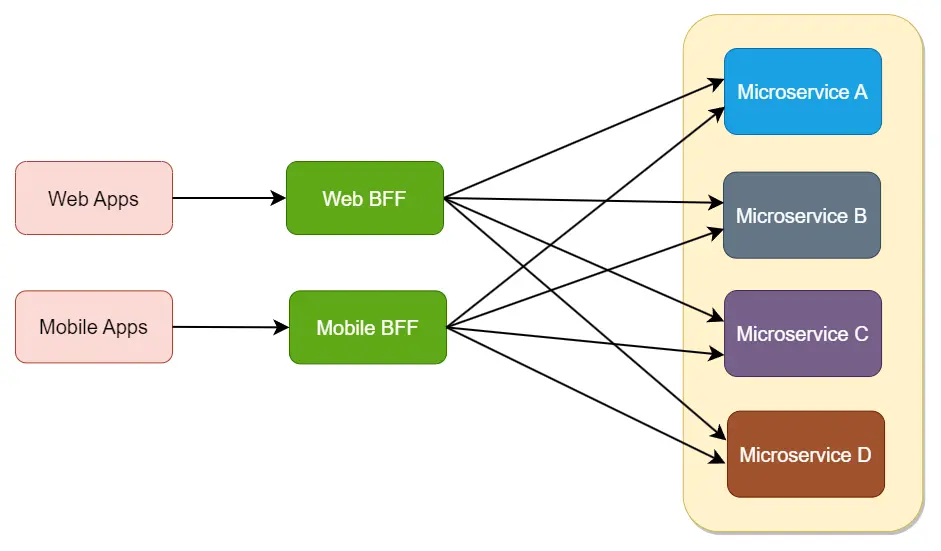
The architecture of the BFF pattern primarily consists of individual backends (the BFFs), each catering to a specific frontend. These BFFs, in turn, communicate with the underlying microservices to fetch the required data.
Let's break down this structure:
-
Frontend Applications: These are the various user-facing applications, such as desktop, mobile, or web applications. They are like the customers ordering from a menu in a restaurant.
-
BFFs (Backends for Frontends): Each BFF is paired with a specific frontend application, catering to its unique requirements. They are like the chefs preparing each dish according to a customer's preferences.
-
Microservices: These are the underlying services that the BFFs interact with to fetch data. They are like the kitchen staff, providing the raw materials needed for each dish.
A Closer Look at BFFs
But what does a BFF (Backend for Frontend) actually do? It takes on several crucial responsibilities:
-
Tailored Data Delivery: Each BFF ensures that its paired frontend receives just the data it needs. It's like a filter, ensuring that the frontend isn't overwhelmed with unnecessary information.
-
Streamlining Communication: The BFF communicates with multiple microservices, consolidates the data, and presents it to the frontend in a streamlined manner. It's like an interpreter, translating a myriad of languages into one that the frontend understands.
-
Handling Client-Specific Logic: Each BFF can also handle logic specific to its frontend, relieving the client from complex computations. It's like a personal assistant, taking care of tasks to make the client's job easier.
🤖 Don't fully get this? Learn it with Claude
Stuck on The Architecture of the BFF Pattern? Open Claude, copy a block below, and it'll teach you this exact concept — visually and interactively.
Build the mental picture, not memorization.
I just read a lesson on **The Architecture of the BFF Pattern** (System Design) and want to truly understand it. Explain The Architecture of the BFF Pattern from first principles using ONE vivid real-world analogy and a visual mental model — draw it as ASCII art or a clear step-by-step diagram — with a concrete example using real numbers. Then ask me one question to check I got the mental picture, and wait for my reply. If you're unsure or a claim isn't standard, say so and reason from first principles instead of guessing.
Socratic — adapts to where you're stuck.
Teach me **The Architecture of the BFF Pattern** interactively. Ask me ONE guiding question at a time, wait for my answer, and adapt to my confusion — build the idea with me step by step instead of explaining it all at once. If you're unsure or a claim isn't standard, say so and reason from first principles instead of guessing.
Active recall exposes what you missed.
Quiz me on **The Architecture of the BFF Pattern** with 5 questions, easy to tricky, ONE at a time. Tell me if each answer is right; at the end, explain clearly what I got wrong and why. If you're unsure or a claim isn't standard, say so and reason from first principles instead of guessing.
Intuition + hook + flashcards for long-term memory.
Help me remember **The Architecture of the BFF Pattern** for the long term: give the one-sentence intuition, a memorable hook/mnemonic, a tiny worked example, and 3 active-recall flashcards (Q -> A). If you're unsure or a claim isn't standard, say so and reason from first principles instead of guessing.