A Solution to the Monolithic Mayhem
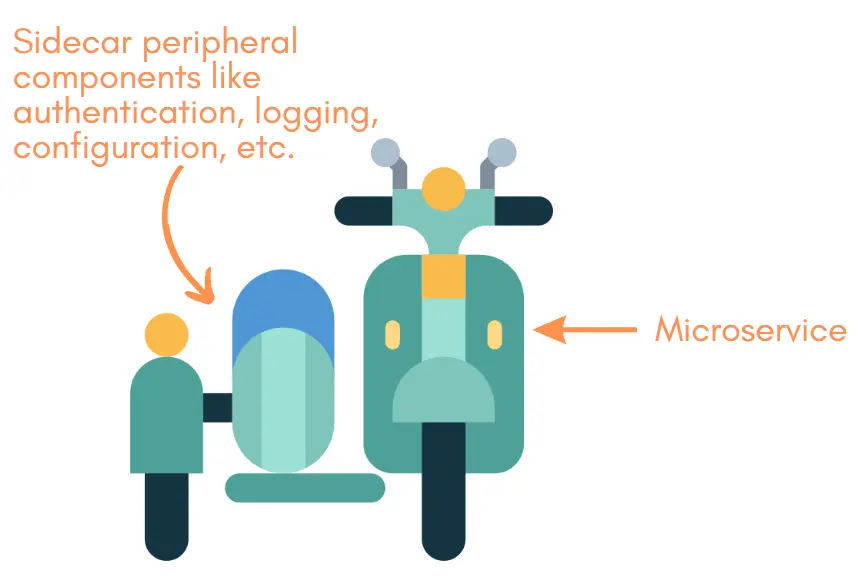
The Sidecar Pattern proposes that each service in an application should be paired with a secondary component – a 'sidecar' – that takes over some of the responsibilities of the main service. The sidecar and the main service run in the same process and communicate with each other directly, creating a self-contained module that's easy to manage and scale.
Sidecar: The Flexible Warrior
Remember how we talked about the lack of flexibility being a major issue with monolithic applications. Well, the Sidecar Pattern tackles this head-on. By separating the main service from its secondary functions, the Sidecar Pattern makes it easier to update, modify, or replace individual components without affecting the others.
Let's say you want to update a specific functionality of your service. Instead of having to redeploy the entire application, you can simply update the relevant sidecar, leaving the rest of the application untouched.
Enhanced Scalability
Scalability was another mountain we needed to climb with monolithic applications. However, with the Sidecar Pattern, scaling becomes as easy as riding a motorcycle. Since each sidecar is a separate entity, you can scale each one independently, depending on the needs of your application.
Do you need to handle a surge in user logins? Just scale up the authentication sidecar. Experiencing a high load on your data processing functions? Simply scale up the data processing sidecar. This independent scalability not only makes the process more efficient but also saves valuable resources.
The Isolation Idol
With monolithic applications, the lack of isolation was like putting all your eggs in one basket. However, the Sidecar Pattern changes the game by providing fault isolation. Since each sidecar is independent, a failure in one does not affect the others. It's like having separate baskets for each of your eggs - if one basket falls, the rest are still safe!
The Complexity Conqueror
Remember the tangled web of complexity we faced with monolithic applications? Well, the Sidecar Pattern helps us cut through this web by reducing complexity. By breaking down the application into self-contained modules, each with its own sidecar, it makes the application easier to understand, manage, and maintain. It's like clearing a path through the dense forest – you can finally see where you're going!
The Tech-Savvy Trendsetter
One of the biggest constraints with monolithic applications was the inability to integrate new technologies. However, the Sidecar Pattern, with its independent and flexible structure, makes it possible to use different technologies for different sidecars. This allows you to always stay ahead of the curve and make the most of the latest technological advances.
🤖 Don't fully get this? Learn it with Claude
Stuck on A Solution to the Monolithic Mayhem? Open Claude, copy a block below, and it'll teach you this exact concept — visually and interactively.
Progressively stronger hints — you still solve it.
I'm working on the problem **A Solution to the Monolithic Mayhem** (System Design). Give me a HINT LADDER: start with the tiniest nudge, then wait. Only reveal the next, stronger hint when I ask. Do NOT show the full solution unless I type 'show solution'. Keep me doing the thinking. If you're unsure or a claim isn't standard, say so and reason from first principles instead of guessing.
See the technique, not just code.
Explain the optimal approach to **A Solution to the Monolithic Mayhem** with a VISUAL walkthrough: trace it on a small concrete example using ASCII art / a step-by-step diagram, narrate what changes each step, then give time & space complexity with a one-line derivation. If you're unsure or a claim isn't standard, say so and reason from first principles instead of guessing.
Catch bugs, edge cases, sub-optimality.
I'll paste my solution to **A Solution to the Monolithic Mayhem**. Review it for correctness, missed edge cases, and time/space complexity, then coach me toward the optimal — don't just rewrite it. Ask me to paste my code now. If you're unsure or a claim isn't standard, say so and reason from first principles instead of guessing.
Lock in recognition with look-alikes.
Give me 2 problems that use the SAME underlying pattern as **A Solution to the Monolithic Mayhem**. For each, let me attempt first, then review my answer and name the trigger signal that reveals the pattern. If you're unsure or a claim isn't standard, say so and reason from first principles instead of guessing.