Advantages of API Gateway Pattern
Imagine a city with lots of different services and places to visit. If you are a tourist and you have to interact with each service individually, it can get confusing and overwhelming very quickly. But, if there is a single information center that guides you and helps you interact with all these services, your life becomes a whole lot easier. That’s what the API Gateway does in the world of microservices.
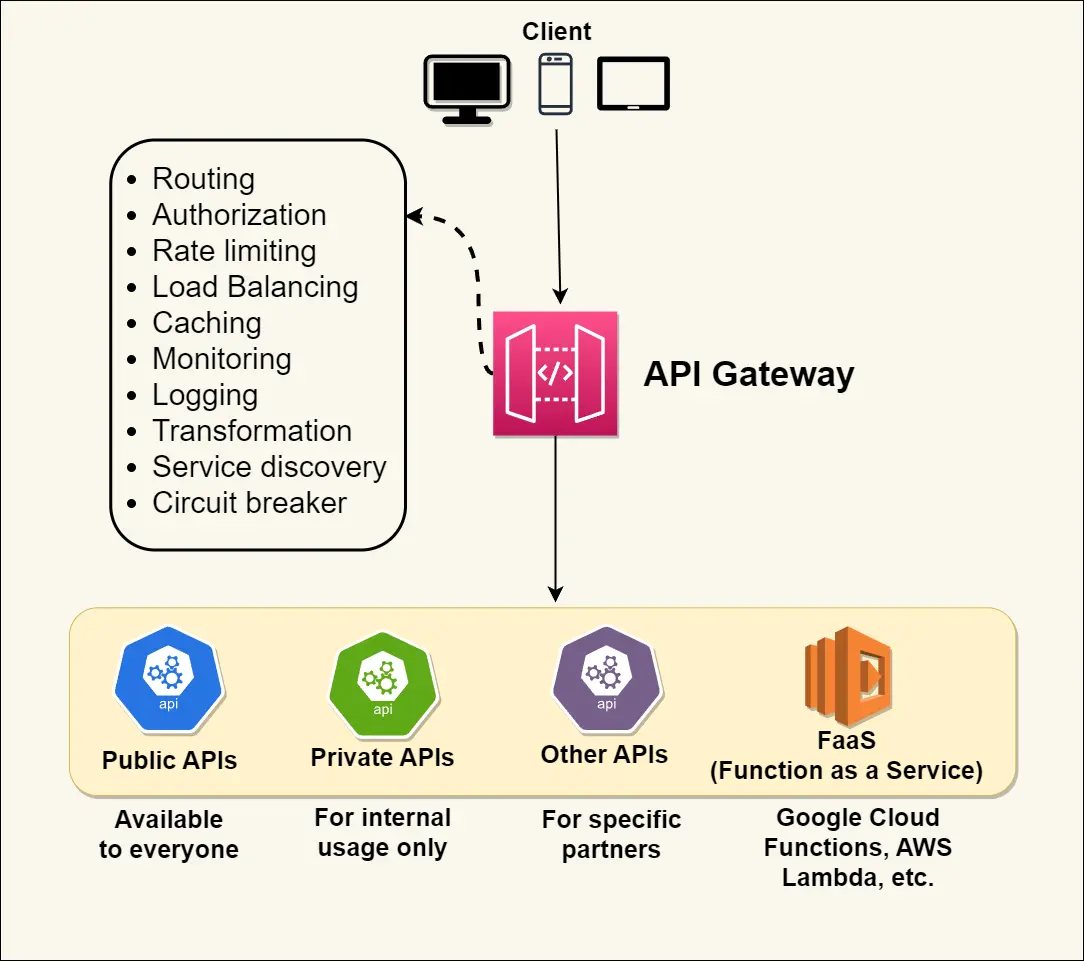
The API Gateway Pattern really is a powerhouse when it comes to organizing and simplifying interactions in a microservices architecture. Here are a few problems that it helps to solve:
1. Complexity of Interactions:
- Problem: In a microservices architecture, there are many services talking to each other. If each service communicates with all the others directly, it can get very complex, very fast.
- API Gateway Solution: The API Gateway simplifies this by being the central point of communication. Services talk to the Gateway, and the Gateway talks to other services.
2. Inconsistency in Service Calls:
- Problem: Different services might require different ways of interaction, have different data formats, etc.
- API Gateway Solution: It provides a consistent way to interact with all the services. The Gateway can translate calls and data formats, making life easier for the client.
3. Security and Authentication:
- Problem: Handling security for each service individually can be a nightmare. You need to make sure each service is secure, and that’s a lot of work.
- API Gateway Solution: It can handle authentication and authorization centrally. Clients authenticate with the Gateway, and then the Gateway ensures that the clients are who they say they are.
4. Load Balancing:
- Problem: Some services might get more traffic than others, and you need to manage this traffic efficiently.
- API Gateway Solution: It can distribute the incoming traffic evenly across services, ensuring no single service is overwhelmed.
5. Performance Issues:
- Problem: Services might be spread out, and network calls between services can add delays.
- API Gateway Solution: It can cache responses from services, reducing the need for repeated calls and improving performance.
6. Cross-Cutting Concerns:
- Problem: Concerns like logging, monitoring, and analytics need to be implemented in every service.
- API Gateway Solution: It can handle these concerns centrally, reducing the need to implement them in every single service.
7. Managing Legacy Systems:
- Problem: You might have old services that need to be accessed in specific ways.
- API Gateway Solution: It can interact with legacy services, providing a modern interface to them.
8. Version Management:
- Problem: Different clients might need to interact with different versions of a service.
- API Gateway Solution: The Gateway can route requests to the appropriate version of a service based on the client’s needs.
9. Aggregation of Results:
- Problem: A client might need information that is spread across multiple services. Getting this info could require multiple network calls, which can be inefficient.
- API Gateway Solution: The Gateway can aggregate results from multiple services and send a consolidated response back to the client.
10. Service Orchestration:
- Problem: Some operations might require a series of service calls to be made in a particular order.
- API Gateway Solution: The Gateway can orchestrate these calls and ensure they are made in the correct order, handling any necessary transformations along the way.
11. Handling Partial Failures:
- Problem: In a distributed system, some services might fail while others are still functioning. Handling these partial failures gracefully is challenging.
- API Gateway Solution: The Gateway can detect these failures and reroute requests or provide fallback responses to ensure the system remains robust.
12. Request Transformation:
- Problem: Different services might require requests to be formatted in different ways.
- API Gateway Solution: The Gateway can transform incoming requests into the format expected by each service.
13. Client-Specific Adaptations:
- Problem: Different clients (mobile, web, etc.) might have different requirements.
- API Gateway Solution: The Gateway can adapt responses to suit the needs of different clients.
14. Centralized Logging and Monitoring:
- Problem: Collecting logs and monitoring data from all services in a distributed system can be challenging.
- API Gateway Solution: The Gateway can collect logs and monitoring data, providing a centralized point for observability.
15. Handling Asynchronous Operations:
- Problem: Some operations might take a long time to complete and shouldn’t block the client.
- API Gateway Solution: The Gateway can handle these asynchronous operations, providing clients with a way to check on progress or receive a callback when the operation is complete.
By addressing these issues, the API Gateway Pattern helps create a smoother, more reliable interaction layer for clients to communicate with a microservices architecture. It’s like having a super-efficient helper that takes care of all the nitty-gritty details, letting you enjoy a seamless experience.
🤖 Don't fully get this? Learn it with Claude
Stuck on Advantages of API Gateway Pattern? Open Claude, copy a block below, and it'll teach you this exact concept — visually and interactively.
Build the mental picture, not memorization.
I just read a lesson on **Advantages of API Gateway Pattern** (System Design) and want to truly understand it. Explain Advantages of API Gateway Pattern from first principles using ONE vivid real-world analogy and a visual mental model — draw it as ASCII art or a clear step-by-step diagram — with a concrete example using real numbers. Then ask me one question to check I got the mental picture, and wait for my reply. If you're unsure or a claim isn't standard, say so and reason from first principles instead of guessing.
Socratic — adapts to where you're stuck.
Teach me **Advantages of API Gateway Pattern** interactively. Ask me ONE guiding question at a time, wait for my answer, and adapt to my confusion — build the idea with me step by step instead of explaining it all at once. If you're unsure or a claim isn't standard, say so and reason from first principles instead of guessing.
Active recall exposes what you missed.
Quiz me on **Advantages of API Gateway Pattern** with 5 questions, easy to tricky, ONE at a time. Tell me if each answer is right; at the end, explain clearly what I got wrong and why. If you're unsure or a claim isn't standard, say so and reason from first principles instead of guessing.
Intuition + hook + flashcards for long-term memory.
Help me remember **Advantages of API Gateway Pattern** for the long term: give the one-sentence intuition, a memorable hook/mnemonic, a tiny worked example, and 3 active-recall flashcards (Q -> A). If you're unsure or a claim isn't standard, say so and reason from first principles instead of guessing.