The Circuit Breaker Pattern An Effective Shield Against Cascading Failures
The Circuit Breaker Pattern solves the above problems by failing fast and preventing repeated futile attempts once a service is known to be faulty. In practice, you wrap calls to an external service in a Circuit Breaker component that monitors the outcomes of those calls. Initially, the circuit breaker is in a Closed state, allowing calls to flow normally. It counts failures (such as exceptions or timeouts). When the number of failures reaches a certain threshold, the breaker "trips" to an Open state. In the Open state, calls are immediately rejected – for example, your code might instantly throw an exception or return a fallback value without even attempting the remote call. By doing this, the application avoids waiting on a likely unresponsive service, thus preserving its own responsiveness and resources.
Crucially, an open circuit also stops adding load on the failing service, which gives that service a chance to recover. After a predefined timeout period, the circuit breaker will enter a Half-Open state, where it allows a limited number of test calls to see if the external service is healthy again. If a test call succeeds, the breaker is reset back to Closed (meaning the service is back up, so resume normal operations). If the test call fails (e.g., the service is still down), the breaker returns to Open state immediately and the cycle repeats (the system will wait again before trying next time). In this way, the Circuit Breaker Pattern isolates failures and prevents them from cascading through the system by controlling the flow of calls based on service health. It prefers fast failure and graceful degradation over long waits and resource exhaustion, significantly enhancing overall system resilience.
Architecture & Inner Workings
Under the hood, a circuit breaker maintains some state and counters to decide whether to allow calls. There are typically three states in the Circuit Breaker finite-state machine:
- Closed – Normal operations. The circuit is closed, so traffic flows to the service as usual. The breaker monitors the number of recent failures. If the number of failures exceeds a configured failure threshold (within a certain time window), the breaker transitions to Open state. While closed, successful calls generally reset the failure counter (so the occasional transient error won’t trip the breaker immediately).
- Open – Circuit is “tripped.” The breaker has detected too many failures and opens the circuit. In this state, calls are blocked immediately – the application will typically get an error or fallback response without trying the real operation. Open state endures for a certain timeout period (the open interval). The idea is to prevent any calls to the troubled service for a little while, to avoid useless load and give it time to recover.
- Half-Open – Trial mode. After the open timeout expires, the circuit breaker half-closes (goes to Half-Open). In this state, it will allow a limited number of test requests to pass through to the actual service. Think of this as cautiously probing the service: “Are you OK now?” If a test request succeeds, it’s a signal that the service is likely back up; the breaker resets to Closed state (often resetting failure counters). If a test request fails, the breaker immediately flips back to Open and the timeout period starts over. Only a few requests are let through in half-open to avoid blasting a recovering service with traffic. Often, one successful call is enough to close the circuit, but some implementations might require a few successes to be sure.
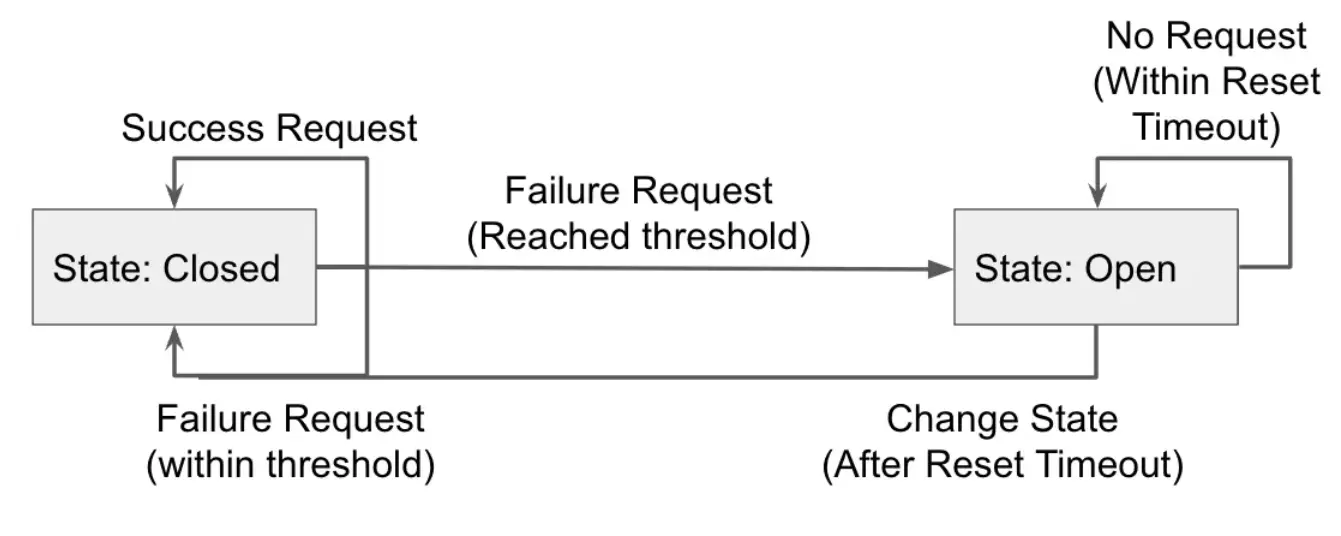
State Transitions: The transitions can be summarized as: Closed → Open when failures exceed the threshold; Open → Half-Open after the timeout elapses; Half-Open → Closed if the next call succeeds (or after a certain number of consecutive successes), or Half-Open → Open if the test call fails. The diagram below (if we had one) would show a loop: Closed → Open → (wait) → Half-Open → Closed (or back to Open). These states and transitions implement the logic of “stop calling when it’s likely down, and periodically check if it’s back up.”
Every call through the circuit breaker will perform a quick check of the state:
- If Closed, just attempt the call and record the outcome.
- If Open, skip the call and immediately return a failure (or use a fallback).
- If Half-Open, allow the call (perhaps only a certain number of concurrent calls) and then adjust the state based on the result.
In essence, the circuit breaker acts as a safety valve in your architecture. It ensures that a failing component of the system doesn’t drag down the rest. By tuning the failure threshold and timeout, you can decide what “failure rate” warrants cutting off calls and how long to wait before giving the service another chance.
Integrating the Circuit Breaker Pattern
Integrating the Circuit Breaker pattern into your system does not necessarily require a complete system overhaul. In fact, it can be added as a protective layer around your existing service calls without disrupting the underlying service logic.
Essentially, every time a request is made to a service, it is made through the Circuit Breaker. It is the Circuit Breaker that determines whether to forward the request to the service based on its current state and the outcome of recent requests.
This way, the Circuit Breaker pattern can be introduced gradually into a system, starting with critical services that could have a significant impact on the system's functionality if they were to fail. Over time, as the benefits of the pattern become evident, it can be expanded to protect other services as well.
Circuit Breaker Settings: Finding the Right Balance
When implementing the Circuit Breaker pattern, it's crucial to focus on the configuration of its parameters. These include:
- Failure Threshold: Determines when the circuit breaker switches from Closed to Open state. It's the limit of failed requests needed before activating the circuit breaker.
- Timeout Period: The duration the Circuit Breaker remains in the Open state before moving to Half-Open. This is the recovery time given to the service.
- Number of Requests in Half-Open State: This is how many requests are allowed through when the Circuit Breaker is in the Half-Open state, testing if the service has recovered.
The values for these parameters are vital. They must strike a balance between protecting the service, allowing it time to recover, and keeping the service as available as possible for handling requests. The ideal settings depend on several factors:
- The nature of the service and the system.
- The expected load on the service.
- The criticality of the service to the system's overall functionality.
It's important to remember that these parameters shouldn't be static. They can and should be adjusted dynamically in response to the system's state and performance. For example, in times of high demand, adjustments might include:
- Increasing the failure threshold, allowing the service to endure more failed requests before the Circuit Breaker activates.
- Reducing the timeout period, enabling quicker recovery attempts, thus allowing the service to handle more requests during peak times.
These dynamic adjustments help in maintaining optimal service availability and performance, even under varying system conditions.
🤖 Don't fully get this? Learn it with Claude
Stuck on The Circuit Breaker Pattern An Effective Shield Against Cascading Failures? Open Claude, copy a block below, and it'll teach you this exact concept — visually and interactively.
Build the mental picture, not memorization.
I just read a lesson on **The Circuit Breaker Pattern An Effective Shield Against Cascading Failures** (System Design) and want to truly understand it. Explain The Circuit Breaker Pattern An Effective Shield Against Cascading Failures from first principles using ONE vivid real-world analogy and a visual mental model — draw it as ASCII art or a clear step-by-step diagram — with a concrete example using real numbers. Then ask me one question to check I got the mental picture, and wait for my reply. If you're unsure or a claim isn't standard, say so and reason from first principles instead of guessing.
Socratic — adapts to where you're stuck.
Teach me **The Circuit Breaker Pattern An Effective Shield Against Cascading Failures** interactively. Ask me ONE guiding question at a time, wait for my answer, and adapt to my confusion — build the idea with me step by step instead of explaining it all at once. If you're unsure or a claim isn't standard, say so and reason from first principles instead of guessing.
Active recall exposes what you missed.
Quiz me on **The Circuit Breaker Pattern An Effective Shield Against Cascading Failures** with 5 questions, easy to tricky, ONE at a time. Tell me if each answer is right; at the end, explain clearly what I got wrong and why. If you're unsure or a claim isn't standard, say so and reason from first principles instead of guessing.
Intuition + hook + flashcards for long-term memory.
Help me remember **The Circuit Breaker Pattern An Effective Shield Against Cascading Failures** for the long term: give the one-sentence intuition, a memorable hook/mnemonic, a tiny worked example, and 3 active-recall flashcards (Q -> A). If you're unsure or a claim isn't standard, say so and reason from first principles instead of guessing.