Introduction to the API Gateway Pattern
Imagine for a moment you’re ordering a burger at a fast-food restaurant. You go to the counter, place your order, pay for it, and then wait for your burger. Here, the counter where you place your order is like an API Gateway in microservices. It’s the single point where you, as a customer, interact with the restaurant's services (kitchen, billing, etc.).
What is API Gateway Pattern? In microservice architecture, you have lots of different services doing their own thing. The API Gateway Pattern is about having a single entry point for external consumers to access these various services. This makes it easier to manage, secures your services, and provides a unified interface for the external world.
Why API Gateway Pattern?
In the world of software architecture, one trend that has become increasingly dominant over the past few years is the shift from monolithic structures to microservices architecture. This change, much like the shift from landlines to smartphones in telecommunications, has brought forth an array of benefits - enhanced scalability, increased flexibility, and more. However, as with any technological advancement, it also presents its own unique set of challenges.
One of the biggest challenges of microservices is: How can we ensure effective and efficient communication between these large number of services? How do we manage the growing complexity that comes with the increasing number of interactions between services? This is where the API Gateway Pattern steps in. Let's understand this with an example.
Example:
Think about Netflix. When you open Netflix on your TV or phone, it needs to get data like movie lists, user preferences, subtitles, etc. Netflix has a ton of microservices for these different pieces of data. Instead of your TV app calling each microservice separately, it calls a Netflix API Gateway, which then talks to the necessary microservices. Simpler for your TV app, right?
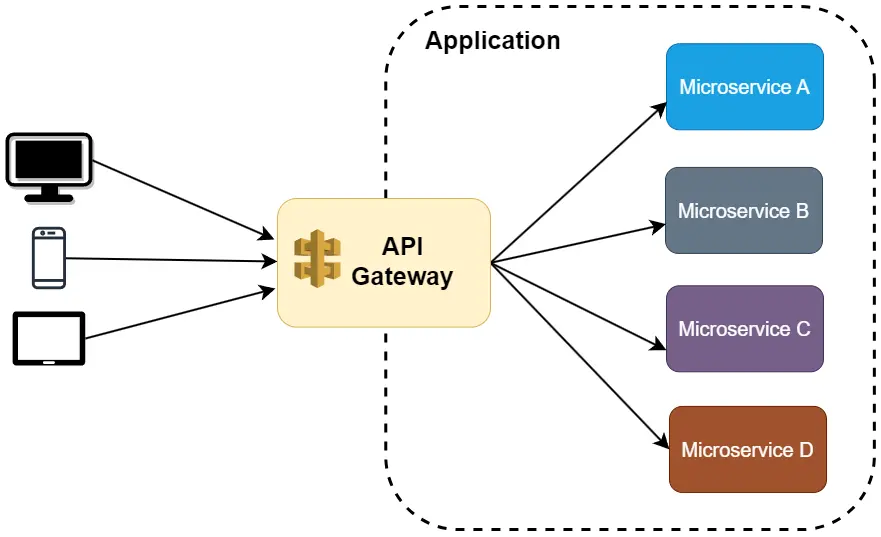
API Gateway Pattern: The Master Orchestrator
The API Gateway Pattern operates much like the conductor of an orchestra. It oversees and directs the entire ensemble of services, ensuring that each plays its part at the right time to produce a harmonious output. It serves as the single entry point for all client requests and routes these requests to the appropriate microservices. It then gathers the responses from the concerned microservices and delivers a unified response back to the client.
The beauty of this pattern lies in its ability to mask the underlying complexity from the clients. As a client, you wouldn't need to know how many services are involved or how they communicate with each other. All you need to do is make a request, and the API Gateway takes care of the rest. Isn't that marvelously efficient and convenient?
Advantages of API Gateway
- Simplified Client: Clients interact with one gateway instead of multiple services.
- Security: You can add authentication and authorization at the gateway level.
- Performance: You can add caching, compress responses, and manage load balancing.
- Cross-Cutting Concerns: Handle logging, analytics, and other stuff at one place.
🤖 Don't fully get this? Learn it with Claude
Stuck on Introduction to the API Gateway Pattern? Open Claude, copy a block below, and it'll teach you this exact concept — visually and interactively.
Build the mental picture, not memorization.
I just read a lesson on **Introduction to the API Gateway Pattern** (System Design) and want to truly understand it. Explain Introduction to the API Gateway Pattern from first principles using ONE vivid real-world analogy and a visual mental model — draw it as ASCII art or a clear step-by-step diagram — with a concrete example using real numbers. Then ask me one question to check I got the mental picture, and wait for my reply. If you're unsure or a claim isn't standard, say so and reason from first principles instead of guessing.
Socratic — adapts to where you're stuck.
Teach me **Introduction to the API Gateway Pattern** interactively. Ask me ONE guiding question at a time, wait for my answer, and adapt to my confusion — build the idea with me step by step instead of explaining it all at once. If you're unsure or a claim isn't standard, say so and reason from first principles instead of guessing.
Active recall exposes what you missed.
Quiz me on **Introduction to the API Gateway Pattern** with 5 questions, easy to tricky, ONE at a time. Tell me if each answer is right; at the end, explain clearly what I got wrong and why. If you're unsure or a claim isn't standard, say so and reason from first principles instead of guessing.
Intuition + hook + flashcards for long-term memory.
Help me remember **Introduction to the API Gateway Pattern** for the long term: give the one-sentence intuition, a memorable hook/mnemonic, a tiny worked example, and 3 active-recall flashcards (Q -> A). If you're unsure or a claim isn't standard, say so and reason from first principles instead of guessing.