Introduction to Simulation Pattern
Simulation solves a problem by literally executing the process the problem describes — advancing state one step (or one time-tick) at a time and applying the rules given — instead of deriving a closed-form formula for the answer; it trades mathematical insight for direct, faithful re-enactment of the system's dynamics.
Recognize the pattern
- The problem hands you an explicit sequence of instructions/events (a string, a list of commands, a turn order) and asks for the state after applying them.
- Each step's effect depends only on the current state (position, direction, board) and the current instruction — no global formula connects step 1 to step n directly.
- Keywords: "robot moves", "simulate", "process each operation", "game of life", "conveyor/queue ticks", "after k rounds".
- A closed-form shortcut (e.g. sum of an arithmetic series) does not obviously exist because state can branch, wrap, bounce, or depend on collisions.
Brute force vs. optimal
Brute force for this class of problem often means re-deriving the whole trajectory whenever you need an intermediate answer (e.g. recomputing position from scratch for every query) — O(n) per query, O(n·q) total for q queries.
Optimal (the simulation pattern itself) walks the instruction stream exactly once, updating a small mutable state object in place — O(n) total regardless of how many intermediate states you need to inspect, because each step is processed exactly once and folded into the running state.
The "optimization" here is not asymptotic wizardry; it's recognizing that a single linear pass with O(1) work per step is already optimal — you cannot answer "final position" without reading every instruction at least once, so Ω(n) is a hard lower bound.
Complexity, derived
Time: the loop body does a constant number of comparisons and arithmetic ops (one switch/if-chain, one increment) per character. Total operations = c·n for constant c, so T(n) = O(n). You cannot do better than Θ(n) because the final position genuinely depends on every character (adversarial input can make the last character flip the answer).
Space: state is two integers (x, y) plus the loop index — no auxiliary array grows with n, so S(n) = O(1) beyond the input string itself.
Worked example
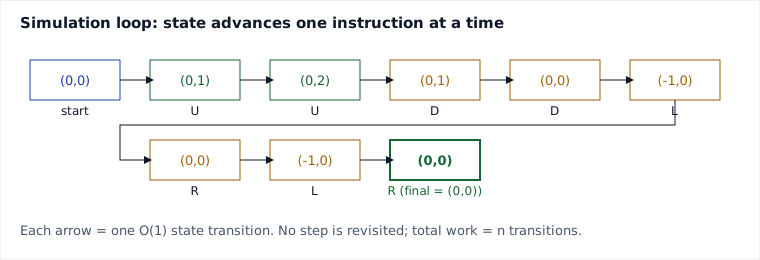
Input: instructions = "UUDDLRLR", start (0,0).
| i | char | update | (x,y) after |
|---|---|---|---|
| 0 | U | y+=1 | (0,1) |
| 1 | U | y+=1 | (0,2) |
| 2 | D | y-=1 | (0,1) |
| 3 | D | y-=1 | (0,0) |
| 4 | L | x-=1 | (-1,0) |
| 5 | R | x+=1 | (0,0) |
| 6 | L | x-=1 | (-1,0) |
| 7 | R | x+=1 | (0,0) |
Final position: (0, 0) — 8 steps, 8 O(1) updates, matches n=8.
Java implementation
public int[] finalPosition(String instructions) {
    int x = 0, y = 0;
    for (char instr : instructions.toCharArray()) {
        switch (instr) {
            case 'U': y += 1; break;
            case 'D': y -= 1; break;
            case 'L': x -= 1; break;
            case 'R': x += 1; break;
            default: throw new IllegalArgumentException("bad instruction: " + instr);
        }
    }
    return new int[]{x, y};
}
Pitfalls
- Mutating shared/aliased state instead of a local copy when the problem asks you to return intermediate snapshots (e.g. a path array) — all snapshots end up pointing to the same final array.
- Off-by-one on boundary/wrap conditions (grid edges, modulo wraparound) — simulate the boundary case explicitly, don't assume it "just works".
- Simulating naively when n is astronomically large (e.g. "after 10^18 steps") — this is the tell that you need cycle detection (Floyd/Brent) or matrix exponentiation instead of a literal loop, because O(n) becomes infeasible.
- Forgetting to validate/default unexpected input characters, silently corrupting state.
When to use / when not — trade-offs
Use simulation when the instruction count n is bounded (fits in a linear pass, roughly n ≤ 10^7–10^8), the rules are stated procedurally, and no closed form is evident.
Avoid / augment it when:
- n is huge but the state space is small and finite — state must eventually repeat, so detect the cycle (Floyd's tortoise-hare) and jump via
remaining = (n - cycle_start) % cycle_length, turning O(n) into O(state space). - the transition is linear/affine (e.g. population growth, linear recurrences) — matrix exponentiation answers "state after n steps" in O(log n) instead of O(n).
- you need arbitrary random-access to state at any past index cheaply — precompute a prefix array of states once (O(n) space) rather than re-simulating per query.
Trade-off: simulation is the simplest to write and reason about but scales linearly with the number of events; the alternatives above trade implementation complexity for sublinear (or amortized O(1) per query) time.
Takeaways
- Simulation = replay the process step by step, updating minimal state — no magic formula required.
- It's optimal (Θ(n)) whenever every instruction can affect the final answer; you can't skip reading input you're forced to depend on.
- When n explodes, look for a repeating state (cycle detection) or a linear transition (matrix power) before defaulting to a literal loop.
Recall: Why is O(n) simulation already asymptotically optimal for the robot-position problem, and what property of the input would let you beat it?
Derived from the extracted course notes on the Simulation pattern, cross-checked against standard interview-prep treatments of simulation vs. cycle-detection/matrix-exponentiation trade-offs.
🤖 Don't fully get this? Learn it with Claude
Stuck on Introduction to Simulation Pattern? Open Claude, copy a block below, and it'll teach you this exact concept — visually and interactively.
Build the mental picture, not memorization.
I just read a lesson on **Introduction to Simulation Pattern** (DSA) and want to truly understand it. Explain Introduction to Simulation Pattern from first principles using ONE vivid real-world analogy and a visual mental model — draw it as ASCII art or a clear step-by-step diagram — with a concrete example using real numbers. Then ask me one question to check I got the mental picture, and wait for my reply. If you're unsure or a claim isn't standard, say so and reason from first principles instead of guessing.
Socratic — adapts to where you're stuck.
Teach me **Introduction to Simulation Pattern** interactively. Ask me ONE guiding question at a time, wait for my answer, and adapt to my confusion — build the idea with me step by step instead of explaining it all at once. If you're unsure or a claim isn't standard, say so and reason from first principles instead of guessing.
Active recall exposes what you missed.
Quiz me on **Introduction to Simulation Pattern** with 5 questions, easy to tricky, ONE at a time. Tell me if each answer is right; at the end, explain clearly what I got wrong and why. If you're unsure or a claim isn't standard, say so and reason from first principles instead of guessing.
Intuition + hook + flashcards for long-term memory.
Help me remember **Introduction to Simulation Pattern** for the long term: give the one-sentence intuition, a memorable hook/mnemonic, a tiny worked example, and 3 active-recall flashcards (Q -> A). If you're unsure or a claim isn't standard, say so and reason from first principles instead of guessing.