Introduction to MO’s Algorithm Pattern
Mo's Algorithm answers a batch of offline range queries on a static array by sorting the queries so that consecutive queries have nearby endpoints, then sliding a two-pointer window [curL, curR] from one query's range to the next, adding or removing one element at a time instead of recomputing each answer from scratch. Grouping left endpoints into blocks of size about sqrt(N) bounds the total pointer movement across all Q queries to roughly O((N+Q)·sqrt(N)).
Recognize the pattern
- Many queries Q (typically 104–105+) asking for a property of a range [L, R] on one array that never changes between queries (offline, static).
- Extending or shrinking the current range by one index has a cheap incremental update — add(x) / remove(x) in O(1) or O(log N) — e.g. running sum, count of distinct elements, frequency of the mode, XOR.
- You may answer queries out of order and print results back in original order at the end.
- Does NOT fit: point updates interleaved with queries (needs Mo-with-updates, a 3rd dimension), or an add/remove that forces a full O(N) recompute (no incremental structure).
Brute force to optimal
Brute force: for each query scan from L to R and recompute the answer independently. Cost O(Q·N) — with Q = N = 105 that is 1010 operations, far too slow.
Optimal (Mo's): pick block size B ≈ sqrt(N). Sort queries by (L / B), tie-broken by R (alternate ascending/descending R per block to avoid worst-case re-scans). Maintain a window [curL, curR] and an incrementally-updated answer; move curL and curR one step at a time to reach each query's [L, R] in sorted order.
Complexity, derived from first principles
Split total pointer movement into contributions from L and R separately.
- R pointer: within one block of queries, L only ranges over B consecutive values, and queries in that block are sorted by R, so R moves monotonically across the whole block — at most O(N) movement per block. There are N/B blocks, giving O(N · N/B) = O(N²/B) total R-movement.
- L pointer: within a block, L can move by at most B per query (block width), and there are Q queries, so total L-movement is O(Q·B).
- Total: O(N²/B + Q·B). Minimizing over B by calculus (derivative zero at B = N/√Q) gives B ≈ N/√Q, and substituting back yields O(N·√Q). Using the common simplification B = √N (valid when Q ≈ N, the typical contest case) gives the familiar O((N+Q)·√N).
- Space: O(N) for the array plus O(N) frequency/aux structures plus O(Q) to store and re-sort queries — O(N+Q) total.
- Each single-step add/remove must be O(1) (or O(log N), multiplying the whole bound by log N) or the derivation's O(1)-per-step assumption breaks.
Worked example
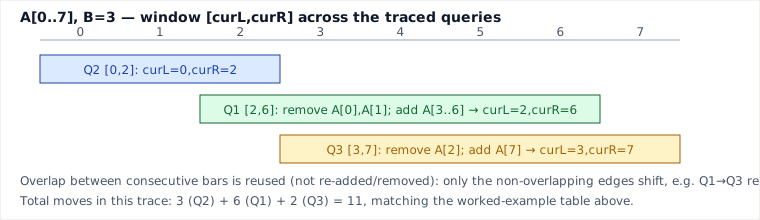
Array A = [1, 3, 5, 7, 9, 11, 13, 15] (N = 8). For this trace we pick block size B = 3 purely because it gives clean, easy-to-follow index arithmetic — B is a tunable parameter, not a fixed constant. Note that the shipped Java implementation below instead auto-computes block = (int) Math.sqrt(n), which for n = 8 gives block = 2, not 3; both are valid choices of B, they just differ between this illustration and that specific default. Queries (0-indexed, inclusive): Q1=[2,6], Q2=[0,2], Q3=[3,7].
Sort by block of L (using B=3): Q2 (L=0, block 0), Q1 (L=2, block 0), Q3 (L=3, block 1). Process in that order, sliding [curL,curR] and a running sum:
| Step | Action | curL,curR | sum |
|---|---|---|---|
| init | - | 0,-1 | 0 |
| Q2=[0,2] | add A[0],A[1],A[2] | 0,2 | 1+3+5=9 |
| Q1=[2,6] | remove A[0],A[1]; add A[3..6] | 2,6 | 5+7+9+11+13=45 |
| Q3=[3,7] | remove A[2]; add A[7] | 3,7 | 45-5+15=55 |
Total single-element moves here: 3 for init/Q2 (3 adds) + 6 for Q1 (2 removes + 4 adds) + 2 for Q3 (1 remove + 1 add) = 3 + 6 + 2 = 11 moves for 3 queries — far fewer than re-summing every range from scratch once N and Q grow large.
Java implementation
import java.util.*;

class MoQuery {
    int l, r, idx;
    MoQuery(int l, int r, int idx) { this.l = l; this.r = r; this.idx = idx; }
}

public class MoAlgorithm {

    public static long[] answerQueries(int[] a, int[][] queries) {
        int n = a.length, q = queries.length;
        int block = Math.max(1, (int) Math.sqrt(n));
        MoQuery[] qs = new MoQuery[q];
        for (int i = 0; i < q; i++) qs[i] = new MoQuery(queries[i][0], queries[i][1], i);

        Arrays.sort(qs, (x, y) -> {
            int bx = x.l / block, by = y.l / block;
            if (bx != by) return bx - by;
            return (bx % 2 == 0) ? x.r - y.r : y.r - x.r; // alternate direction
        });

        long[] ans = new long[q];
        long curSum = 0; // local accumulator: reset every call, no cross-call state leaks
        int curL = 0, curR = -1;
        for (MoQuery mq : qs) {
            while (curR < mq.r) curSum += a[++curR];
            while (curL > mq.l) curSum += a[--curL];
            while (curR > mq.r) curSum -= a[curR--];
            while (curL < mq.l) curSum -= a[curL++];
            ans[mq.idx] = curSum;
        }
        return ans;
    }
}
Note: curSum is a local variable declared inside answerQueries, so each call starts fresh at 0 — calling this method repeatedly (e.g. across multiple test cases in one process) never leaks state from a prior call. There is no unused freq field here: this example implements range-sum only, so only the state that sum actually needs (curSum) is declared.
Pitfalls
- Forgetting to sort R in alternating direction per block: still asymptotically correct but roughly 2x slower in practice from wasted re-scans at block boundaries.
- Using an add/remove that costs O(N) (e.g. recomputing max via full scan) silently destroys the whole complexity guarantee — it must be O(1)/O(log N).
- Applying Mo's to a mutable array without the update-aware 3D variant — a plain Mo's assumes the array never changes between queries.
- Off-by-one errors in the four while-loops for expanding/shrinking L and R — order matters (expand before shrink) to avoid transient negative-size windows.
- Not restoring answers to original query order before output.
- Keeping query-processing state (like a running answer) in a
staticfield instead of scoping it to the call: if the same class/method runs more than once in a process (multiple test cases, unit tests), leftover state from a previous run silently corrupts the next one. Scope accumulators locally, as in the implementation above.
When to use / when not, and alternatives
- Use when: Q and N are both large (104+), queries are offline, and the metric supports O(1)/O(log N) incremental add/remove (distinct count, mode frequency, sum, XOR).
- Avoid when: queries must be answered online (Mo's requires knowing all queries upfront), or the array is updated between queries (use Mo's with updates, adding a time dimension, O(N^(5/3))) or a segment tree if updates are frequent and metric is associative.
- Vs. Segment Tree / Fenwick Tree: segment trees give O(log N) per query AND support point updates, and work online — strictly more powerful when the query function is associative (sum, min, max). Mo's wins precisely when the function is NOT easily associative/mergeable (e.g. "count distinct in range") but IS easily updated one element at a time.
- Vs. Sparse Table: sparse tables answer idempotent range queries (min/max) in O(1) with O(N log N) preprocessing but need updates never to happen and the function to be idempotent; Mo's has no such idempotency restriction.
Takeaways
- Mo's Algorithm trades an ordering trick (sort by sqrt-block of L, then R) for near-linear total pointer movement across all queries.
- The O((N+Q)√N) bound falls out of splitting movement into an R-term (O(N²/B)) and an L-term (O(QB)) and balancing them via B ≈ N/√Q.
- It only works when queries are offline and the range metric has a cheap single-element add/remove.
- Prefer a segment tree instead whenever the metric is associative and updates or online queries are required.
Recall: Why does sorting queries by block of L, then alternating the sort direction of R per block, bound the total movement of the R pointer to O(N·N/B) instead of O(Q·N)?
Synthesized from competitive-programming references on Mo's Algorithm and Square Root Decomposition; complexity derivation is original to this page.
🤖 Don't fully get this? Learn it with Claude
Stuck on Introduction to MO’s Algorithm Pattern? Open Claude, copy a block below, and it'll teach you this exact concept — visually and interactively.
Build the mental picture, not memorization.
I just read a lesson on **Introduction to MO’s Algorithm Pattern** (DSA) and want to truly understand it. Explain Introduction to MO’s Algorithm Pattern from first principles using ONE vivid real-world analogy and a visual mental model — draw it as ASCII art or a clear step-by-step diagram — with a concrete example using real numbers. Then ask me one question to check I got the mental picture, and wait for my reply. If you're unsure or a claim isn't standard, say so and reason from first principles instead of guessing.
Socratic — adapts to where you're stuck.
Teach me **Introduction to MO’s Algorithm Pattern** interactively. Ask me ONE guiding question at a time, wait for my answer, and adapt to my confusion — build the idea with me step by step instead of explaining it all at once. If you're unsure or a claim isn't standard, say so and reason from first principles instead of guessing.
Active recall exposes what you missed.
Quiz me on **Introduction to MO’s Algorithm Pattern** with 5 questions, easy to tricky, ONE at a time. Tell me if each answer is right; at the end, explain clearly what I got wrong and why. If you're unsure or a claim isn't standard, say so and reason from first principles instead of guessing.
Intuition + hook + flashcards for long-term memory.
Help me remember **Introduction to MO’s Algorithm Pattern** for the long term: give the one-sentence intuition, a memorable hook/mnemonic, a tiny worked example, and 3 active-recall flashcards (Q -> A). If you're unsure or a claim isn't standard, say so and reason from first principles instead of guessing.