medium Subsets
Problem Statement
Given a set with distinct elements, find all of its distinct subsets.
Example 1:
Input: [1, 3]
Output: [], [1], [3], [1,3]
Example 2:
Input: [1, 5, 3]
Output: [], [1], [5], [3], [1,5], [1,3], [5,3], [1,5,3]
Constraints:
1 <= nums.length <= 10-10 <= nums[i] <= 10- All the numbers of nums are
unique.
Try it yourself
Try solving this question here:
🎯 STRICT STANDOUT — Subsets medium
0. Why this page exists
Family: Subsets — power set backtrack/bits
Include/exclude foundation without dup-skip (Subsets II separate).
1. Pattern + when-NOT (K12)
Pattern / template: Skip/take DFS or bit masks 0..2^n-1.
When-NOT: When-NOT perms; dups need skip; n large explodes 2^n output.
2. Complexity derivation (K11)
Theta(n*2^n) time/output.3. Edge hand-run (K13)
[1,2,3] size 8; [] -> [[]].4. Interviewer follow-ups & drills
Q1. Why n*2^n?
Model answer: Copy cost.
Q2. Bits vs DFS?
Model answer: Same set.
Q3. Dups?
Model answer: Subsets II sort+skip.
✅ Solution Subsets
Problem Statement
Given a set with distinct elements, find all of its distinct subsets.
Example 1:
Input: [1, 3]
Output: [], [1], [3], [1,3]
Example 2:
Input: [1, 5, 3]
Output: [], [1], [5], [3], [1,5], [1,3], [5,3], [1,5,3]
Constraints:
1 <= nums.length <= 10-10 <= nums[i] <= 10- All the numbers of nums are
unique.
Solution
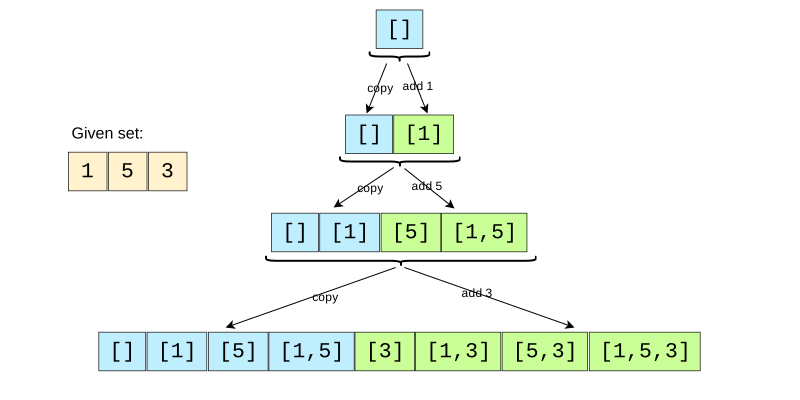
To generate all subsets of the given set, we can use the Breadth First Search (BFS) approach. We can start with an empty set, iterate through all numbers one-by-one, and add them to existing sets to create new subsets.
Let’s take the example-2 mentioned above to go through each step of our algorithm:
Given set: [1, 5, 3]
- Start with an empty set: [[]]
- Add the first number (1) to all the existing subsets to create new subsets: [[], [1]];
- Add the second number (5) to all the existing subsets: [[], [1], [5], [1,5]];
- Add the third number (3) to all the existing subsets: [[], [1], [5], [1,5], [3], [1,3], [5,3], [1,5,3]].
Here is the visual representation of the above steps:
Since the input set has distinct elements, the above steps will ensure that we will not have any duplicate subsets.
Code
Here is what our algorithm will look like:
import java.util.*;

class Solution {

  public List<List<Integer>> findSubsets(int[] nums) {
    List<List<Integer>> subsets = new ArrayList<>();
    // start by adding the empty subset
    subsets.add(new ArrayList<>());
    for (int currentNumber : nums) {
      // we will take all existing subsets and insert the current number in them to
      // create new subsets
      int n = subsets.size();
      for (int i = 0; i < n; i++) {
        // create a new subset from the existing subset and insert the current
        // element to it
        List<Integer> set = new ArrayList<>(subsets.get(i));
        set.add(currentNumber);
        subsets.add(set);
      }
    }
    return subsets;
  }

  public static void main(String[] args) {
    Solution sol = new Solution();
    List<List<Integer>> result = sol.findSubsets(new int[] { 1, 3 });
    System.out.println("Here is the list of subsets: " + result);

    result = sol.findSubsets(new int[] { 1, 5, 3 });
    System.out.println("Here is the list of subsets: " + result);
  }
}
Time Complexity
Since, in each step, the number of subsets doubles as we add each element to all the existing subsets, therefore, we will have a total of
Space Complexity
All the additional space used by our algorithm is for the output list. Since we will have a total of
🎯 STRICT STANDOUT — Solution Subsets
0. Why this page exists
Family: Subsets solution — include/exclude DFS
Clean power-set backtracking template.
1. Pattern + when-NOT (K12)
Pattern / template: dfs(i): skip and take with push/pop; or start-index for-loop.
When-NOT: Dups without skip; fixed k without prune.
2. Complexity derivation (K11)
O(n*2^n).3. Edge hand-run (K13)
[1,2] size 4; |ans|=2^n.4. Interviewer follow-ups & drills
Q1. Every node vs leaf push?
Model answer: Both templates OK.
Q2. Bits?
Model answer: Same.
Q3. Subsets II?
Model answer: Sort skip dups.
Recognize it: Enumerate all subsets / permutations / combinations under constraints → recurse, choose, un-choose.
▶ Visualize the Backtracking pattern (step it, predict each fork)
🤖 Don't fully get this? Learn it with Claude
Stuck on Subsets? Open Claude, copy a block below, and it'll teach you this exact concept — visually and interactively.
Progressively stronger hints — you still solve it.
I'm working on the problem **Subsets** (DSA). Give me a HINT LADDER: start with the tiniest nudge, then wait. Only reveal the next, stronger hint when I ask. Do NOT show the full solution unless I type 'show solution'. Keep me doing the thinking. If you're unsure or a claim isn't standard, say so and reason from first principles instead of guessing.
See the technique, not just code.
Explain the optimal approach to **Subsets** with a VISUAL walkthrough: trace it on a small concrete example using ASCII art / a step-by-step diagram, narrate what changes each step, then give time & space complexity with a one-line derivation. If you're unsure or a claim isn't standard, say so and reason from first principles instead of guessing.
Catch bugs, edge cases, sub-optimality.
I'll paste my solution to **Subsets**. Review it for correctness, missed edge cases, and time/space complexity, then coach me toward the optimal — don't just rewrite it. Ask me to paste my code now. If you're unsure or a claim isn't standard, say so and reason from first principles instead of guessing.
Lock in recognition with look-alikes.
Give me 2 problems that use the SAME underlying pattern as **Subsets**. For each, let me attempt first, then review my answer and name the trigger signal that reveals the pattern. If you're unsure or a claim isn't standard, say so and reason from first principles instead of guessing.