hard Longest Increasing Path in a Matrix
Problem Statement
Given a 2D matrix of size m x n, return the length of the longest increasing path in the matrix. The increasing path should have each element should be greater than the previous element in the path.
It is given that you can move only in 4-directions: left, right, top, and bottom.
Examples
Example 1:
- Input: matrix =
[[3, 4, 5],
 [3, 2, 6],
 [2, 2, 1]]
- Expected Output:
4
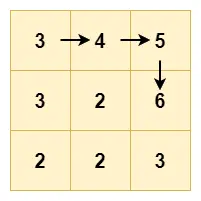
- Justification: The longest increasing path is
3 -> 4 -> 5 -> 6. No other path has a greater length.
Example 2:
- Input: matrix =
[[5,4,9],
 [5,3,8],
 [4,6,7]]
- Expected Output:
5
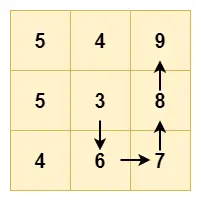
- Justification: The longest increasing path starts from the cell with value 3 (1, 1), moving to 6, then 7, 8, and finally 9.
Example 3:
- Input: matrix =
[[1, 2, 3, 4],
 [6, 5, 4, 3],
 [7, 8, 9, 2],
 [10, 11, 12, 1]]
- Expected Output:
10
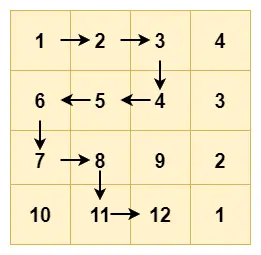
- Justification: The longest increasing path is
1 -> 2 -> 3 -> 4 -> 5 -> 6 -> 7 -> 8 -> 11 -> 12.
Try it yourself
Try solving this question here:
🎯 STRICT STANDOUT — Longest Increasing Path in a Matrix — problem
0. Pattern family
Family: DFS + memo on DAG of increasing cells (or topo)
1. Why / judgment (K3)
Cells are nodes; edge u→v if adjacent and val[v]>val[u]. Graph is DAG (values strictly increase). Longest path in DAG via DFS+memo: lip(u)=1+max(lip(v) for edges u→v). Judgment: plain DFS without memo is exponential; DP on values-sorted order is topo alternative. Not BFS shortest-path.
2. Worked complexity / derivation (K11)
m·n cells; each 4-neighbors checked once after memo → O(mn) time, O(mn) memo + stack.
Without memo: exponential paths. Topo multi-source: also O(mn).
3. Pattern + recognition + when-NOT (K12)
Name: MATRIX LONGEST PATH — DFS MEMO ON INCREASING DAG
Recognition: matrix; 4-dir moves; strictly increasing values; return max path length (cells).
When-NOT: If non-strict ≥ allowed → cycles if equal plateaus — need different handling. If 8-dir or knight moves → same pattern, different edges. If path sum max → different objective.
4. Edge hand-run (K13)
[[9,9,4],[6,6,8],[2,1,1]]:
path 1→2→6→9 length 4.
Edge: 1×1 →1. All equal →1 (no strict increase).
5. Interviewer follow-ups & drills
Q1. Why DAG?
Model answer: Strict increase forbids cycles.
Q2. Memo key?
Model answer: Only cell (i,j) — path extension depends only on start cell in this problem.
Q3. Global max?
Model answer: Run lip from every cell; take max — each cell computed once.
✅ Solution Longest Increasing Path in a Matrix
Problem Statement
Given a 2D matrix of size m x n, return the length of the longest increasing path in the matrix. The increasing path should have each element should be greater than the previous element in the path.
It is given that you can move only in 4-directions: left, right, top, and bottom.
Examples
Example 1:
- Input: matrix =
[[3, 4, 5],
 [3, 2, 6],
 [2, 2, 1]]
- Expected Output:
4
- Justification: The longest increasing path is
3 -> 4 -> 5 -> 6. No other path has a greater length.
Example 2:
- Input: matrix =
[[5,4,9],
 [5,3,8],
 [4,6,7]]
- Expected Output:
5
- Justification: The longest increasing path starts from the cell with value 3 (1, 1), moving to 6, then 7, 8, and finally 9.
Example 3:
- Input: matrix =
[[1, 2, 3, 4],
 [6, 5, 4, 3],
 [7, 8, 9, 2],
 [10, 11, 12, 1]]
- Expected Output:
10
- Justification: The longest increasing path is
1 -> 2 -> 3 -> 4 -> 5 -> 6 -> 7 -> 8 -> 11 -> 12.
Solution
To solve this problem, we'll use dynamic programming with depth-first search (DFS). The idea is to store the length of the longest increasing path starting from each cell, so we do not need to recompute it each time. This approach works because the longest path from any given cell is fixed once calculated.
In the beginning, we'll create a cache matrix of the same size as the input matrix to store the lengths of the longest paths. Then, we'll perform a DFS from each cell, checking its four adjacent cells (up, down, left, right). If an adjacent cell has a higher value, we'll continue the DFS from that cell. We'll update the cache with the maximum length found during these searches. This approach is efficient because it combines the exhaustive nature of DFS with the optimization of dynamic programming, allowing us to avoid unnecessary recalculations.
Step-by-step Algorithm
-
Initialize Cache: Create a cache matrix of the same size as the input matrix. Initialize all values to 0. This cache will store the length of the longest increasing path starting from each cell.
-
Iterate Through Matrix: Go through each cell in the input matrix. For each cell, perform a Depth-First Search (DFS) if its corresponding value in the cache is 0.
-
Depth-First Search (DFS):
- If the current cell is out of bounds or its value is not greater than the previous cell's value, return 0.
- If the cache value at the current cell is non-zero, return it (to avoid recomputation).
- Explore all four adjacent cells (up, down, left, right). If an adjacent cell has a greater value, recursively call DFS on that cell.
- Update the cache value for the current cell as 1 plus the maximum length obtained from the adjacent cells.
- Return the cache value for the current cell.
-
Track Maximum Path Length: During the iteration, keep track of the maximum length found across all cells.
-
Return Result: After completing the iterations, return the maximum path length found.
Algorithm Walkthrough
Let's use the matrix:
[[5, 4, 9],
 [5, 3, 8],
 [4, 6, 7]]
Step 1: Start DFS at (0, 0) - Value 5
- Initial exploration. There are not any adjacent values greater than 5.
- Cache matrix after update:
1 0 0 0 0 0 0 0 0 - maxPath:
1
Step 2: Explore (0, 1) - Value 4
- Finds a path to 5, updates its path length to 2.
- Cache matrix:
1 2 0 0 0 0 0 0 0 - maxPath:
2
Step 3: Move to (0, 2) - Value 9
- Directly reaches the end of a potential path.
- Cache matrix update reflects this cell as an endpoint of a path.
1 2 1 0 0 0 0 0 0 - maxPath:
2
Step 4: Explore (1, 0) - Value 5
- Same value as (0,0), no increase.
- Cache matrix:
1 2 1 1 0 0 0 0 0 - maxPath:
2
Step 5: Explore from (1, 1) - Value 3
-
Moving to the top: Find a path from 3 to 4, update
maxLengthto1 + 2 = 3. -
Moving to the bottom: Find a path from 3 to 6.
-
Next, explore the path from 6 to 7, as it is the only valid move.
-
Next, explore the path from 7 to 8, as it is the only valid move.
-
Next, explore the path from 8 to 9, as it is the only valid move.
-
After exploring, the 8 to 9 path, the updated cache matrix is:
1 2 1 1 0 2 0 0 0 -
After exploring, the 7 to 8 path, the updated cache matrix is:
1 2 1 1 0 2 0 0 3 -
After exploring, the 6 to 7 path, the updated cache matrix is:
1 2 1 1 0 2 0 4 3 -
After exploring, the 3 to 6 path, the updated cache matrix is:
1 2 1 1 5 2 0 4 3 -
maxPath:
5. -
Continue traversing each cell of the matrix this way. The length of the maximum increasing path would be
5and path would be either3 -> 6 -> 7 -> 8 -> 9or4 -> 6 -> 7 -> 8 -> 9
Code
public class Solution {

  private int[][] matrix; // The input matrix
  private int[][] cache; // Cache to store lengths of longest increasing paths
  private int rows, cols; // Dimensions of the matrix

  // Main method to find the longest increasing path
  public int longestIncreasingPath(int[][] matrix) {
    // Edge case check
    if (matrix == null || matrix.length == 0 || matrix[0].length == 0) {
      return 0;
    }

    this.matrix = matrix;
    rows = matrix.length;
    cols = matrix[0].length;
    cache = new int[rows][cols];
    int maxPath = 0;

    // Iterate through each cell of the matrix
    for (int i = 0; i < rows; i++) {
      for (int j = 0; j < cols; j++) {
        // Use DFS to find the longest path from each cell
        maxPath = Math.max(maxPath, dfs(i, j));
      }
    }

    return maxPath;
  }

  // DFS function to explore all possible paths
  private int dfs(int row, int col) {
    // If the value is already computed, return it to avoid recomputation
    if (cache[row][col] != 0) {
      return cache[row][col];
    }
    int maxLength = 1; // Initializing path length to 1 (the cell itself)
    int[][] dirs = { { -1, 0 }, { 1, 0 }, { 0, -1 }, { 0, 1 } }; // Directions: up, down, left, right

    for (int[] dir : dirs) {
      int newRow = row + dir[0], newCol = col + dir[1];
      // Check if the new cell is within bounds and is greater than the current cell
      if (
        newRow >= 0 &&
        newRow < rows &&
        newCol >= 0 &&
        newCol < cols &&
        matrix[newRow][newCol] > matrix[row][col]
      ) {
        // DFS to the new cell and update the maximum path length
        maxLength = Math.max(maxLength, 1 + dfs(newRow, newCol));
      }
    }

    cache[row][col] = maxLength; // Update the cache
    return maxLength;
  }

  // Main method for testing the algorithm with examples
  public static void main(String[] args) {
    Solution solution = new Solution();

    // Example 1
    int[][] matrix1 = { { 3, 4, 5 }, { 3, 2, 6 }, { 2, 2, 1 } };
    System.out.println("Example 1: " + solution.longestIncreasingPath(matrix1)); // Expected: 4

    // Example 2
    int[][] matrix2 = { { 5, 4, 9 }, { 5, 3, 8 }, { 4, 6, 7 } };
    System.out.println("Example 2: " + solution.longestIncreasingPath(matrix2)); // Expected: 5

    // Example 3 (Revised)
    int[][] matrix3 = {
      { 1, 2, 3, 4 },
      { 6, 5, 4, 3 },
      { 7, 8, 9, 2 },
      { 10, 11, 12, 1 },
    };
    System.out.println("Example 3: " + solution.longestIncreasingPath(matrix3)); // Expected: 9
  }
}
Complexity Analysis
-
Time Complexity:
O(M * N), whereMandNare the dimensions of the matrix. This is because each cell in the matrix is the starting point for DFS only once, thanks to caching. -
Space Complexity:
O(M * N), due to the cache matrix and recursion stack. The cache stores the longest path starting from each cell, and the recursion stack depth can potentially be as large as the number of cells in the matrix in the worst case.
🎯 STRICT STANDOUT — Solution Longest Increasing Path in a Matrix
0. Pattern family
Family: DFS + memo on DAG of increasing cells (or topo)
1. Why / judgment (K3)
Cells are nodes; edge u→v if adjacent and val[v]>val[u]. Graph is DAG (values strictly increase). Longest path in DAG via DFS+memo: lip(u)=1+max(lip(v) for edges u→v). Judgment: plain DFS without memo is exponential; DP on values-sorted order is topo alternative. Not BFS shortest-path.
2. Worked complexity / derivation (K11)
m·n cells; each 4-neighbors checked once after memo → O(mn) time, O(mn) memo + stack.
Without memo: exponential paths. Topo multi-source: also O(mn).
3. Pattern + recognition + when-NOT (K12)
Name: MATRIX LONGEST PATH — DFS MEMO ON INCREASING DAG
Recognition: matrix; 4-dir moves; strictly increasing values; return max path length (cells).
When-NOT: If non-strict ≥ allowed → cycles if equal plateaus — need different handling. If 8-dir or knight moves → same pattern, different edges. If path sum max → different objective.
4. Edge hand-run (K13)
[[9,9,4],[6,6,8],[2,1,1]]:
path 1→2→6→9 length 4.
Edge: 1×1 →1. All equal →1 (no strict increase).
5. Interviewer follow-ups & drills
Q1. Why DAG?
Model answer: Strict increase forbids cycles.
Q2. Memo key?
Model answer: Only cell (i,j) — path extension depends only on start cell in this problem.
Q3. Global max?
Model answer: Run lip from every cell; take max — each cell computed once.
Recognize it: Grid traversal / rotation / in-place marking → index arithmetic, or DFS/BFS over cells.
▶ Visualize this problem (step it, predict each fork)
🤖 Don't fully get this? Learn it with Claude
Stuck on Longest Increasing Path in a Matrix? Open Claude, copy a block below, and it'll teach you this exact concept — visually and interactively.
Progressively stronger hints — you still solve it.
I'm working on the problem **Longest Increasing Path in a Matrix** (DSA). Give me a HINT LADDER: start with the tiniest nudge, then wait. Only reveal the next, stronger hint when I ask. Do NOT show the full solution unless I type 'show solution'. Keep me doing the thinking. If you're unsure or a claim isn't standard, say so and reason from first principles instead of guessing.
See the technique, not just code.
Explain the optimal approach to **Longest Increasing Path in a Matrix** with a VISUAL walkthrough: trace it on a small concrete example using ASCII art / a step-by-step diagram, narrate what changes each step, then give time & space complexity with a one-line derivation. If you're unsure or a claim isn't standard, say so and reason from first principles instead of guessing.
Catch bugs, edge cases, sub-optimality.
I'll paste my solution to **Longest Increasing Path in a Matrix**. Review it for correctness, missed edge cases, and time/space complexity, then coach me toward the optimal — don't just rewrite it. Ask me to paste my code now. If you're unsure or a claim isn't standard, say so and reason from first principles instead of guessing.
Lock in recognition with look-alikes.
Give me 2 problems that use the SAME underlying pattern as **Longest Increasing Path in a Matrix**. For each, let me attempt first, then review my answer and name the trigger signal that reveals the pattern. If you're unsure or a claim isn't standard, say so and reason from first principles instead of guessing.