hard Serialize and Deserialize Binary Tree
Problem Statement
Serialization involves converting a binary tree into a string format such that it can be stored in the file or memory, preserving its structure and data.
Deserialization, on the other hand, is about reconstructing the binary tree from this string representation.
Design an algorithm to serialize and deserialize the binary tree. There is no restriction on designing the algorithm for serialization and deserialization of the binary tree.
Examples
Example 1:
- Input:
[1,2,3,null,null,4,5]
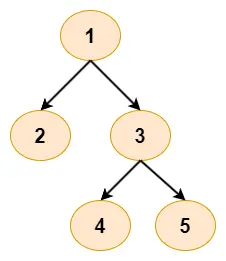
- Expected Output:
[1,2,3,null,null,4,5] - Justification: The tree starts with the root node 1, followed by its left child 2 and right child 3. Since 2 and 3 have no left children, they are followed by
null. Nodes 4 and 5 are the left and right children of 3.
Example 2:
- Input:
[5,4,null,3,null,2,null,1]
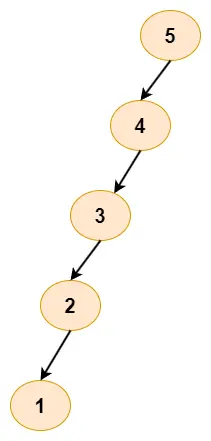
- Expected Output:
[5,4,null,3,null,2,null,1] - Justification: This represents a skewed tree where each node except the last one has a left child. The serialized format follows the tree structure exactly.
Example 3:
- Input:
[] - Expected Output:
[] - Justification: Since the tree is empty, both the serialized and deserialized outputs should be empty.
Try it yourself
Try solving this question here:
🎯 STRICT STANDOUT — Serialize and Deserialize Binary Tree — problem
0. Pattern family
Family: Tree encode/decode — preorder with null markers (or level-order)
1. Why / judgment (K3)
Any complete traversal that records null children uniquely reconstructs shape+values. Preorder + “#”/null tokens: serialize is DFS write; deserialize consumes iterator left-to-right mirroring the same DFS. Judgment: without null markers, ambiguous trees share traversals. Level-order BFS with nulls also works (LeetCode codec style). Do not use inorder alone.
2. Worked complexity / derivation (K11)
n nodes → ≤2n+1 tokens (each node + null children markers compactly).
Time O(n) serialize + O(n) deserialize. Space O(n) string + O(h) stack.
Cannot do better than Θ(n) output size in worst case.
3. Pattern + recognition + when-NOT (K12)
Name: TREE CODEC — PREORDER/BFS WITH NULL SENTINELS
Recognition: design encode↔decode that restores exact binary tree; interview “codec” class.
When-NOT: If BST only → can omit some nulls via bounds. If only structure not values → different. If N-ary → need child counts or delimiters.
4. Edge hand-run (K13)
Tree 1,{2,3,{4,5}}: preorder 1,2,#,#,3,4,#,#,5,#,#
Deserialize consumes stream: rebuild identical.
Edge: empty root → single #. Single node 7 → 7,#,#. Skewed left depth n: O(n) stack.
5. Interviewer follow-ups & drills
Q1. Why null markers?
Model answer: Otherwise [1,2] as left-child vs right-child collide in preorder values-only.
Q2. Preorder vs BFS?
Model answer: Both fine; BFS matches level-order mental model; preorder is shorter code with recursion.
Q3. Security/production?
Model answer: Validate token count and bounds; untrusted strings need limits.
✅ Solution Serialize and Deserialize Binary Tree
Problem Statement
Serialization involves converting a binary tree into a string format such that it can be stored in the file or memory, preserving its structure and data.
Deserialization, on the other hand, is about reconstructing the binary tree from this string representation.
Design an algorithm to serialize and deserialize the binary tree. There is no restriction on designing the algorithm for serialization and deserialization of the binary tree.
Examples
Example 1:
- Input:
[1,2,3,null,null,4,5]
- Expected Output:
[1,2,3,null,null,4,5] - Justification: The tree starts with the root node 1, followed by its left child 2 and right child 3. Since 2 and 3 have no left children, they are followed by
null. Nodes 4 and 5 are the left and right children of 3.
Example 2:
- Input:
[5,4,null,3,null,2,null,1]
- Expected Output:
[5,4,null,3,null,2,null,1] - Justification: This represents a skewed tree where each node except the last one has a left child. The serialized format follows the tree structure exactly.
Example 3:
- Input:
[] - Expected Output:
[] - Justification: Since the tree is empty, both the serialized and deserialized outputs should be empty.
Solution
To solve this problem, we'll employ a breadth-first search (BFS) approach for serialization and a queue-based mechanism for deserialization. BFS is chosen for serialization because it naturally navigates through the tree levels, ensuring all nodes are covered and properly placed in the serialized string. For deserialization, using a queue enables us to reconstruct the tree level by level, maintaining the structure as in the serialized string. This method is effective as it straightforwardly maps the tree structure to a string format and vice versa, ensuring no data loss and maintaining the original tree structure.
Step-by-step Algorithm
Serialization:
-
Initialize: Create an empty string
resultand a queuenodeQueue. -
Check for Empty Tree: If the root is
null, return an empty string. -
Enqueue Root: Enqueue the root node into
nodeQueue. -
Process Queue:
- While
nodeQueueis not empty:- Dequeue Node: Remove the front node from the queue.
- Append to String:
- If the node is
null, append"null"toresult. - If the node is not
null, append the node’s value.
- If the node is
- Enqueue Children:
- If the node is not
null, enqueue its left and right children (includingnull).
- If the node is not
- While
-
Return Result: Return
resultas the serialized string.
Deserialization:
-
Check for Empty String: If the input string is empty, return
null(representing an empty tree). -
Split String: Split the input string into an array of values.
-
Create Root: Construct the root from the first value.
-
Initialize Queue: Create a queue
childQueueand enqueue the root. -
Reconstruct Tree:
- Iterate through the array of values (starting from the second value):
- Assign Children:
- For each node in
childQueue, assign the next two values as its left and right children. - Enqueue these children if they are not
null.
- For each node in
- Remove Processed Node: Dequeue the processed node.
- Assign Children:
- Iterate through the array of values (starting from the second value):
-
Return Root: Return the root of the reconstructed tree.
Algorithm Walkthrough
Let's consider the Input: [5,4,null,3,null,2,null,1]
Serialization Walkthrough:
-
Initialize:
result = "",nodeQueue = []. -
Enqueue Root: Enqueue 5.
-
Process Queue:
- Dequeue 5 (front of queue), append "5" to
result. Enqueue 4 (left child of 5) andnull(right child of 5). - Dequeue 4, append "4" to
result. Enqueue 3 (left child of 4) andnull(right child of 4). - Dequeue
null, append "null" toresult. Since it'snull, no children are enqueued. - Dequeue 3, append "3" to
result. Enqueue 2 (left child of 3) andnull(right child of 3). - Dequeue
null, append "null" toresult. No children to enqueue. - Dequeue 2, append "2" to
result. Enqueue 1 (left child of 2) andnull(right child of 2). - Dequeue
null, append "null" toresult. No children to enqueue. - Dequeue 1, append "1" to
result. Both children arenull, so nothing to enqueue. - Queue is now empty.
- Dequeue 5 (front of queue), append "5" to
-
Serialization Result:
result = "5,4,null,3,null,2,null,1".
Deserialization Walkthrough:
-
Split String:
["5", "4", "null", "3", "null", "2", "null", "1"]. -
Create Root: Root = Node(5).
-
Initialize Queue:
childQueue = [Node(5)]. -
Reconstruct Tree:
- Dequeue Node(5). Assign 4 as left child and
nullas right child. Enqueue Node(4). - Dequeue Node(4). Assign 3 as left child and
nullas right child. Enqueue Node(3). - Dequeue Node(3). Assign 2 as left child and
nullas right child. Enqueue Node(2). - Dequeue Node(2). Assign 1 as left child and
nullas right child. Enqueue Node(1). - Dequeue Node(1). No children to assign as both are
null.
- Dequeue Node(5). Assign 4 as left child and
-
Deserialization Result: The tree structure is reconstructed to match the original input
[5,4,null,3,null,2,null,1].
Code
import java.util.*;

public class Solution {

  // Definition for a binary tree node.
  // public static class TreeNode {
  //     int val;
  //     TreeNode left;
  //     TreeNode right;
  //     TreeNode(int x) { val = x; }
  // }

  // Encodes a tree to a single string.
  public String serialize(TreeNode root) {
    if (root == null) return ""; // Handle empty tree
    StringBuilder sb = new StringBuilder(); // StringBuilder for efficient string concatenation
    Queue<TreeNode> queue = new LinkedList<>(); // Queue to hold nodes for BFS
    queue.offer(root); // Start with root node
    while (!queue.isEmpty()) {
      TreeNode node = queue.poll(); // Remove the next node from the queue
      if (node != null) {
        sb.append(node.val).append(","); // Append node value
        queue.offer(node.left); // Add left child to queue
        queue.offer(node.right); // Add right child to queue
      } else {
        sb.append("null,"); // Handle null children
      }
    }
    return sb.toString(); // Return the serialized string
  }

  // Decodes your encoded data to tree.
  public TreeNode deserialize(String data) {
    if (data.equals("")) return null; // Handle empty input
    String[] values = data.split(","); // Split string into values
    TreeNode root = new TreeNode(Integer.parseInt(values[0])); // Create root node
    Queue<TreeNode> queue = new LinkedList<>(); // Queue to manage nodes
    queue.offer(root); // Add root to the queue
    for (int i = 1; i < values.length; i++) {
      TreeNode parent = queue.poll(); // Get next node to add children
      if (!values[i].equals("null")) {
        TreeNode left = new TreeNode(Integer.parseInt(values[i])); // Create left child
        parent.left = left; // Link left child
        queue.offer(left); // Add left child to queue
      }
      if (++i < values.length && !values[i].equals("null")) {
        TreeNode right = new TreeNode(Integer.parseInt(values[i])); // Create right child
        parent.right = right; // Link right child
        queue.offer(right); // Add right child to queue
      }
    }
    return root; // Return the root of the deserialized tree
  }

  // Method to print the binary tree
  public static void printTree(TreeNode root) {
    if (root == null) return;

    Queue<TreeNode> queue = new LinkedList<>();
    queue.add(root);

    while (!queue.isEmpty()) {
      int levelSize = queue.size(); // Number of elements at the current level
      boolean isLastLevel = true;

      for (int i = 0; i < levelSize; i++) {
        TreeNode curr = queue.poll();

        if (curr != null) {
          // Print the value of the current node
          System.out.print(curr.val + " ");
          queue.add(curr.left);
          queue.add(curr.right);
          // If any of the children is not null, this is not the last level
          if (curr.left != null || curr.right != null) {
            isLastLevel = false;
          }
        } else {
          System.out.print("null ");
        }
      }
      // After finishing a level, if it's the last level, break out of the loop
      if (isLastLevel) {
        break;
      }
    }
  }

  public static void main(String[] args) {
    Solution solution = new Solution();
    // Testing with provided examples
    // Example 1
    TreeNode root1 = new TreeNode(1);
    root1.left = new TreeNode(2);
    root1.right = new TreeNode(3);
    root1.right.left = new TreeNode(4);
    root1.right.right = new TreeNode(5);
    String serialized1 = solution.serialize(root1);
    TreeNode deserialized1 = solution.deserialize(serialized1);

    System.out.println("Example 1 Tree:");
    solution.printTree(deserialized1);
  }
}
Complexity Analysis
Time Complexity
-
Serialization: The time complexity for the given algorithm is
O(N), where N is the number of nodes in the tree. It is because we iterate through each node once using a queue. -
Deserialization: Each node value in the serialized string is processed exactly once. Thus, the time complexity is also
O(N), where N is the number of nodes represented in the serialized string.
Space Complexity
-
Serialization: The space complexity of the algorithm is
O(N)due to the queue holding a maximum of N/2 nodes at the widest level of the tree. -
Deserialization: The space required for the tree is
O(N), leading to a total space complexity of O(N).
🎯 STRICT STANDOUT — Solution Serialize and Deserialize Binary Tree
0. Pattern family
Family: Tree encode/decode — preorder with null markers (or level-order)
1. Why / judgment (K3)
Any complete traversal that records null children uniquely reconstructs shape+values. Preorder + “#”/null tokens: serialize is DFS write; deserialize consumes iterator left-to-right mirroring the same DFS. Judgment: without null markers, ambiguous trees share traversals. Level-order BFS with nulls also works (LeetCode codec style). Do not use inorder alone.
2. Worked complexity / derivation (K11)
n nodes → ≤2n+1 tokens (each node + null children markers compactly).
Time O(n) serialize + O(n) deserialize. Space O(n) string + O(h) stack.
Cannot do better than Θ(n) output size in worst case.
3. Pattern + recognition + when-NOT (K12)
Name: TREE CODEC — PREORDER/BFS WITH NULL SENTINELS
Recognition: design encode↔decode that restores exact binary tree; interview “codec” class.
When-NOT: If BST only → can omit some nulls via bounds. If only structure not values → different. If N-ary → need child counts or delimiters.
4. Edge hand-run (K13)
Tree 1,{2,3,{4,5}}: preorder 1,2,#,#,3,4,#,#,5,#,#
Deserialize consumes stream: rebuild identical.
Edge: empty root → single #. Single node 7 → 7,#,#. Skewed left depth n: O(n) stack.
5. Interviewer follow-ups & drills
Q1. Why null markers?
Model answer: Otherwise [1,2] as left-child vs right-child collide in preorder values-only.
Q2. Preorder vs BFS?
Model answer: Both fine; BFS matches level-order mental model; preorder is shorter code with recursion.
Q3. Security/production?
Model answer: Validate token count and bounds; untrusted strings need limits.
Recognize it: Hierarchical data → recurse on children; BFS (queue) for level-order, DFS (recursion) for paths.
▶ Visualize this problem (step it, predict each fork)
🤖 Don't fully get this? Learn it with Claude
Stuck on Serialize and Deserialize Binary Tree? Open Claude, copy a block below, and it'll teach you this exact concept — visually and interactively.
Progressively stronger hints — you still solve it.
I'm working on the problem **Serialize and Deserialize Binary Tree** (DSA). Give me a HINT LADDER: start with the tiniest nudge, then wait. Only reveal the next, stronger hint when I ask. Do NOT show the full solution unless I type 'show solution'. Keep me doing the thinking. If you're unsure or a claim isn't standard, say so and reason from first principles instead of guessing.
See the technique, not just code.
Explain the optimal approach to **Serialize and Deserialize Binary Tree** with a VISUAL walkthrough: trace it on a small concrete example using ASCII art / a step-by-step diagram, narrate what changes each step, then give time & space complexity with a one-line derivation. If you're unsure or a claim isn't standard, say so and reason from first principles instead of guessing.
Catch bugs, edge cases, sub-optimality.
I'll paste my solution to **Serialize and Deserialize Binary Tree**. Review it for correctness, missed edge cases, and time/space complexity, then coach me toward the optimal — don't just rewrite it. Ask me to paste my code now. If you're unsure or a claim isn't standard, say so and reason from first principles instead of guessing.
Lock in recognition with look-alikes.
Give me 2 problems that use the SAME underlying pattern as **Serialize and Deserialize Binary Tree**. For each, let me attempt first, then review my answer and name the trigger signal that reveals the pattern. If you're unsure or a claim isn't standard, say so and reason from first principles instead of guessing.