Introduction to API Gateway
What is an API gateway?
An API gateway is a server-side component that sits between external clients (web browsers, mobile apps, partner integrations) and a system's backend services, acting as the single entry point for every inbound request. Instead of a client knowing the network address of forty different microservices, it knows one address: the gateway.
On a typical request, the gateway performs some subset of:
- Routing — map an incoming path/method to the backend service that owns it (e.g.
GET /orders/42→ orders-service). - Authentication — validate a token or API key once, at the edge, instead of every service re-implementing it.
- Rate limiting — protect backend services from being overwhelmed by any single client.
- Request/response transformation — translate protocols, reshape payloads, or attach headers before forwarding.
- Observability — a natural place to emit consistent access logs, metrics, and trace headers for every request entering the system.
Centralizing this cross-cutting logic frees individual microservices to focus on their own business logic, and gives consumers of the system one consistent contract instead of many bespoke ones.
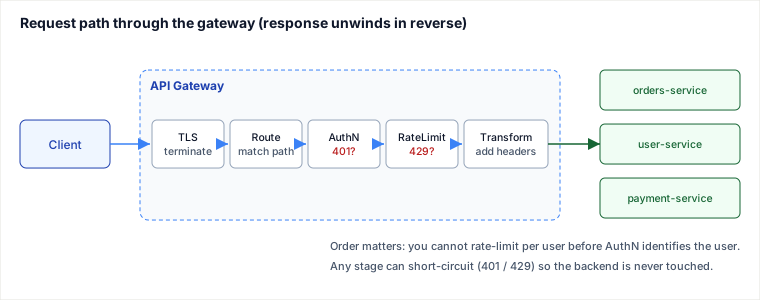
Worked trace: one request through the pipeline
The diagram above shows why order matters inside the gateway: AuthN has to run before RateLimit, because the limiter needs to know which client's budget to check. Reverse the two and the only key left is the source IP — which lumps every user behind a shared NAT or CGNAT egress into one bucket, so one noisy tenant exhausts the quota for everyone sharing that address. Walk one request through it.
A mobile client calls GET /orders/42. The gateway rate-limits per client using a token bucket with capacity 100. This client has already spent tokens earlier in the current window, leaving 58 tokens remaining.
| Stage | What happens | State after the stage |
|---|---|---|
| TLS terminate | Gateway decrypts the connection and reads the plaintext HTTP request. | No change to the bucket |
| Route | /orders/42 matches the route table entry for orders-service. | No change to the bucket |
| AuthN | Bearer token is validated and resolved to a client identity. Without this step the gateway has no identity to key the rate limiter on. | Caller resolved as this client's account; bucket lookup can now proceed |
| RateLimit | Gateway checks this client's bucket: 58 tokens remaining out of 100 capacity, 1 token required per request. Since 58 > 0, the request is allowed and the bucket is decremented by 1. | Bucket: 58 − 1 = 57 tokens remaining |
| Transform | Gateway attaches rate-limit headers to the eventual response. | X-RateLimit-Limit: 100, X-RateLimit-Remaining: 57 |
| Forward | Request is sent to orders-service, which returns 200 OK. | Bucket unchanged at 57 |
The number that changes on every allowed request is tokens remaining — the bucket only ever tracks how much budget is left, and it decrements. Had this client been at 0 tokens remaining, RateLimit would have short-circuited the pipeline with 429 Too Many Requests before Transform or the backend ever saw the request — exactly as the diagram's short-circuit paths show.
Difference between an API gateway and a load balancer
The two are easy to conflate because both sit in front of backend infrastructure and forward traffic — but they make different kinds of decisions.
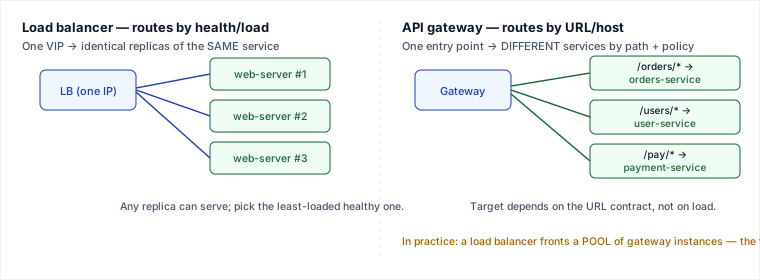
An API gateway is focused on routing a request to the appropriate microservice based on its URL/contract, while a load balancer is focused on distributing requests evenly across a group of interchangeable replicas of the same service.
| Concern | Load balancer | API gateway |
|---|---|---|
| Decision it makes | Which replica of the same service should handle this? | Which service should handle this? |
| Backends it targets | A pool of identical instances of one service | Many distinct, non-interchangeable services |
| Typical logic | Round robin, least connections, health checks | Path/host-based routing, auth, rate limiting, transformation |
Another difference is the type of request each typically handles. An API gateway routes requests based on a URL that identifies a specific API or resource, while a load balancer routes requests sent to a single well-known IP address toward whichever backend server is healthiest and least loaded — it doesn't need to understand what the request is about to make that call.
Common failure modes and pitfalls
- Single point of failure. If the gateway goes down, every client is cut off — even though every backend microservice may be perfectly healthy. Mitigate by running gateway instances behind their own load balancer, across multiple availability zones.
- Added latency. Every request now pays for an extra network hop plus whatever work the gateway does (auth lookups, transformation, logging). Usually a few milliseconds, but it compounds under high fan-out or when the gateway makes synchronous calls to enrich a request.
- Configuration drift and blast radius. Routing rules, rate limits, and auth policy for the whole system now live in one place. A bad deploy to the gateway's config can break every service at once, instead of just the one team that pushed a bug.
- Becoming a dumping ground for business logic. It's tempting to add response aggregation, orchestration, or domain-specific transformation into the gateway because "it already sees every request." Left unchecked, the gateway grows into a shared, hard-to-own monolith that every team is afraid to touch.
- Versioning and backward compatibility. Because the gateway is the contract clients depend on, changing routes or response shapes there is a breaking change for every consumer, not just one service's callers.
- Cascading timeouts under backend failure. If a downstream service slows down, gateway threads/connections can pile up waiting on it, starving capacity for requests bound for unrelated, healthy services. This needs its own timeouts, bulkheads, and circuit breakers at the gateway layer, not just at each service.
When an API gateway is the wrong call
An API gateway is a judgment call, not a default. Before centralizing at the edge, weigh it against these alternatives.
| Situation | Better alternative | Why |
|---|---|---|
| Early-stage system: one or two services, or a monolith just starting to be split up | Direct client-to-service calls (no gateway) | A gateway adds an operational component, a deployment pipeline, and a new failure mode before there's enough surface area — multiple services, multiple client types — to justify centralizing routing and policy. Introduce it once you actually have several services to unify, not preemptively. |
| Small deployment that mainly needs TLS termination, basic routing, or a stable public IP in front of one app | A plain reverse proxy (e.g. Nginx, Caddy) | A reverse proxy gives routing and TLS without the auth/rate-limit/transformation machinery of a full gateway — less to configure, less to operate, fewer places for a bug to hide. |
| The cross-cutting concern is really service-to-service (east-west) traffic — retries, mTLS, fine-grained traffic shifting between internal services | A service mesh (sidecar proxies, e.g. Envoy/Istio/Linkerd) | A mesh applies L7 policy at each service's own sidecar, distributed across the fleet, instead of funneling all traffic through one centralized hop. It fits better when the problem is internal service-to-service reliability, not the client-facing edge. |
| A very latency-sensitive internal path where even one extra hop matters | Direct service-to-service calls via a lightweight client-side load balancer | A gateway hop is worth paying for at the client-facing edge, where you need one contract and centralized policy; it's harder to justify on hot internal paths that never see an external client. |
| Global multi-region API | Gateway per region + GSLB (geo-DNS/anycast) | A single gateway region is both a SPOF and a latency penalty for far users; per-region gateways keep the edge close and let a region fail independently. |
In practice a gateway and a mesh are not mutually exclusive: many systems put a gateway at the edge for north-south traffic (external clients in) and a mesh internally for east-west traffic (service to service) — each solving the problem it's actually good at, instead of one component trying to do both jobs.
Where the route table lives
Everything above assumed the gateway simply knows that /orders/* maps to orders-service. That mapping has to come from somewhere, and there are two answers with different failure modes:
- Static configuration — routes live in a config file or a declarative object (in Kubernetes, a CRD such as an Ingress or Gateway resource) that is versioned and deployed like code. This is simple and auditable, but it is exactly where the "configuration blast radius" pitfall above becomes concrete: one bad config push can 404 every route at once, so route changes should be canaried to a slice of traffic and be one-command rollbackable.
- Service-discovery-backed routing — the gateway watches a registry (Kubernetes Endpoints, Consul) and updates its upstream pool membership without a redeploy: new instances start receiving traffic as they register, removed ones drop out. The failure mode is staleness — a just-killed pod can keep receiving traffic for up to one refresh interval until the gateway's view catches up, which is why discovery-backed routing still needs health checks and retries in front of it.
And what about a request that is in flight when the gateway instance handling it dies? The TCP connection resets and the client sees a connection error — the gateway cannot hand a half-processed request to a peer. Only idempotent requests are safe for the client (or a retry layer) to automatically retry, because the client cannot know whether the backend already applied the work. This is exactly why load balancers do connection draining for planned restarts — finish open requests, stop accepting new ones — and why unplanned instance death is the case idempotency keys exist for.
Check yourself
- Why must AuthN run before RateLimit? The limiter needs an identity to key the budget on; keyed only by source IP, every user behind a shared NAT/CGNAT egress collapses into one bucket and one noisy tenant exhausts it for all of them.
- Gateway vs load balancer — what decision does each make? The gateway decides which service owns the request (by URL/contract); the load balancer decides which replica of one service takes it (by health/load).
- Your gateway config push 404s every route — what limits the blast radius? Canarying the config change to a slice of traffic before full rollout, plus a fast, tested rollback path — per the configuration-drift pitfall above.
Sources: original lesson content from this course's "Introduction to API Gateway" material; the gateway-vs-load-balancer distinction, rate-limiting/token-bucket behavior, and failure-mode guidance cross-checked against standard system-design references (AWS API Gateway and NGINX documentation on reverse proxies and API gateways; Istio and Linkerd documentation on service-mesh sidecar architecture).
🤖 Don't fully get this? Learn it with Claude
Stuck on Introduction to API Gateway? Open Claude, copy a block below, and it'll teach you this exact concept — visually and interactively.
Build the mental picture, not memorization.
I just read a lesson on **Introduction to API Gateway** (System Design) and want to truly understand it. Explain Introduction to API Gateway from first principles using ONE vivid real-world analogy and a visual mental model — draw it as ASCII art or a clear step-by-step diagram — with a concrete example using real numbers. Then ask me one question to check I got the mental picture, and wait for my reply. If you're unsure or a claim isn't standard, say so and reason from first principles instead of guessing.
Socratic — adapts to where you're stuck.
Teach me **Introduction to API Gateway** interactively. Ask me ONE guiding question at a time, wait for my answer, and adapt to my confusion — build the idea with me step by step instead of explaining it all at once. If you're unsure or a claim isn't standard, say so and reason from first principles instead of guessing.
Active recall exposes what you missed.
Quiz me on **Introduction to API Gateway** with 5 questions, easy to tricky, ONE at a time. Tell me if each answer is right; at the end, explain clearly what I got wrong and why. If you're unsure or a claim isn't standard, say so and reason from first principles instead of guessing.
Intuition + hook + flashcards for long-term memory.
Help me remember **Introduction to API Gateway** for the long term: give the one-sentence intuition, a memorable hook/mnemonic, a tiny worked example, and 3 active-recall flashcards (Q -> A). If you're unsure or a claim isn't standard, say so and reason from first principles instead of guessing.