N-Tier Architecture
Separating responsibilities into tiers
N-tier (multi-tier) architecture splits an application into physically separable layers, each with one responsibility, communicating only with its neighbours. It is the default shape of most server applications and the baseline every other pattern is contrasted against. The classic three-tier split:
- Presentation tier — the UI / client and the API surface it talks to.
- Logic (application) tier — business rules, validation, orchestration.
- Data tier — databases, caches, and storage.
"N-tier" generalises this: you might add a dedicated caching tier, a messaging tier, or a separate service tier. The point is not the exact count but the discipline — a tier depends only on the tier directly beneath it.
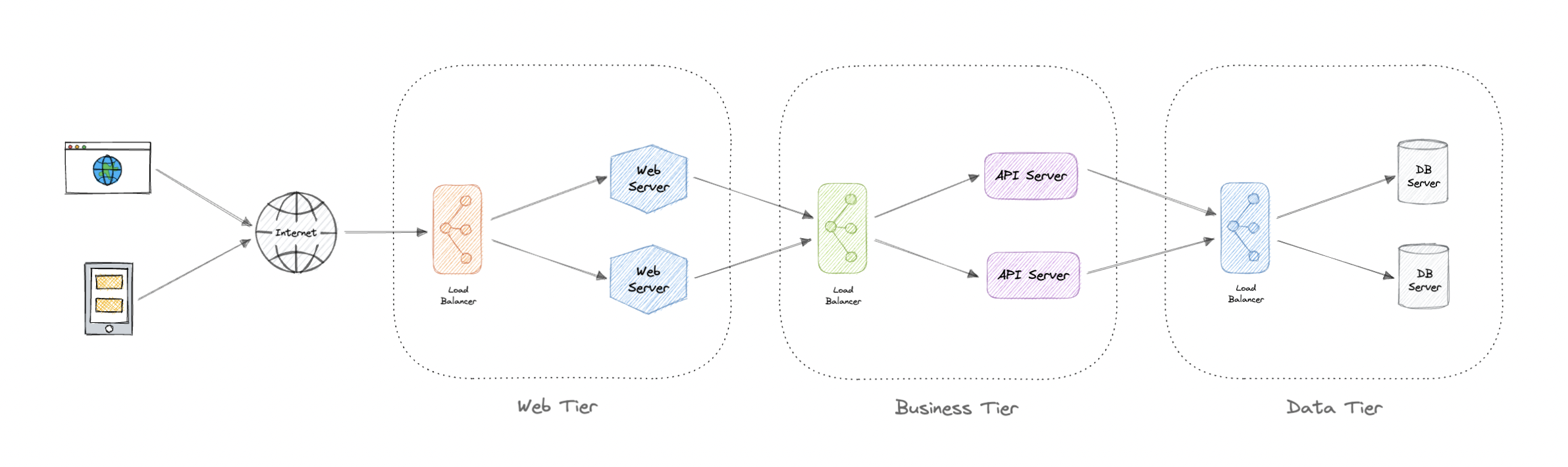
Why tiers exist
- Independent scaling — a read-heavy app can scale the logic tier horizontally behind a load balancer without touching the database.
- Separation of concerns — UI changes don't ripple into data access; each tier is testable and replaceable on its own.
- Security boundaries — the data tier lives in a private network reachable only from the logic tier, never directly from the internet.
Tiers vs layers (a common interview trap)
Layers are a logical separation of code (e.g. packages within one process). Tiers are a physical separation across processes or machines. A single deployable can have three layers and still be one tier.
The trade-off, and where it leads
Each network hop between tiers adds latency and a failure point, so more tiers is not "better". N-tier is the pragmatic starting point; when a single logic tier grows too large to scale or own independently, teams decompose it into microservices — which is N-tier's ideas (separation, independent scaling) taken to a finer grain.
Takeaways
- N-tier = physically separated, single-responsibility tiers; the classic three are presentation / logic / data.
- Buys independent scaling, clean separation, and security boundaries — at the cost of inter-tier latency.
- Layer = logical (code); tier = physical (deployment).
- Microservices are the natural evolution when one logic tier needs finer-grained ownership.
Re-authored for this guide, with concepts and diagrams adapted from Karan Pratap Singh’s System Design (course, MIT licence) and the System Design Primer (CC BY 4.0). Diagrams © their respective authors.
🤖 Don't fully get this? Learn it with Claude
Stuck on N-Tier Architecture? Open Claude, copy a block below, and it'll teach you this exact concept — visually and interactively.
Build the mental picture, not memorization.
I just read a lesson on **N-Tier Architecture** (System Design) and want to truly understand it. Explain N-Tier Architecture from first principles using ONE vivid real-world analogy and a visual mental model — draw it as ASCII art or a clear step-by-step diagram — with a concrete example using real numbers. Then ask me one question to check I got the mental picture, and wait for my reply. If you're unsure or a claim isn't standard, say so and reason from first principles instead of guessing.
Socratic — adapts to where you're stuck.
Teach me **N-Tier Architecture** interactively. Ask me ONE guiding question at a time, wait for my answer, and adapt to my confusion — build the idea with me step by step instead of explaining it all at once. If you're unsure or a claim isn't standard, say so and reason from first principles instead of guessing.
Active recall exposes what you missed.
Quiz me on **N-Tier Architecture** with 5 questions, easy to tricky, ONE at a time. Tell me if each answer is right; at the end, explain clearly what I got wrong and why. If you're unsure or a claim isn't standard, say so and reason from first principles instead of guessing.
Intuition + hook + flashcards for long-term memory.
Help me remember **N-Tier Architecture** for the long term: give the one-sentence intuition, a memorable hook/mnemonic, a tiny worked example, and 3 active-recall flashcards (Q -> A). If you're unsure or a claim isn't standard, say so and reason from first principles instead of guessing.