Designing Twitter's Timeline — Fan-out on Write, Traced
Why Twitter's timeline is a caching problem, not a query problem
Reads dwarf writes: people scroll far more than they tweet. Building each home timeline by querying "all tweets from everyone I follow, sorted by time" at read time would hammer the database for every scroll. The design flips it — precompute each user's timeline when tweets are posted.
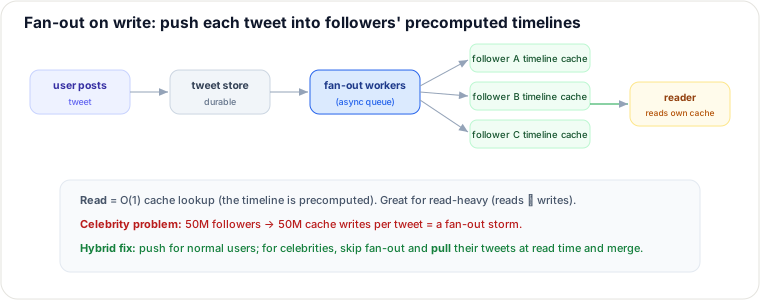
Traced: posting a tweet (fan-out on write)
- Write the tweet to durable storage (returns fast).
- Enqueue a fan-out job (async — the user isn't blocked).
- Workers look up the author's followers and push the tweet id into each follower's timeline cache (e.g. a Redis list per user).
Traced: loading the home timeline
- Read your precomputed timeline cache — O(1), the whole point.
- Merge in tweets from anyone on the pull path (celebrities), sorted by time.
- Hydrate tweet ids → full tweets (from cache/store).
The celebrity problem & the hybrid fix
A user with 50M followers would trigger 50M cache writes per tweet — a fan-out storm that swamps the system and delays everyone. Fix: don't fan-out celebrities. Their followers pull celebrity tweets at read time and merge them in. Push for the many, pull for the few — the hybrid model real systems use.
Back-of-envelope (see Capacity Estimation): ~6K tweets/s with avg ~100s of followers = millions of cache writes/s — which is exactly why fan-out is async and celebrities are excluded.
Pitfalls
- Synchronous fan-out blocks the poster — always async via a queue.
- Unbounded celebrity fan-out → storm; cap with the pull path.
- Cache/store consistency: timeline holds ids; deleted/edited tweets must reflect on hydrate.
Takeaways
- Read-heavy → precompute (fan-out on write); reads become O(1) cache lookups.
- Fan-out is async (message queue); celebrities use fan-out on read — the hybrid.
- This is caching + queues + estimation applied together.
Re-authored for this guide; fan-out diagram hand-authored as SVG. See also: Caching, Messaging System, Capacity Estimation. (Complements the existing "Designing Twitter / Newsfeed" problem pages with a traced flow.)
🤖 Don't fully get this? Learn it with Claude
Stuck on Designing Twitter's Timeline — Fan-out on Write, Traced? Open Claude, copy a block below, and it'll teach you this exact concept — visually and interactively.
Build the mental picture, not memorization.
I just read a lesson on **Designing Twitter's Timeline — Fan-out on Write, Traced** (System Design) and want to truly understand it. Explain Designing Twitter's Timeline — Fan-out on Write, Traced from first principles using ONE vivid real-world analogy and a visual mental model — draw it as ASCII art or a clear step-by-step diagram — with a concrete example using real numbers. Then ask me one question to check I got the mental picture, and wait for my reply. If you're unsure or a claim isn't standard, say so and reason from first principles instead of guessing.
Socratic — adapts to where you're stuck.
Teach me **Designing Twitter's Timeline — Fan-out on Write, Traced** interactively. Ask me ONE guiding question at a time, wait for my answer, and adapt to my confusion — build the idea with me step by step instead of explaining it all at once. If you're unsure or a claim isn't standard, say so and reason from first principles instead of guessing.
Active recall exposes what you missed.
Quiz me on **Designing Twitter's Timeline — Fan-out on Write, Traced** with 5 questions, easy to tricky, ONE at a time. Tell me if each answer is right; at the end, explain clearly what I got wrong and why. If you're unsure or a claim isn't standard, say so and reason from first principles instead of guessing.
Intuition + hook + flashcards for long-term memory.
Help me remember **Designing Twitter's Timeline — Fan-out on Write, Traced** for the long term: give the one-sentence intuition, a memorable hook/mnemonic, a tiny worked example, and 3 active-recall flashcards (Q -> A). If you're unsure or a claim isn't standard, say so and reason from first principles instead of guessing.