Designing YouTube/Netflix — Transcode, CDN & Adaptive Bitrate, Traced
The defining problems: huge files in, smooth playback out, worldwide
Video (YouTube, Netflix) is two systems: an ingest/transcode pipeline that turns one uploaded file into many streamable renditions, and a delivery path that gets bytes to a viewer anywhere with minimal buffering. Both are dominated by one resource: bandwidth.
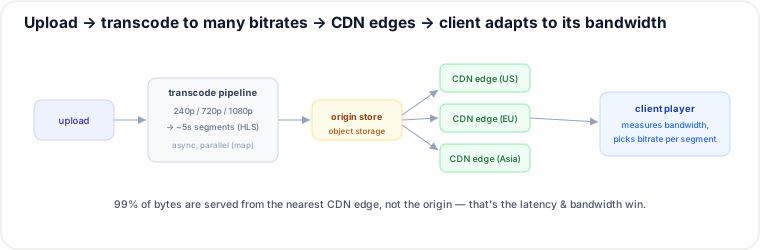
The architecture
- Transcode pipeline: the upload is transcoded into multiple resolutions/bitrates (240p…4K) and cut into short (~2–10s) segments (HLS/DASH). This is embarrassingly parallel — the data-parallel/map pattern across a worker fleet.
- CDN: popular content is pushed to edge servers near users (see CDN). ~99% of bytes are served from the nearest edge, not the origin — the latency and origin-offload win that makes global video viable.
- Adaptive bitrate streaming: the client fetches a manifest, then requests segments; it measures its own bandwidth and picks the next segment's quality — bandwidth drops → step down a rung (blurry beats buffering); recovers → step up.
- Metadata, recommendations, and view-counts are separate read-heavy services (the view counter is its own classic problem).
Traced: hit play
- Player fetches the manifest (list of renditions + segment URLs).
- Starts low for instant playback; fetches segments from the nearest CDN edge.
- Continuously measures throughput → requests the highest bitrate that won't stall → smooth playback, no rebuffer.
The hard parts
- Storage & cost: N renditions × segments × popularity → huge; tier cold content (see hot/warm/cold storage).
- Bandwidth estimation (Capacity Estimation): a single 1080p stream is ~5 Mbps → CDN egress dominates cost.
- Cache strategy at the edge: the long tail of unpopular videos can't all live at every edge.
Takeaways
- Ingest = parallel transcode into multi-bitrate segments; delivery = CDN edges + adaptive bitrate.
- ~99% of bytes come from the nearest edge; the client adapts quality to its bandwidth (blurry > buffering).
- It's a bandwidth/cost problem — estimate egress, tier cold content.
Re-authored for this guide; pipeline diagram hand-authored as SVG. Complements the "Designing YouTube/Netflix" problem page with a traced flow. See also: CDN, Distributed File System, Data Parallelism (transcode), Capacity Estimation (bandwidth).
🤖 Don't fully get this? Learn it with Claude
Stuck on Designing YouTube/Netflix — Transcode, CDN & Adaptive Bitrate, Traced? Open Claude, copy a block below, and it'll teach you this exact concept — visually and interactively.
Build the mental picture, not memorization.
I just read a lesson on **Designing YouTube/Netflix — Transcode, CDN & Adaptive Bitrate, Traced** (System Design) and want to truly understand it. Explain Designing YouTube/Netflix — Transcode, CDN & Adaptive Bitrate, Traced from first principles using ONE vivid real-world analogy and a visual mental model — draw it as ASCII art or a clear step-by-step diagram — with a concrete example using real numbers. Then ask me one question to check I got the mental picture, and wait for my reply. If you're unsure or a claim isn't standard, say so and reason from first principles instead of guessing.
Socratic — adapts to where you're stuck.
Teach me **Designing YouTube/Netflix — Transcode, CDN & Adaptive Bitrate, Traced** interactively. Ask me ONE guiding question at a time, wait for my answer, and adapt to my confusion — build the idea with me step by step instead of explaining it all at once. If you're unsure or a claim isn't standard, say so and reason from first principles instead of guessing.
Active recall exposes what you missed.
Quiz me on **Designing YouTube/Netflix — Transcode, CDN & Adaptive Bitrate, Traced** with 5 questions, easy to tricky, ONE at a time. Tell me if each answer is right; at the end, explain clearly what I got wrong and why. If you're unsure or a claim isn't standard, say so and reason from first principles instead of guessing.
Intuition + hook + flashcards for long-term memory.
Help me remember **Designing YouTube/Netflix — Transcode, CDN & Adaptive Bitrate, Traced** for the long term: give the one-sentence intuition, a memorable hook/mnemonic, a tiny worked example, and 3 active-recall flashcards (Q -> A). If you're unsure or a claim isn't standard, say so and reason from first principles instead of guessing.