Designing Search — The Inverted Index, Traced
Full-text search = the inverted index
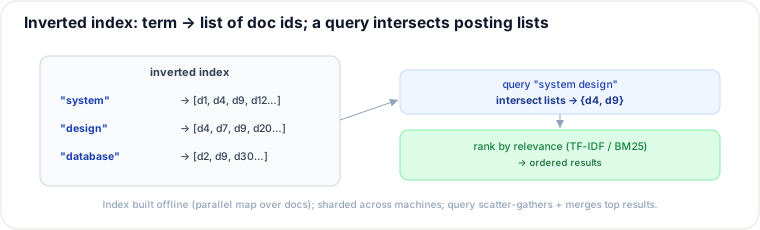
Searching billions of documents for "system design" by scanning each is impossible. Search engines (and Twitter Search, log search, Elasticsearch) precompute an inverted index: for every term, the list of documents that contain it. A query becomes a fast set operation over short lists, not a scan.
The architecture
- Inverted index:
term → posting list(sorted doc ids, often with positions + frequencies). Built offline by a parallel pipeline (map over docs → emit term→doc → group) — the data-parallel pattern again. - Query: look up each term's posting list and intersect them (AND) — the result is docs containing all terms. Intersecting two sorted lists is linear and cache-friendly.
- Ranking: order results by relevance — TF-IDF / BM25 (rare terms + term frequency), plus signals like recency/popularity (PageRank for the web).
- Sharding: split the index across machines — by document (each shard indexes a subset; query scatter-gathers and merges top-K) or by term. Document sharding is the common choice.
Traced: search "system design"
- Tokenize → terms ["system", "design"].
- Fetch each term's posting list; intersect → candidate docs (e.g. {d4, d9}).
- Score candidates with BM25; return the top-K ordered.
- At scale: the query fans out to all shards, each returns its top-K, a coordinator merges (scatter-gather).
The hard parts
- Index size & build: huge; built/updated incrementally; segment merges (LSM-like).
- Ranking quality is the real product; the index is just retrieval.
- Scatter-gather latency = the slowest shard (tail latency!) → hedged requests help.
Takeaways
- Inverted index (term → posting list) turns search into list intersection, not a scan.
- Built offline (parallel), sharded by document; query = intersect → rank (BM25) → scatter-gather merge.
- Tail latency bites scatter-gather; ranking is the hard, valuable part.
Re-authored for this guide; inverted-index diagram hand-authored as SVG. Complements the "Designing Twitter Search" problem page with a traced flow. See also: Data Partitioning/Sharding, Data Parallelism, Tail Latency.
🤖 Don't fully get this? Learn it with Claude
Stuck on Designing Search — The Inverted Index, Traced? Open Claude, copy a block below, and it'll teach you this exact concept — visually and interactively.
Build the mental picture, not memorization.
I just read a lesson on **Designing Search — The Inverted Index, Traced** (System Design) and want to truly understand it. Explain Designing Search — The Inverted Index, Traced from first principles using ONE vivid real-world analogy and a visual mental model — draw it as ASCII art or a clear step-by-step diagram — with a concrete example using real numbers. Then ask me one question to check I got the mental picture, and wait for my reply. If you're unsure or a claim isn't standard, say so and reason from first principles instead of guessing.
Socratic — adapts to where you're stuck.
Teach me **Designing Search — The Inverted Index, Traced** interactively. Ask me ONE guiding question at a time, wait for my answer, and adapt to my confusion — build the idea with me step by step instead of explaining it all at once. If you're unsure or a claim isn't standard, say so and reason from first principles instead of guessing.
Active recall exposes what you missed.
Quiz me on **Designing Search — The Inverted Index, Traced** with 5 questions, easy to tricky, ONE at a time. Tell me if each answer is right; at the end, explain clearly what I got wrong and why. If you're unsure or a claim isn't standard, say so and reason from first principles instead of guessing.
Intuition + hook + flashcards for long-term memory.
Help me remember **Designing Search — The Inverted Index, Traced** for the long term: give the one-sentence intuition, a memorable hook/mnemonic, a tiny worked example, and 3 active-recall flashcards (Q -> A). If you're unsure or a claim isn't standard, say so and reason from first principles instead of guessing.