hard Tracing a Request Against a Latency Budget (SLA)
An SLA is a budget you spend hop-by-hop, not a hope you check afterward
A latency SLA like "p99 < 200ms" is not one number to hit at the end — it is a budget you allocate across every hop a request touches before you build the path. Add each hop's cost as the request crosses it (load balancer, gateway, application logic, cache or database, serialization) and you get a running total against the budget. The moment that running total, plus a safety margin, would exceed the SLA, you know — at design time — which hop has to change: cached, parallelized, or bounded by a timeout. Tracing the budget turns "will this be fast enough?" from a guess into arithmetic.
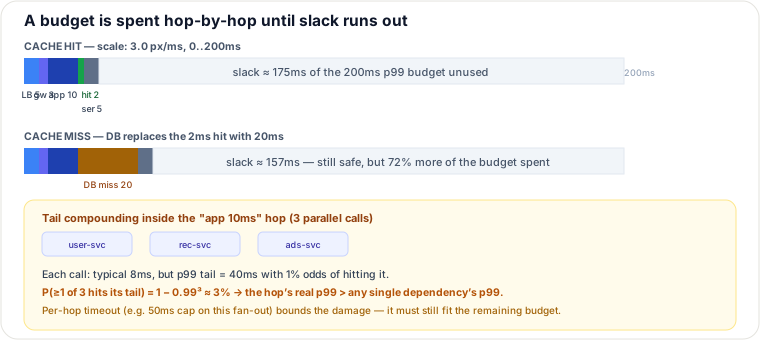
Traced: a 200ms p99 budget for one API read
| Hop | Typical cost | Running total | Remaining budget |
|---|---|---|---|
| Load balancer + TLS termination | 5ms | 5ms | 195ms |
| Gateway (auth check) | 3ms | 8ms | 192ms |
| App logic | 10ms | 18ms | 182ms |
| Cache hit | 2ms | 20ms | 180ms |
| Serialize + egress | 5ms | 25ms | 175ms slack |
On a cache hit, the request spends 25ms of its 200ms budget — 175ms of slack. Swap the cache hit for a cache miss that falls through to the database (20ms instead of 2ms) and the total becomes 5+3+10+20+5 = 43ms, leaving 157ms of slack. Both are comfortably inside the SLA on paper — but the miss path consumes 72% more of the budget than the hit path, which is exactly why cache hit ratio is a first-class capacity number, not an afterthought: it decides how often a request runs "cheap" versus how often it runs "expensive but still legal."
The slack is not free money — tail latency eats it
25ms or 43ms is the typical (mean-ish) path. The SLA is stated at p99, and typical-case sums badly underestimate p99 the moment any hop fans out internally. Say the "app logic" hop actually issues 3 independent calls in parallel — a user-info service, a recommendation service, an ads service — each with a typical latency of 8ms but its own p99 tail of 40ms (a 1% chance of hitting it, from GC pauses, a hot shard, lock contention). Using the fan-out math from tail-latency analysis:
P(≥1 of 3 hits its tail) = 1 − 0.99³ ≈ 3%
So the "app logic" hop's own p99 is worse than any single dependency's p99, purely from fanning out to three of them. Chain a few such hops together (gateway → app → cache/DB → downstream fan-out) and the request's real p99 compounds well past the sum of typical costs — it can approach or blow through the 200ms budget even though every individual hop "looks fine on average." Summing means tells you the best case; the SLA is a promise about the worst 1%.
How the budget forces decisions
- Cache to stay under budget. The 25ms-vs-43ms gap between a cache hit and a cache miss is exactly why the cache-hit-ratio number matters: a low hit ratio means the "expensive" row of the table is the common case, not the exception, so the effective p99 sits close to the miss-path number, not the hit-path number.
- Parallelize independent calls. The 3 downstream calls inside "app logic" have no
dependency on each other, so they must run concurrently: the hop then costs
max(user-svc, rec-svc, ads-svc)≈ 8ms typical, not theirsum≈ 24ms. Running them sequentially would have silently burned 16ms of budget for nothing. - Set per-hop timeouts that sum to less than the SLA. A generous per-hop timeout (say 50ms, to cover the fan-out's own p99 tail) still has to fit inside whatever budget is left when that hop starts — not the full 200ms. If LB+gateway+app-typical have already spent 18ms, the fan-out's timeout must be sized against the remaining ~182ms, and every later hop's timeout against what's left after that.
Pitfalls
- Checking the mean, not the tail. 25ms average against a 200ms budget looks safe; it says nothing about how often the request actually pays the compounding tail from an internal fan-out.
- Sequential calls that could be parallel. Silently converts a
max()hop into asum()hop, burning budget nobody accounted for. - No per-hop timeout. One hung downstream call (a network partition, a stuck lock) can hold the request open far past the SLA instead of failing fast into a fallback.
- Timeout inflation. Setting every hop's timeout close to the full 200ms SLA rather than its allocated share — three sequential hops each timing out at 190ms gives a worst case of 570ms, not 200ms.
- Retries that forget the budget. A retry after a timeout roughly doubles that hop's worst-case cost; the remaining-budget check has to account for the retry, not just the first attempt.
Judgment layer: how to actually allocate the budget
Budget-per-hop (top-down, before or while building) means allocating an SLA slice to each hop up front and designing to fit it — you gain early warning that an architecture is structurally incapable of meeting the SLA (e.g. discovering that 5 sequential service calls can never fit) before it's built. The cost is that the numbers are estimates until real traffic exists, so the allocation itself needs revisiting once measured.
Measure-and-optimize-hotspot (bottom-up) means shipping first, then profiling with real percentile data (the USE method, flame graphs) and fixing whichever hop is actually the biggest contributor to p99. You gain ground truth — you optimize what's really slow, not what you guessed would be slow — but you risk discovering the SLA is unmeetable only after the system is built, when the fix (e.g., turning a sequential chain into a parallel fan-out) is a structural change, not a tuning pass.
In practice: budget top-down during design to catch architectural dead ends early, then replace every estimated number with a measured percentile once the system is live, and re-run the same hop-by-hop trace against real p99s rather than typical-case guesses.
For parallel vs sequential calls specifically: parallelize whenever calls are independent (no data
dependency) — you pay max() instead of sum(), at the cost of harder
error handling (a partial failure now needs a per-call fallback) and a burst of simultaneous load on
several downstreams at once instead of a trickle. Keep calls sequential only when one truly depends
on the previous one's result.
For timeout allocation: a hop's timeout must fit the budget remaining at that point in the chain, not the SLA as a whole — the alternative (no timeout, or a timeout sized to the full SLA on every hop) trades a small amount of implementation complexity (fallback logic, timeout testing) for an unbounded worst case where a single slow dependency can consume the entire request.
Takeaways
- An SLA is a budget: sum each hop's cost against it, with margin, before assuming the design is fast enough.
- Summed typical latencies look safe (25–43ms of a 200ms budget), but tail latency compounds across any internal fan-out (1−0.99³≈3% for 3 parallel calls) — the SLA is a p99 promise, not a mean-latency promise.
- Caching and parallelizing independent calls buy back budget; per-hop timeouts sized to the remaining budget (not the full SLA) turn one slow dependency into a bounded failure instead of an SLA breach.
Re-authored for this guide; budget-waterfall and tail-compounding diagram hand-authored as SVG. Synthesizes the Google SRE Book's error-budget framing and Dean & Barroso, "The Tail at Scale" (CACM 2013). See also: "Tail Latency & Fan-out Amplification," "Performance Engineering — USE Method & Flame Graphs," and the SLI/SLO/SLA error-budget page.
🤖 Don't fully get this? Learn it with Claude
Stuck on Tracing a Request Against a Latency Budget (SLA)? Open Claude, copy a block below, and it'll teach you this exact concept — visually and interactively.
Build the mental picture, not memorization.
I just read a lesson on **Tracing a Request Against a Latency Budget (SLA)** (System Design) and want to truly understand it. Explain Tracing a Request Against a Latency Budget (SLA) from first principles using ONE vivid real-world analogy and a visual mental model — draw it as ASCII art or a clear step-by-step diagram — with a concrete example using real numbers. Then ask me one question to check I got the mental picture, and wait for my reply. If you're unsure or a claim isn't standard, say so and reason from first principles instead of guessing.
Socratic — adapts to where you're stuck.
Teach me **Tracing a Request Against a Latency Budget (SLA)** interactively. Ask me ONE guiding question at a time, wait for my answer, and adapt to my confusion — build the idea with me step by step instead of explaining it all at once. If you're unsure or a claim isn't standard, say so and reason from first principles instead of guessing.
Active recall exposes what you missed.
Quiz me on **Tracing a Request Against a Latency Budget (SLA)** with 5 questions, easy to tricky, ONE at a time. Tell me if each answer is right; at the end, explain clearly what I got wrong and why. If you're unsure or a claim isn't standard, say so and reason from first principles instead of guessing.
Intuition + hook + flashcards for long-term memory.
Help me remember **Tracing a Request Against a Latency Budget (SLA)** for the long term: give the one-sentence intuition, a memorable hook/mnemonic, a tiny worked example, and 3 active-recall flashcards (Q -> A). If you're unsure or a claim isn't standard, say so and reason from first principles instead of guessing.