What is RDBMS
An RDBMS is a storage engine that enforces a fixed schema and the ACID guarantees on top of unreliable hardware by funneling every change through a write-ahead log (WAL) first, holding locks (or MVCC versions) to isolate concurrent transactions, and checking constraints (types, primary/foreign keys) before any row is allowed to become visible — so what you read back is always a state that obeys the rules you declared.
The boilerplate definition ("data in tables with rows and columns, queried with SQL") is true but tells a systems engineer nothing. The interesting question is the one this page answers: by what mechanism does a crash mid-write not corrupt your data, and how does the engine refuse to leave a child row pointing at a parent that does not exist?
The mechanism: WAL + locks + constraints
Take three real tables and walk a single transfer through the engine. Schema (PostgreSQL syntax):
CREATE TABLE accounts (
  id      INT PRIMARY KEY,
  owner   TEXT NOT NULL,
  balance NUMERIC NOT NULL CHECK (balance >= 0)
);

CREATE TABLE transfers (
  id        INT PRIMARY KEY,
  from_acct INT NOT NULL REFERENCES accounts(id),
  to_acct   INT NOT NULL REFERENCES accounts(id),
  amount    NUMERIC NOT NULL
);

INSERT INTO accounts VALUES (1,'Asha',100), (2,'Ravi',0);
Now move 30 from Asha to Ravi. The application sends one transaction; the engine does the following internally — note that nothing the application can see changes until the very end.
A traced transaction, step by step
| # | SQL / engine action | What the engine actually does | Property in play |
|---|---|---|---|
| 1 | BEGIN; | Opens a transaction; assigns a transaction id. No rows touched yet. | — |
| 2 | UPDATE accounts SET balance = balance - 30 WHERE id = 1; | Acquires a row lock on account 1. Writes a redo+undo record to the WAL buffer in memory ("acct 1: 100→70"), then modifies the page in the buffer cache. Re-checks CHECK (balance >= 0): 70 ≥ 0, passes. (The WAL record is buffered in RAM, not yet fsync'd to disk.) | Durability, Consistency |
| 3 | UPDATE accounts SET balance = balance + 30 WHERE id = 2; | Row lock on account 2; WAL record ("acct 2: 0→30"); page modified. Both rows now changed in this transaction's view only. | Isolation |
| 4 | INSERT INTO transfers VALUES (9, 1, 2, 30); | Before the row is accepted, the engine validates the foreign keys: does accounts.id = 1 exist? Yes. = 2? Yes. Both pass, so the insert is logged. | Referential integrity |
| 5 | COMMIT; | Writes a commit record to the WAL and fsyncs it. This single durable write is the atomic switch: the moment it hits disk, all three changes are official; one byte earlier, none of them are. | Atomicity, Durability |
A concurrent reader running SELECT balance FROM accounts between steps 2 and 5 sees 100 and 0 — the pre-transaction state — never 70/0 or 100/30. That "all or nothing" visibility is isolation, and it is enforced by the lock taken in step 2 (or, under MVCC, by the reader being routed to the old row version).
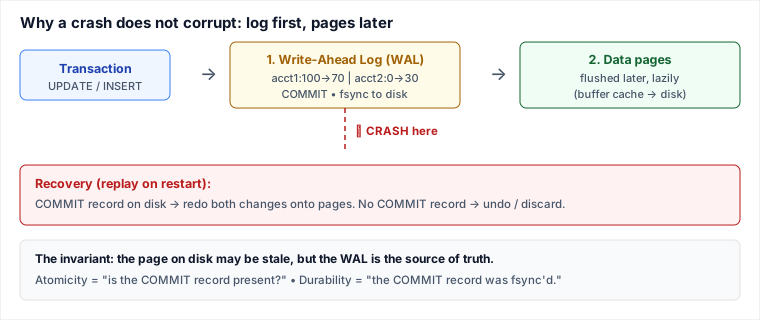
How the four ACID letters map to real machinery
The acronym is useless until you can point at the code path that delivers each letter. Each is a distinct mechanism, not a synonym:
- Atomicity — the single commit record in the WAL. Either it is on disk (all changes count) or it is not (recovery rolls them back via undo records). There is no partial state to observe.
- Consistency — declared constraints (
NOT NULL,CHECK,UNIQUE, foreign keys) re-validated at write time. The transfer'sCHECK (balance >= 0)is what makes an overdraft impossible, not application code that might be skipped. - Isolation — locks or MVCC row versions decide what a concurrent transaction is allowed to see. The isolation level (READ COMMITTED, REPEATABLE READ, SERIALIZABLE) is a dial on how strict this is.
- Durability — the
fsyncof the WAL before COMMIT returns. Once your client gets "COMMIT OK," the data survives a power cut, even though the data pages may not be written for seconds.
Pitfalls
- Treating the foreign key as documentation, not enforcement. If you delete
accounts.id = 1while transfer #9 references it, the engine raises a foreign-key violation — it will not let you orphan the child. Engineers "fix" this by addingON DELETE CASCADEwithout realizing it now silently deletes transfer history. The relationship is enforced on both the insert and the delete side. - Assuming COMMIT means "written to the data file." It means "written to the WAL." The data pages are flushed lazily by a checkpoint. This is why a database can replay hours of WAL on startup after a crash — and why a corrupt or full WAL disk halts writes even though the table files look fine.
- Assuming a SELECT sees the latest committed data. Under the default READ COMMITTED level a long transaction can read a value, and by the time it acts on it another transaction has changed it (a lost update). Wrapping the read-modify-write in
SELECT ... FOR UPDATEor raising the isolation level is what actually serializes it — "it's an RDBMS, so it's safe" is not true by default. - Disabling
fsyncfor speed. Settings like Postgres'sfsync = offor MySQL'sinnodb_flush_log_at_trx_commit = 0make benchmarks fly by breaking durability: a power loss can lose committed transactions. Fast until the data center loses power.
Takeaways
- An RDBMS is not "tables + SQL" — it is a machine that enforces a schema and the ACID guarantees by logging changes before applying them and gating visibility through locks/MVCC.
- The WAL is the heart of the system: atomicity is "is the commit record there?" and durability is "was that record fsync'd?"
- Constraints (PK, FK, CHECK, NOT NULL) are enforced by the engine at write time, which is the whole reason invalid or orphaned data cannot enter — but only if you let the engine enforce them instead of working around them.
- The guarantees have dials (isolation level, fsync, cascade rules). Knowing a relational engine means knowing where those dials sit and what each one trades away.
Sources: C. J. Date, An Introduction to Database Systems, 8th ed. (relational model, integrity); Hellerstein, Stonebraker & Hamilton, Architecture of a Database System (Foundations and Trends in Databases, 2007) for the storage-engine/WAL/transaction-manager structure; Mohan et al., ARIES (ACM TODS, 1992) for write-ahead logging and redo/undo recovery; the PostgreSQL documentation (WAL, fsync, isolation levels) and MySQL InnoDB reference manual (innodb_flush_log_at_trx_commit) for the concrete behaviors traced above. Re-authored/Deepened for this guide — replaced the definition-only catalog and the alt='Image' placeholder with the WAL/constraint mechanism, a traced transfer transaction, and a recovery diagram.
🎯 STRICT STANDOUT: Why / mental model / when-not / worked / failure / hostile panel — What is RDBMS
Why this concept exists (judgment layer)
Tables+SQL is marketing. The systems definition is WAL-before-data, constraint enforcement at write time, and isolation dials — so a crash mid-transfer cannot leave half-moved money and an orphan FK cannot land.
Mental model (install this intuition)
COMMIT = fsync of commit record in WAL (atomicity+durability switch). Constraints = consistency gate. Locks/MVCC = isolation. Data pages flush lazily — pages can be stale; WAL is truth.
Worked example with numbers or traced steps
Asha 100, Ravi 0; transfer 30
UPDATE A -30 → WAL buf '100→70'; page dirty; CHECK ≥0 ok
UPDATE B +30 → WAL '0→30'
INSERT transfer FK check both accounts
COMMIT → WAL commit record + fsync → durable
Crash before fsync: recovery finds no commit → UNDO both
Concurrent SELECT during txn sees 100/0 not 70/0
When NOT to use / named alternative
Do not treat every store as an RDBMS: object stores, KV caches, and append logs trade constraints/transactions for scale or latency. Do not disable fsync for benchmarks then call the system durable. Do not assume default isolation is serializable.
Failure mode & ops fingerprint
Fingerprint: innodb_flush_log_at_trx_commit=0 or fsync=off 'for speed' then power loss loses 'committed' rows; app deletes parent with ON DELETE CASCADE and history vanishes; lost update at READ COMMITTED without SELECT FOR UPDATE.
Hostile-panel drills (defend the decision)
Q1. What single durable write makes a multi-statement transaction atomic?
Model answer: The WAL commit record fsync: present → all effects official; absent → recovery undoes.
Q2. Why can data pages be dirty after COMMIT?
Model answer: NO-FORCE: commit only forces the log; checkpoints flush pages later. Durability is log-based.
Q3. Map C in ACID to mechanisms on this page.
Model answer: Engine CHECK/FK/NOT NULL at write time; app still owns multi-row business invariants inside the transaction.
🤖 Don't fully get this? Learn it with Claude
Stuck on What is RDBMS? Open Claude, copy a block below, and it'll teach you this exact concept — visually and interactively.
Build the mental picture, not memorization.
I just read a lesson on **What is RDBMS** (Databases) and want to truly understand it. Explain What is RDBMS from first principles using ONE vivid real-world analogy and a visual mental model — draw it as ASCII art or a clear step-by-step diagram — with a concrete example using real numbers. Then ask me one question to check I got the mental picture, and wait for my reply. If you're unsure or a claim isn't standard, say so and reason from first principles instead of guessing.
Socratic — adapts to where you're stuck.
Teach me **What is RDBMS** interactively. Ask me ONE guiding question at a time, wait for my answer, and adapt to my confusion — build the idea with me step by step instead of explaining it all at once. If you're unsure or a claim isn't standard, say so and reason from first principles instead of guessing.
Active recall exposes what you missed.
Quiz me on **What is RDBMS** with 5 questions, easy to tricky, ONE at a time. Tell me if each answer is right; at the end, explain clearly what I got wrong and why. If you're unsure or a claim isn't standard, say so and reason from first principles instead of guessing.
Intuition + hook + flashcards for long-term memory.
Help me remember **What is RDBMS** for the long term: give the one-sentence intuition, a memorable hook/mnemonic, a tiny worked example, and 3 active-recall flashcards (Q -> A). If you're unsure or a claim isn't standard, say so and reason from first principles instead of guessing.