ORDER BY Clause
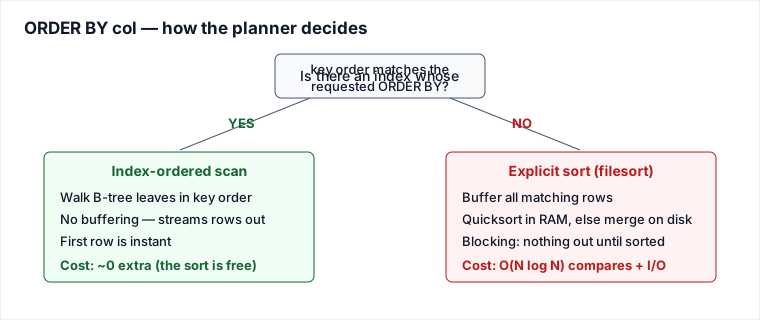
ORDER BY does not magically return rows in order — after the rest of the query produces an unordered bag of rows, the engine either reads them through an index that already stores keys in sorted order (no work), or it buffers the rows and runs a comparison sort (an explicit, costed operator) before handing them to the client.
The two ways the engine can satisfy a sort
This is the single most important thing to understand about ORDER BY: it is a request for an ordering of the output, not an instruction to run a sort. The planner has two strategies, and which one it picks decides whether your query is free or expensive.
- Index-ordered scan (free sort). A B-tree index stores its keys already sorted. If you
ORDER BYa column with a matching index, the engine can walk the index leaf pages in order and emit rows as it goes. No buffering, no sort step, and the first row can be returned immediately. - Explicit sort (filesort). If there is no usable index for the requested order, the engine must collect the qualifying rows into memory (spilling to disk if they do not fit) and run a comparison sort — typically quicksort in RAM, or an external merge sort on disk. MySQL calls this a filesort in
EXPLAIN; PostgreSQL shows it as aSortnode with aSort Methodofquicksortorexternal merge.
Worked example: tracing ORDER BY Age ASC
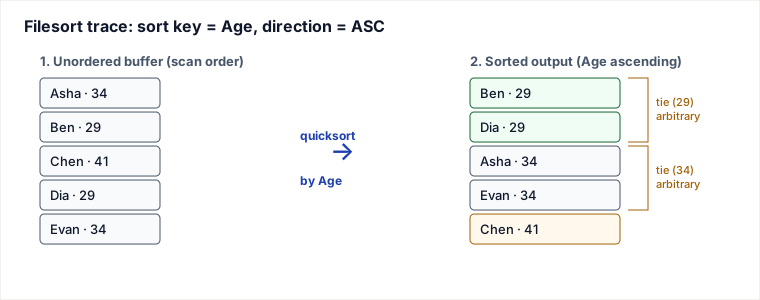
Start with an Employee table holding five rows, in the physical order they were inserted (this is the unordered bag the engine starts from):
| id | Name | Age |
|---|---|---|
| 1 | Asha | 34 |
| 2 | Ben | 29 |
| 3 | Chen | 41 |
| 4 | Dia | 29 |
| 5 | Evan | 34 |
We run:
SELECT id, Name, Age
FROM Employee
ORDER BY Age ASC;
With no index on Age, the engine performs a filesort. Walk it step by step:
- Scan the table heap, collecting all five
(id, Name, Age)tuples into a sort buffer. - Sort the buffer by the key
Ageusing a comparison sort. With 5 rows that is a single in-RAM quicksort; the comparator returns the smallerAgefirst because the direction isASC. - Resolve ties. Ben(29) and Dia(29) compare equal; Asha(34) and Evan(34) compare equal. The sort is free to place either tie member first — see the determinism pitfall below.
- Emit the sorted buffer to the client.
One valid result (ascending by Age, ties in arbitrary order):
| id | Name | Age |
|---|---|---|
| 2 | Ben | 29 |
| 4 | Dia | 29 |
| 1 | Asha | 34 |
| 5 | Evan | 34 |
| 3 | Chen | 41 |
Now add CREATE INDEX idx_age ON Employee(Age);. The same query no longer sorts: the engine walks idx_age from its smallest leaf entry upward, and for each index entry fetches the row. The output ordering is produced by the traversal path, not by a sort operator — the planner has eliminated step 2 entirely.
The Top-N optimization
The combination ORDER BY ... LIMIT k does not require fully sorting all N rows. The engine keeps a bounded priority structure of size k (a binary heap) and streams the input through it: each incoming row is compared against the current worst element in the heap, kept only if better, evicting the worst. This is the Top-N heapsort — MySQL prints Using filesort but internally uses a priority queue; PostgreSQL prints Sort Method: top-N heapsort. The cost drops from O(N log N) to O(N log k), and memory from O(N) to O(k). So ORDER BY created_at DESC LIMIT 10 over a billion rows can run in a few MB of RAM — but only because of the LIMIT. Drop the LIMIT and you are back to a full sort.
Pitfalls
- Assuming ties have a stable order. When sort keys are equal, SQL gives no guarantee about the relative order of the tied rows, and it can change between runs, after an index is added, or when the optimizer picks a parallel plan. Ben/Dia (both 29) above could swap on the next execution. Fix: add a unique tiebreaker —
ORDER BY Age ASC, id ASC— whenever the order must be deterministic, especially for paginatedLIMIT/OFFSETqueries where a non-deterministic tie causes rows to be skipped or duplicated across pages. - Relying on a default order without
ORDER BY. A query with noORDER BYmay appear sorted (because rows came back in insertion or index order) but is formally unordered; any plan change silently breaks it. If you need order, say so. - Sorting blocks the pipeline. An explicit sort is a blocking operator: it cannot emit its first row until it has consumed and sorted its entire input. So
ORDER BY non_indexed_col LIMIT 1without the Top-N path still reads and sorts the whole table. WatchEXPLAINforfilesort/Sorton hot queries. - Spilling to disk. If the sort set exceeds the working-memory budget (
sort_buffer_sizein MySQL,work_memin PostgreSQL), the engine switches from in-RAM quicksort to an external merge sort that writes runs to temp files — orders of magnitude slower.EXPLAIN ANALYZEshowingSort Method: external merge Disk: 240MBis the smoking gun; either raise the budget or add an index. - Collation, not byte order. Text sorting follows the column's collation, not raw byte values. Under
utf8mb4_0900_ai_ci'apple' < 'Banana', but under a binary collation 'B' (0x42) < 'a' (0x61), so 'Banana' sorts first. A query that orders names differently across two databases is almost always a collation mismatch, not a bug in your SQL. - NULL placement is dialect-dependent. Where NULLs land depends on the engine: PostgreSQL puts NULLs last for
ASC, MySQL puts them first. Be explicit withORDER BY col ASC NULLS LAST(PostgreSQL/Oracle/standard) rather than trusting the default.
Takeaways
ORDER BYis satisfied two ways: walk a matching index (free, streaming) or buffer-and-sort (filesort, O(N log N), blocking). CheckEXPLAINto know which you got.- An index whose key order matches the
ORDER BYturns the sort into a no-op — the single biggest win for ordered queries. ORDER BY ... LIMIT ktriggers a Top-N heapsort: O(N log k) time, O(k) memory. TheLIMITis what makes it cheap.- Equal keys have undefined order — add a unique tiebreaker column for any deterministic or paginated result, and be explicit about
NULLS FIRST/LASTand collation.
Sources: ISO/IEC 9075 SQL standard (sort specification and NULL ordering rules); PostgreSQL documentation — "ORDER BY", "Sorting Rows", and EXPLAIN sort methods (quicksort / top-N heapsort / external merge); MySQL 8.0 Reference Manual — "ORDER BY Optimization", filesort, and the LIMIT priority-queue optimization; Hellerstein, Stonebraker & Hamilton, Architecture of a Database System
(sort and external merge operators). Re-authored and deepened for this guide to add the sort-vs-index mechanism, a traced filesort example, Top-N optimization, collation, NULL ordering, and tie-determinism — replacing the syntax-only original and its placeholder images.
🎯 STRICT STANDOUT: Why / worked / when-not / failure / drills — ORDER BY Clause
Why this concept exists (judgment chain)
ORDER BY requests an ordered result, not necessarily a sort operator. Planners walk a matching B-tree (streaming, free) or buffer-and-sort (filesort/external merge). LIMIT k enables Top-N heapsort O(N log k). Ties, NULL placement, and collation are the interview traps.
Worked example with numbers or traced steps
Ages: Asha34, Ben29, Chen41, Dia29, Evan34. ORDER BY Age ASC without index → filesort.
Possible emit: Ben,Dia,Asha,Evan,Chen — ties 29 and 34 arbitrary.
With INDEX(Age): index-ordered scan, no Sort node.
ORDER BY Age LIMIT 2 → Top-N heap size 2, not full sort of N.
ORDER BY Age, id → deterministic pagination; without id, page2 can skip/dupe ties.
NULL: PG ASC → NULLS LAST default; MySQL ASC → NULLs first — be explicit.
When NOT to use / named alternative
Skip ORDER BY when the consumer truly is set-oriented (hash join input, aggregate). Do not add a sort-only index for rare admin queries on small tables — cost of index maintenance may dominate. Prefer keyset pagination over large OFFSET when order is stable.
Failure / ops fingerprint
EXPLAIN ANALYZE: Sort Method external merge Disk: hundreds of MB → work_mem/sort_buffer too small. Pagination bugs: missing rows across pages when ties lack unique order. Cross-DB sort differences from collation. Ops: alert on filesort ratio for hot endpoints.
Hostile-panel Q&As (model answers)
Q1. Two strategies for ORDER BY?
Model answer: Index-ordered scan vs explicit sort (quicksort/external merge). LIMIT may switch to top-N heapsort.
Q2. Why add id as tiebreaker?
Model answer: Equal sort keys have undefined relative order; unique total order is required for stable LIMIT/OFFSET pages.
Q3. Does ORDER BY col LIMIT 1 always avoid full work?
Model answer: Top-N helps, but without a supporting index you still scan all qualifying rows to fill the heap of size 1.
🤖 Don't fully get this? Learn it with Claude
Stuck on ORDER BY Clause? Open Claude, copy a block below, and it'll teach you this exact concept — visually and interactively.
Build the mental picture, not memorization.
I just read a lesson on **ORDER BY Clause** (Databases) and want to truly understand it. Explain ORDER BY Clause from first principles using ONE vivid real-world analogy and a visual mental model — draw it as ASCII art or a clear step-by-step diagram — with a concrete example using real numbers. Then ask me one question to check I got the mental picture, and wait for my reply. If you're unsure or a claim isn't standard, say so and reason from first principles instead of guessing.
Socratic — adapts to where you're stuck.
Teach me **ORDER BY Clause** interactively. Ask me ONE guiding question at a time, wait for my answer, and adapt to my confusion — build the idea with me step by step instead of explaining it all at once. If you're unsure or a claim isn't standard, say so and reason from first principles instead of guessing.
Active recall exposes what you missed.
Quiz me on **ORDER BY Clause** with 5 questions, easy to tricky, ONE at a time. Tell me if each answer is right; at the end, explain clearly what I got wrong and why. If you're unsure or a claim isn't standard, say so and reason from first principles instead of guessing.
Intuition + hook + flashcards for long-term memory.
Help me remember **ORDER BY Clause** for the long term: give the one-sentence intuition, a memorable hook/mnemonic, a tiny worked example, and 3 active-recall flashcards (Q -> A). If you're unsure or a claim isn't standard, say so and reason from first principles instead of guessing.