LEFT OUTER JOIN
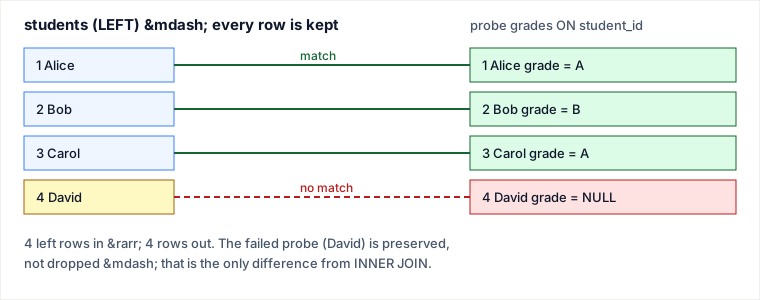
A LEFT OUTER JOIN walks every row of the left table and, for each one, scans the right table for rows that satisfy the ON predicate: matches produce one combined row each, and a left row that finds no match still survives — the engine emits it once with every right-side column set to NULL. The mechanism is "preserve all left rows, fill the right side with NULL when the join fails," which is exactly why a LEFT JOIN can never return fewer rows than the left table has.
Worked example, with real values
Two tables. students is the left table (we want to keep all of them); grades is the right table and is deliberately missing a row for David.
students (left)
| student_id | student_name |
|---|---|
| 1 | Alice |
| 2 | Bob |
| 3 | Carol |
| 4 | David |
grades (right)
| student_id | grade |
|---|---|
| 1 | A |
| 2 | B |
| 3 | A |
SELECT s.student_id, s.student_name, g.grade
FROM students s
LEFT JOIN grades g ON s.student_id = g.student_id;
Row-by-row trace
The engine iterates the left table top to bottom. For each left row it probes grades for g.student_id = s.student_id:
- Alice (id 1) → probe finds grade
A→ emit(1, Alice, A). - Bob (id 2) → probe finds grade
B→ emit(2, Bob, B). - Carol (id 3) → probe finds grade
A→ emit(3, Carol, A). - David (id 4) → probe finds nothing. The left row is preserved anyway, right columns become NULL → emit
(4, David, NULL).
Result — 4 left rows in, 4 rows out:
| student_id | student_name | grade |
|---|---|---|
| 1 | Alice | A |
| 2 | Bob | B |
| 3 | Carol | A |
| 4 | David | NULL |
That single NULL row is the whole point of OUTER: an INNER JOIN would have dropped David entirely.
The anti-join idiom: "rows in LEFT with no match in RIGHT"
The classic reason to reach for LEFT JOIN isn't to list everyone — it's to find the unmatched left rows. After the join, the NULL-filled rows are exactly the ones that failed to match, so filter for them:
-- students who have NO grade row
SELECT s.student_id, s.student_name
FROM students s
LEFT JOIN grades g ON s.student_id = g.student_id
WHERE g.student_id IS NULL;   -- keeps only the NULL-filled (unmatched) rows
Against the data above this returns exactly (4, David). This is the set-difference / "find orphans" pattern: missing receipts, users with no orders, child rows whose parent was deleted. Test the IS NULL on a right-side column that can never legitimately be NULL in a real match — the join key is ideal.
Pitfalls
1. Filtering the right table in WHERE silently turns it into an INNER JOIN
This is the single most common LEFT JOIN bug. A predicate on a right-side column placed in WHERE runs after the join. For David, g.grade is NULL, and NULL = 'A' (or any comparison) evaluates to unknown, so the row is discarded — quietly converting your outer join back into an inner one.
-- WRONG: David vanishes; this is now effectively an INNER JOIN
SELECT s.student_name, g.grade
FROM students s
LEFT JOIN grades g ON s.student_id = g.student_id
WHERE g.grade = 'A';

-- RIGHT: move the right-table condition into the ON clause
SELECT s.student_name, g.grade
FROM students s
LEFT JOIN grades g ON s.student_id = g.student_id
                  AND g.grade = 'A';   -- non-matches still preserved, grade = NULL
Why the naive version is wrong: conditions in ON decide what counts as a match (unmatched left rows are still kept with NULLs); conditions in WHERE filter the already-joined result and will delete the NULL rows. Rule of thumb: a condition on the preserved (left) table can go in WHERE, but a condition on the optional (right) table almost always belongs in ON — unless you genuinely intend an inner join.
2. NULL means "absent", not "zero" or "empty"
The NULL in David's row didn't come from the data — it was manufactured by the join. Downstream code must handle it: g.grade = 'F' won't catch it (use g.grade IS NULL), and you often want COALESCE(g.grade, 'ungraded') for display. Two manufactured NULLs are also never "equal" to each other.
3. Aggregates count NULLs differently
COUNT(*) counts David's row (it exists); COUNT(g.grade) ignores it because COUNT(column) skips NULLs. SUM and AVG over a right-side column also skip the NULL rows. Mixing these up makes "average grade per student" silently exclude ungraded students from the denominator.
4. A duplicate right row multiplies left rows
LEFT JOIN does not guarantee one output row per left row — it guarantees at least one. If grades had two rows for Bob, Bob appears twice in the result. Row-count preservation only holds when the right side is unique on the join key.
Takeaways
- Mechanism: keep every left row; for left rows with no match, emit them once with right-side columns set to NULL. Output rows ≥ left rows, always.
- Anti-join:
LEFT JOIN ... WHERE right.key IS NULLreturns exactly the left rows with no match — the canonical "find orphans / set difference" query. - The ON-vs-WHERE trap: a filter on a right-side column in
WHEREkills the NULL rows and degrades your LEFT JOIN into an INNER JOIN. Put right-table conditions inON. - NULL is synthetic here: it signals "no match," not a real value — guard with
IS NULL/COALESCE, and remember aggregates and equality treat it specially.
Re-authored and deepened for this guide. Sources: ISO/IEC 9075 SQL standard (outer-join semantics and the ON-vs-WHERE evaluation order); PostgreSQL documentation, "Table Expressions — Joined Tables"; SQL and Relational Theory by C. J. Date (NULL three-valued logic and join behaviour); and the widely-used LEFT JOIN ... IS NULL anti-join idiom documented in the PostgreSQL and MySQL manuals. The original page gave a correct definition and the David→NULL insight; this version adds a textual row-by-row trace, a mechanism diagram, the anti-join idiom, the WHERE-vs-ON inner-join trap, and NULL-semantics pitfalls.
🎯 STRICT STANDOUT: Why / worked / when-not / failure / drills — LEFT OUTER JOIN
Why this concept exists (judgment chain)
LEFT JOIN preserves every left row and NULL-pads right columns on failed probes. That mechanism enables anti-join (WHERE right.key IS NULL) and is destroyed when right-side predicates move to WHERE (silent INNER). Output cardinality is ≥ left only if the right key is unique per match.
Worked example with numbers or traced steps
students Alice,Bob,Carol,David; grades only for 1–3.
LEFT JOIN → David grade NULL (4 out).
Anti-join WHERE g.student_id IS NULL → David only.
WHERE g.grade='A' after LEFT → David dropped (NULL='A' UNKNOWN) → effectively INNER.
ON … AND g.grade='A' keeps David with NULL grade.
Two grade rows for Bob → Bob duplicated (fan-out).
COUNT(*) includes David; COUNT(g.grade) excludes him.
When NOT to use / named alternative
Use INNER JOIN when unmatched left rows are never wanted. Prefer NOT EXISTS for anti-join when you only need existence and want to avoid fan-out from duplicate right keys. FULL OUTER is for true bilateral orphans — rarer and often better as two anti-joins unioned.
Failure / ops fingerprint
Report silently loses "no activity" users after a WHERE filter on the optional side. Inflated sums after one-to-many LEFT JOIN without pre-aggregation. Ops: row-count assertions left_rows ≤ result_rows; audit queries that filter right columns in WHERE after LEFT JOIN.
Hostile-panel Q&As (model answers)
Q1. ON vs WHERE for right-table filters?
Model answer: ON decides match; failed matches still emit NULL-padded left rows. WHERE filters after join and deletes those NULL pads.
Q2. Classic anti-join shape?
Model answer: LEFT JOIN … WHERE right.pk IS NULL (test a non-nullable right key).
Q3. Does LEFT JOIN guarantee one output row per left row?
Model answer: No — at least one; multiples if multiple right matches.
🤖 Don't fully get this? Learn it with Claude
Stuck on LEFT OUTER JOIN? Open Claude, copy a block below, and it'll teach you this exact concept — visually and interactively.
Build the mental picture, not memorization.
I just read a lesson on **LEFT OUTER JOIN** (Databases) and want to truly understand it. Explain LEFT OUTER JOIN from first principles using ONE vivid real-world analogy and a visual mental model — draw it as ASCII art or a clear step-by-step diagram — with a concrete example using real numbers. Then ask me one question to check I got the mental picture, and wait for my reply. If you're unsure or a claim isn't standard, say so and reason from first principles instead of guessing.
Socratic — adapts to where you're stuck.
Teach me **LEFT OUTER JOIN** interactively. Ask me ONE guiding question at a time, wait for my answer, and adapt to my confusion — build the idea with me step by step instead of explaining it all at once. If you're unsure or a claim isn't standard, say so and reason from first principles instead of guessing.
Active recall exposes what you missed.
Quiz me on **LEFT OUTER JOIN** with 5 questions, easy to tricky, ONE at a time. Tell me if each answer is right; at the end, explain clearly what I got wrong and why. If you're unsure or a claim isn't standard, say so and reason from first principles instead of guessing.
Intuition + hook + flashcards for long-term memory.
Help me remember **LEFT OUTER JOIN** for the long term: give the one-sentence intuition, a memorable hook/mnemonic, a tiny worked example, and 3 active-recall flashcards (Q -> A). If you're unsure or a claim isn't standard, say so and reason from first principles instead of guessing.