Queue Implementation in Different Languages
A queue enforces FIFO ordering by exposing only two mutation points — insert at the tail, remove from the head — and every language's "built-in queue" is really the same underlying mechanism (a resizable circular buffer, or a doubly linked list) wrapped behind that narrow interface so both operations stay O(1) instead of degrading into O(n) array shifting.
Recognize the pattern
- Problem talks about processing items in the order they arrived — scheduling, BFS frontier, task buffering, rate limiting, producer/consumer.
- You need fast insert-at-one-end / remove-at-other-end, and you do NOT need random access to the middle.
- You're tempted to reach for a plain array/list and call
remove(0)orpop(0)repeatedly — that's the tell you need a real queue, not an array.
Brute force vs optimal
Brute force: a plain dynamic array (Python list, Java ArrayList) where dequeue = remove(0). Every removal must shift all remaining elements left by one slot to keep the array contiguous, costing O(n) per dequeue and O(n²) for n operations.
Optimal: a circular buffer (ring buffer) with head/tail indices that wrap modulo capacity, or a doubly linked list with head/tail references. Both give O(1) enqueue and O(1) dequeue because no shifting is ever needed — pointers move instead of elements.
Complexity, derived
Array-shift queue: dequeuing the front element touches every one of the remaining k elements to slide them down, so n sequential dequeues do 0+1+2+…+(n-1) = n(n-1)/2 element moves → O(n²) total, O(1) space beyond the array.
Circular buffer: enqueue writes to buf[tail] then does tail = (tail+1) % capacity — a fixed number of arithmetic ops regardless of how full the buffer is. Dequeue reads buf[head] then head = (head+1) % capacity. Both are O(1) time, and when the buffer fills it doubles (amortized O(1) per op, same argument as dynamic-array growth: total copy work across n inserts is n+n/2+n/4+… < 2n). Space is O(n) for n stored elements, with occasional O(n) transient copy during a resize.
Linked-list queue: O(1) time per op (pure pointer relinking), O(n) space plus one extra pointer per node overhead — no resize ever needed, but worse cache locality than the array version.
Language cheat-sheet
| Language | Built-in API | Underlying structure |
|---|---|---|
| Java | java.util.ArrayDeque (implements Queue) | resizable circular array |
| Python | collections.deque | doubly linked list of fixed-size blocks |
| C++ | std::queue | wraps std::deque by default (chunked array) |
| JavaScript | none native — Array misused | push/shift; shift() is O(n)! |
| C# | System.Collections.Generic.Queue<T> | resizable circular array |
| Go | none native — slice misused | append + re-slicing; naive front-pop is O(n) |
Note the source table's claim that Java's queue API is java.util.Queue and Python's is queue.Queue is misleading for algorithm work: Queue is an interface (use ArrayDeque as the implementation), and queue.Queue is a thread-safe, lock-based queue meant for cross-thread producer/consumer pipelines — for plain single-threaded FIFO use collections.deque, which is what interview code should use.
Worked example: circular buffer trace
Capacity 4 buffer, enqueue 10, 20, 30, dequeue, enqueue 40, 50 (triggers growth). This trace picks one concrete resolution of the full-vs-empty ambiguity flagged in Pitfalls below: it always leaves one slot empty, defining full as size == capacity − 1 (size = count of live elements). That guarantees head == tail can only ever mean empty, never full, so no separate counter is needed — the trade-off is one wasted slot per buffer.
| Step | Op | head | tail | size | buffer (‑ = empty) |
|---|---|---|---|---|---|
| 0 | init | 0 | 0 | 0 | [‑,‑,‑,‑] |
| 1 | enqueue 10 | 0 | 1 | 1 | [10,‑,‑,‑] |
| 2 | enqueue 20 | 0 | 2 | 2 | [10,20,‑,‑] |
| 3 | enqueue 30 | 0 | 3 | 3 | [10,20,30,‑] |
| 4 | dequeue → 10 | 1 | 3 | 2 | [‑,20,30,‑] |
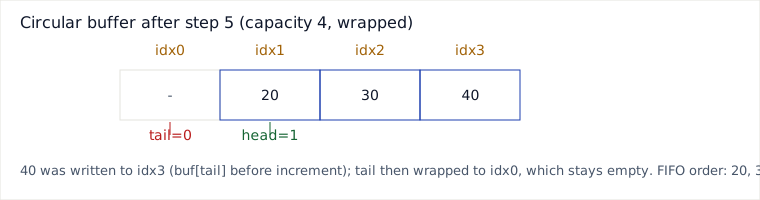
| 5 | enqueue 40: write buf[tail=3]=40, then tail=(3+1)%4=0 | 1 | 0 | 3 | [‑,20,30,40] |
| 6 | enqueue 50: size(3) == capacity−1(3) → full by convention, so resize to cap 8 first (copy logical order head→tail: 20,30,40), then write 50 | 0 | 4 | 4 | [20,30,40,50,‑,‑,‑,‑] |
Step 5 is the one to check by hand: tail was 3 going in, so 40 is written to index 3 — not index 0. Index 0 only becomes the write target after tail wraps; it stays empty until the next enqueue lands there (which step 6's resize preempts).
Java (ArrayDeque as Queue)
import java.util.ArrayDeque;
import java.util.Queue;

Queue<Integer> q = new ArrayDeque<>();
q.offer(10);
q.offer(20);
int front = q.poll();   // 10, removes it
int peek = q.peek();    // 20, does not remove
boolean empty = q.isEmpty();
Python (collections.deque)
from collections import deque
q = deque()
q.append(10)
q.append(20)
front = q.popleft()   # 10
peek = q[0]           # 20
empty = len(q) == 0
Pitfalls
- Using
java.util.LinkedListas a queue works but has worse cache locality and more allocation thanArrayDeque; preferArrayDequeunless you specifically need aListtoo. - In JavaScript,
array.shift()and in Python plain-listlist.pop(0)are O(n) — silently turning an intended O(1) queue op into O(n) and an algorithm's overall complexity from O(n) to O(n²) — a BFS over V vertices degrades to Θ(V²) from queue shifts alone, since each of the V pops can move O(V) elements. - In Go, popping the front of a slice via
s = s[1:]leaks the underlying backing array (memory never freed) unless you periodically reslice/copy; for hot paths usecontainer/listor a manual ring buffer. - Confusing Python's
queue.Queue(thread-safe, blocking, for concurrency) withcollections.deque(plain FIFO) — using the former in single-threaded code pays needless locking overhead. - Forgetting that a fixed-capacity circular buffer must distinguish "empty" from "full" when head==tail — typically solved either by tracking a separate size counter (allows the buffer to fill completely) or by never letting the buffer fill completely (the convention used in the worked example above: full = size == capacity−1). Pick one and apply it consistently — mixing the two is a classic off-by-one source.
When to use / when not
Use a queue when order-of-arrival processing matters and you never need to touch the middle: BFS traversal frontiers, task scheduling, sliding-window algorithms, producer-consumer buffers. Trade-off vs a Deque (double-ended queue): a deque is a strict superset — it supports push/pop at both ends in O(1), so most languages' "queue" is literally a deque used one-ended; reach for the plain queue interface only when you want to statically forbid front-insertion/back-removal for code clarity. Trade-off vs a Stack (LIFO): pick a stack instead when the most-recently-added item should be processed first (DFS, backtracking, expression evaluation) — same O(1) operations, opposite ordering guarantee, and swapping one for the other is a common bug source when translating BFS↔DFS code.
Takeaways
- A queue is an interface contract (FIFO, insert-tail/remove-head); circular buffer and linked list are the two mechanisms that deliver O(1) enqueue/dequeue.
- Array-with-shift is the brute-force trap: O(n) per dequeue, O(n²) overall — avoid
shift()/pop(0)in hot loops. - A circular buffer's wrapped write always lands at the pre-increment
tailindex, not the post-increment one — tracebuf[tail]thentail=(tail+1)%capacityin that order, and pick one full-vs-empty convention (size counter, or reserve one slot) and state it, since head==tail is ambiguous otherwise. - Prefer language-specific real queue types: Java
ArrayDeque, Pythoncollections.deque, C++std::queue/std::deque— not raw arrays, and not Python's thread-safequeue.Queuefor single-threaded code.
Recall
Why does removing from the front of a plain dynamic array cost O(n), and what single change (structure or index scheme) brings it down to O(1)?
Compiled from standard queue ADT theory (CLRS, Ch. 10) and language documentation (java.util.ArrayDeque, Python collections.deque, C++ std::queue) — not from the source page's language-comparison table alone.
🤖 Don't fully get this? Learn it with Claude
Stuck on Queue Implementation in Different Languages? Open Claude, copy a block below, and it'll teach you this exact concept — visually and interactively.
Build the mental picture, not memorization.
I just read a lesson on **Queue Implementation in Different Languages** (DSA) and want to truly understand it. Explain Queue Implementation in Different Languages from first principles using ONE vivid real-world analogy and a visual mental model — draw it as ASCII art or a clear step-by-step diagram — with a concrete example using real numbers. Then ask me one question to check I got the mental picture, and wait for my reply. If you're unsure or a claim isn't standard, say so and reason from first principles instead of guessing.
Socratic — adapts to where you're stuck.
Teach me **Queue Implementation in Different Languages** interactively. Ask me ONE guiding question at a time, wait for my answer, and adapt to my confusion — build the idea with me step by step instead of explaining it all at once. If you're unsure or a claim isn't standard, say so and reason from first principles instead of guessing.
Active recall exposes what you missed.
Quiz me on **Queue Implementation in Different Languages** with 5 questions, easy to tricky, ONE at a time. Tell me if each answer is right; at the end, explain clearly what I got wrong and why. If you're unsure or a claim isn't standard, say so and reason from first principles instead of guessing.
Intuition + hook + flashcards for long-term memory.
Help me remember **Queue Implementation in Different Languages** for the long term: give the one-sentence intuition, a memorable hook/mnemonic, a tiny worked example, and 3 active-recall flashcards (Q -> A). If you're unsure or a claim isn't standard, say so and reason from first principles instead of guessing.