Applications and Advanced Concepts
Every real queue application — router buffers, print spoolers, BFS frontiers, message brokers — works because a queue enforces one guarantee: elements leave in the exact order they arrived, and that ordering can be maintained in O(1) per operation using either a circular array (fixed capacity, wrap-around indices) or a doubly-linked list (unbounded, pointer relinking). The advanced patterns built on top of plain FIFO — circular buffers, blocking/producer-consumer queues, and monotonic deques — all reuse this same insight: never shift existing elements, only move the head/tail pointers.
Recognize the pattern
- The problem talks about arrival order, level-by-level processing, or rate mismatch between a producer and a consumer.
- You need O(1) access to 'the oldest thing still relevant' (BFS frontier, cache eviction, streaming buffer).
- A sliding-window problem asks for the max/min/first-qualifying element as the window slides — that is a signal for a monotonic deque, not a naive rescan.
- Multiple threads/processes hand off work at different speeds — signal for a blocking queue.
Brute force vs optimal — sliding window maximum
Given an array and window size k, find the max of every window of size k.
Brute force: for each of the (n-k+1) windows, scan k elements to find the max → O(n·k) time, O(1) extra space.
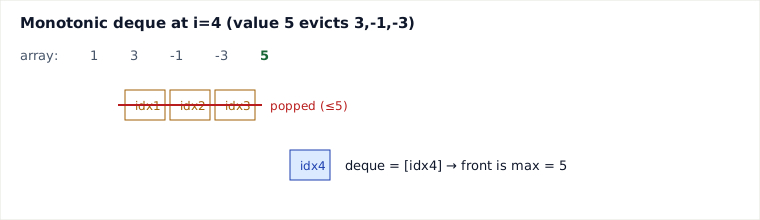
Optimal (monotonic deque): maintain a deque of indices whose values are in decreasing order. For each new index i: pop from the back while the value there is ≤ the new value (it can never be the max again while the new one is in range); push i; pop from the front if it has fallen out of the window. The front is always the current window's max. O(n) time, O(k) space.
Complexity, derived
Time: each index is pushed onto the deque exactly once and popped at most once (from either end), across the whole run. That is 2n deque operations total for n elements, each O(1) (array-backed deque, no shifting) → total work is O(n), not O(n·k). The brute force redoes a k-length scan at every one of the (n-k+1) positions, giving Θ((n-k+1)·k) ≈ O(n·k).
Space: the deque holds at most k indices at any time (older, dominated ones are evicted) → O(k) auxiliary space, plus O(n-k+1) for the output. Degenerate-k sanity checks: k=1 makes the result a copy of the array; k=n collapses it to the single global maximum.
Traced example
Array = [1, 3, -1, -3, 5, 3, 6, 7], k = 3. Deque stores indices; shown values in parentheses.
| i | value | deque after update (front→back) | window max |
|---|---|---|---|
| 0 | 1 | [0(1)] | — |
| 1 | 3 | pop 0 (1≤3) → [1(3)] | — |
| 2 | -1 | [1(3), 2(-1)] | 3 |
| 3 | -3 | [1(3), 2(-1), 3(-3)] | 3 |
| 4 | 5 | pop 3,2,1 → [4(5)] | 5 |
| 5 | 3 | [4(5), 5(3)] | 5 |
| 6 | 6 | pop 5,4 → [6(6)] | 6 |
| 7 | 7 | pop 6 → [7(7)] | 7 |
Result: [3, 3, 5, 5, 6, 7] — matches the six windows of size 3.
Circular buffer core (bounded queue)
class CircularQueue {
    private final int[] buf;
    private int head = 0, tail = 0, size = 0;
    CircularQueue(int capacity) { buf = new int[capacity]; }

    boolean offer(int x) {
        if (size == buf.length) return false; // full
        buf[tail] = x;
        tail = (tail + 1) % buf.length;
        size++;
        return true;
    }

    int poll() {
        if (size == 0) throw new java.util.NoSuchElementException();
        int v = buf[head];
        head = (head + 1) % buf.length;
        size--;
        return v;
    }
}
import java.util.*;
int[] maxSlidingWindow(int[] nums, int k) {
Deque<Integer> dq = new ArrayDeque<>(); // stores indices, decreasing values
int[] res = new int[nums.length - k + 1];
for (int i = 0; i < nums.length; i++) {
while (!dq.isEmpty() && nums[dq.peekLast()] <= nums[i]) dq.pollLast();
dq.offerLast(i);
if (dq.peekFirst() <= i - k) dq.pollFirst();
if (i >= k - 1) res[i - k + 1] = nums[dq.peekFirst()];
}
return res;
}Pitfalls
- Circular buffer off-by-one: confusing 'full' and 'empty' when head==tail — track a separate size counter (as above) instead of relying on pointer equality.
- Unbounded queue as a memory leak: a fast producer and slow consumer on an unbounded queue (e.g. naive message queue) grows without limit — always bound capacity or apply backpressure.
- Monotonic deque holding values instead of indices: without indices you cannot detect when the front has slid out of the window.
- Blocking queue deadlock: producer blocks on a full queue while the consumer is blocked waiting on a resource the producer holds — always reason about lock ordering.
When to use / when not
Use a queue (or its variants) whenever arrival order must be preserved or a producer/consumer rate mismatch must be smoothed. Use a monotonic deque specifically for sliding-window max/min — it beats a heap-based approach: a max-heap with lazy deletion gives O(n log n) (heap insert/remove-stale) versus the deque's O(n), though the heap generalizes more easily to arbitrary removals, not just window-edge removals. Use a blocking queue (e.g. `LinkedBlockingQueue`) over a plain queue with manual locking when you need built-in wait/notify semantics for producer-consumer pipelines. Avoid a queue when you need random access or need the *maximum priority* item regardless of arrival order — that's a job for a priority queue (heap), not FIFO.
Takeaways
- All queue applications reduce to O(1) head/tail movement — circular arrays avoid shifting, linked lists avoid resizing.
- Monotonic deque turns an O(n·k) sliding-window scan into O(n) by ensuring each element is pushed and popped at most once.
- Bound your queues: unbounded producer/consumer queues are a common production memory leak.
Recall: Why is the total work across a monotonic-deque sliding-window run O(n) rather than O(n·k), even though a max is computed for every window?
Synthesized from CLRS §10.1 (queues), Java ArrayDeque/LinkedBlockingQueue documentation, and standard sliding-window-maximum treatments (LeetCode 239 editorial pattern).
🤖 Don't fully get this? Learn it with Claude
Stuck on Applications and Advanced Concepts? Open Claude, copy a block below, and it'll teach you this exact concept — visually and interactively.
Build the mental picture, not memorization.
I just read a lesson on **Applications and Advanced Concepts** (DSA) and want to truly understand it. Explain Applications and Advanced Concepts from first principles using ONE vivid real-world analogy and a visual mental model — draw it as ASCII art or a clear step-by-step diagram — with a concrete example using real numbers. Then ask me one question to check I got the mental picture, and wait for my reply. If you're unsure or a claim isn't standard, say so and reason from first principles instead of guessing.
Socratic — adapts to where you're stuck.
Teach me **Applications and Advanced Concepts** interactively. Ask me ONE guiding question at a time, wait for my answer, and adapt to my confusion — build the idea with me step by step instead of explaining it all at once. If you're unsure or a claim isn't standard, say so and reason from first principles instead of guessing.
Active recall exposes what you missed.
Quiz me on **Applications and Advanced Concepts** with 5 questions, easy to tricky, ONE at a time. Tell me if each answer is right; at the end, explain clearly what I got wrong and why. If you're unsure or a claim isn't standard, say so and reason from first principles instead of guessing.
Intuition + hook + flashcards for long-term memory.
Help me remember **Applications and Advanced Concepts** for the long term: give the one-sentence intuition, a memorable hook/mnemonic, a tiny worked example, and 3 active-recall flashcards (Q -> A). If you're unsure or a claim isn't standard, say so and reason from first principles instead of guessing.