easy Palindrome Check using Queue
Problem Statement
Given a string s, determine if that string is a palindrome using a queue data structure. Return true if the string is a palindrome. Otherwise, return false.
A palindrome is a word, number, phrase, or other sequence of characters that reads the same forward and backward, ignoring spaces, punctuation, and capitalization.
Examples
Example 1
- Input: s = "madam"
- Output: true
- Explanation: The word "madam" reads the same forwards and backwards.
Example 2
- Input: s = "openai"
- Output: false
- Explanation: The word "openai" does not read the same forwards and backwards.
Example 3
- Input: s = "A man a plan a canal Panama"
- Output: true
- Explanation: The phrase "A man a plan a canal Panama" reads the same forwards and backwards when we ignore spaces and capitalization.
Try it yourself
Try solving this question here:
🎯 STRICT STANDOUT — Palindrome Check using Queue (problem)
1. Why / judgment
Title says queue; the algorithm needs a deque (compare front vs rear). A one-ended queue cannot peek/pop both ends in O(1). Teaching point: choose the ADT that matches access pattern.
2. Spec (K13)
"madam" → true; "openai" → false
"A man a plan a canal Panama" → strip non-alnum, lower → true
Empty / single char after normalize → true.
3. Pattern cue (K12)
Name: Two-ended compare (deque palindrome).
When-NOT plain FIFO queue: cannot remove rear. When-NOT only stack: stack+queue combo also works (queue forward, stack reverse) but deque is cleaner. Production: two pointers on cleaned string O(1) extra space — deque is pedagogical.
4. Interviewer follow-ups
Q1. Why not two indices on string?
A: Better O(1) space; problem asks for queue/deque drill.
Q2. Case and spaces?
A: Must normalize per problem statement.
✅ Solution Palindrome Check using Queue
Problem Statement
Given a string s, determine if that string is a palindrome using a queue data structure. Return true if the string is a palindrome. Otherwise, return false.
A palindrome is a word, number, phrase, or other sequence of characters that reads the same forward and backward, ignoring spaces, punctuation, and capitalization.
Examples
Example 1
- Input: s = "madam"
- Output: true
- Explanation: The word "madam" reads the same forwards and backwards.
Example 2
- Input: s = "openai"
- Output: false
- Explanation: The word "openai" does not read the same forwards and backwards.
Example 3
- Input: s = "A man a plan a canal Panama"
- Output: true
- Explanation: The phrase "A man a plan a canal Panama" reads the same forwards and backwards when we ignore spaces and capitalization.
Solution
To solve this problem, the string is first preprocessed by removing all non-alphanumeric characters and converting it to lowercase to ensure consistency. Then, the characters of the cleaned string are stored in a deque (implemented as an array). The algorithm checks if the string is a palindrome by repeatedly removing and comparing characters from both the front and back of the deque. If all pairs of characters match as they are removed, the string is confirmed to be a palindrome; otherwise, it is not. This approach efficiently utilizes the deque's properties to verify the palindrome nature of the string.
Step-by-Step Algorithm
-
Normalize the String: Remove any spaces, punctuation, and convert all characters to the same case (lowercase or uppercase) to ensure consistency in comparison.
-
Initialize a Dequeue: Create an empty Dequeue that will be used to store characters of the string.
-
Enqueue Characters: Iterate over the normalized string and enqueue each character into the Dequeue.
-
Check for Palindrome:
- Dequeue a character from the front and end of the queue.
- Compare these two dequeued characters.
- If at any point the two characters do not match, return
false, indicating the string is not a palindrome. - Repeat step-4, until there are less than 2 characters left in the queue.
-
End of Queue: If you've iterated through the queue without finding a mismatch, return
true, indicating the string is a palindrome.
Algorithm Walkthrough
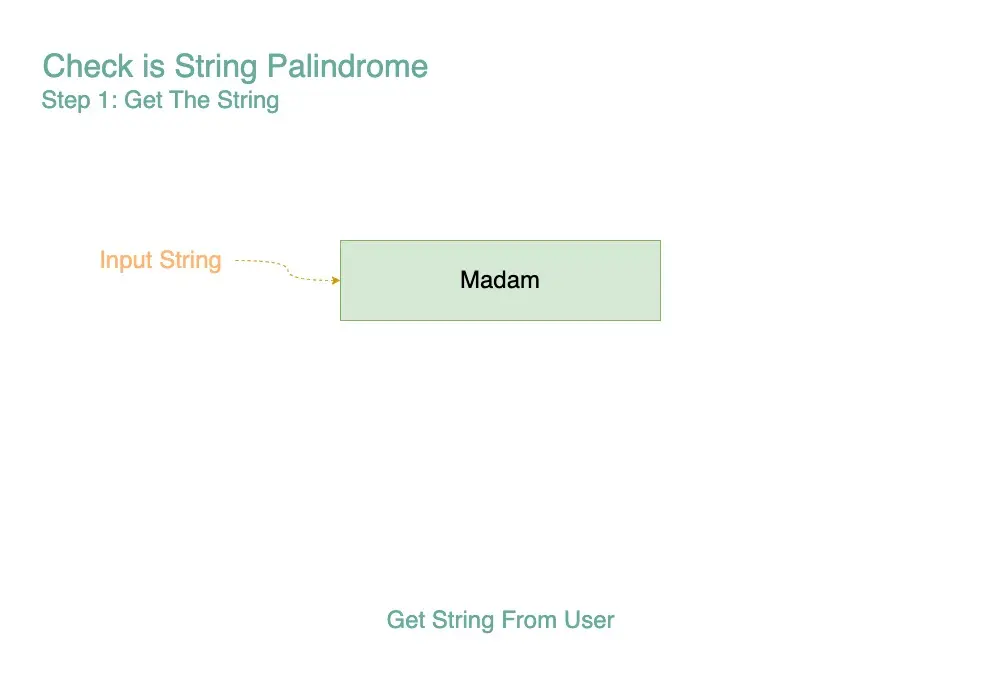
Code
Here is how we can implement this algorithm:
import java.util.Deque;
import java.util.LinkedList;

public class Solution {

  public boolean checkPalindrome(String s) {
    // Remove all non-alphanumeric characters and convert to lowercase
    s = s.replaceAll("[^a-zA-Z0-9]", "").toLowerCase();
    // Create a deque (double-ended queue) from the string
    Deque<Character> deque = new LinkedList<>();
    for (char c : s.toCharArray()) {
      deque.addLast(c);
    }

    // Continue until there is 0 or 1 character left
    while (deque.size() > 1) {
      // Remove and compare characters from both ends
      if (!deque.pollFirst().equals(deque.pollLast())) {
        return false;
      }
    }
    return true;
  }

  public static void main(String[] args) {
    Solution sol = new Solution();
    System.out.println(sol.checkPalindrome("madam")); // returns: True
    System.out.println(sol.checkPalindrome("openai")); // returns: False
    System.out.println(sol.checkPalindrome("A man a plan a canal Panama")); // returns: True
  }
}
Complexity Analysis
Time Complexity
-
Preprocessing (removing non-alphanumeric characters and converting to lowercase): The algorithm processes the input string once to remove non-alphanumeric characters and convert it to lowercase. This takes
time, where Nis the length of the input string. -
Deque operations:
- Deque insertion: Each character from the preprocessed string is added to the deque in constant time,
. This results in a total of for adding all characters to the deque. - Deque comparison: In the main loop, the algorithm compares characters from both ends of the deque. For each comparison, two characters are removed from the deque. This loop runs approximately
times, resulting in operations.
- Deque insertion: Each character from the preprocessed string is added to the deque in constant time,
Overall time complexity: N is the length of the input string.
Space Complexity
-
Deque space: The deque stores all characters from the preprocessed string, requiring
space. -
Additional space: The string that results from preprocessing (removing non-alphanumeric characters and converting to lowercase) also requires
space.
Overall space complexity:
🎯 STRICT STANDOUT — Solution Palindrome Check using Queue
1. Why / judgment
After normalize, store chars in a deque; repeatedly compare pollFirst vs pollLast. Mismatch → false; ≤1 char left → true. This uses deque, not a strict single-ended queue — correctly so.
2. Hand-run (K13) + complexity (K11)
"madam" → deque m a d a m
  m==m, a==a, left d → true
"openai" → o…i fail on first or later mismatch → false
"A man a plan a canal Panama" → amanaplanacanalpanama → true
"" or "a" → true immediately (size≤1)
Time Θ(n) normalize + Θ(n) fill + Θ(n) compares. Space Θ(n) deque (+ cleaned string).
Two-pointer on cleaned string: Θ(n) time, Θ(1) extra — prefer in real code.
3. Pattern (K12)
Deque both-ends equality. When-NOT stack-only without another structure: need forward sequence too. When-NOT: unicode-heavy normalization beyond alnum may need stronger rules than regex used here.
4. Interviewer follow-ups
Q1. Is LinkedList Deque OK?
A: Yes; ArrayDeque better constants.
Q2. Why size>1 loop condition?
A: Middle char free in odd length.
Recognize it: Process in arrival order / level-by-level → a FIFO queue (BFS).
▶ Visualize this problem (step it, predict each fork)
🤖 Don't fully get this? Learn it with Claude
Stuck on Palindrome Check using Queue? Open Claude, copy a block below, and it'll teach you this exact concept — visually and interactively.
Progressively stronger hints — you still solve it.
I'm working on the problem **Palindrome Check using Queue** (DSA). Give me a HINT LADDER: start with the tiniest nudge, then wait. Only reveal the next, stronger hint when I ask. Do NOT show the full solution unless I type 'show solution'. Keep me doing the thinking. If you're unsure or a claim isn't standard, say so and reason from first principles instead of guessing.
See the technique, not just code.
Explain the optimal approach to **Palindrome Check using Queue** with a VISUAL walkthrough: trace it on a small concrete example using ASCII art / a step-by-step diagram, narrate what changes each step, then give time & space complexity with a one-line derivation. If you're unsure or a claim isn't standard, say so and reason from first principles instead of guessing.
Catch bugs, edge cases, sub-optimality.
I'll paste my solution to **Palindrome Check using Queue**. Review it for correctness, missed edge cases, and time/space complexity, then coach me toward the optimal — don't just rewrite it. Ask me to paste my code now. If you're unsure or a claim isn't standard, say so and reason from first principles instead of guessing.
Lock in recognition with look-alikes.
Give me 2 problems that use the SAME underlying pattern as **Palindrome Check using Queue**. For each, let me attempt first, then review my answer and name the trigger signal that reveals the pattern. If you're unsure or a claim isn't standard, say so and reason from first principles instead of guessing.