Generate Binary Numbers from 1 to N
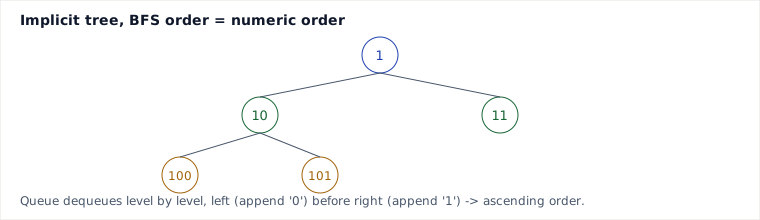
A queue can generate the binary representation of every integer from 1 to N by treating the strings "1" and "0" as building instructions: dequeue a prefix, append "0" and "1" to it to form the next two candidates, and enqueue both — this is level-order (BFS) traversal of the implicit binary-string tree rooted at "1", so numbers pop out in numeric order for free.
Recognize the pattern
- You need results produced in strictly increasing / breadth-first order without sorting afterward.
- Each item can be derived from a smaller, already-generated item by a cheap append/transform (prefix → prefix+'0', prefix+'1').
- The naive approach (convert each number with
Integer.toBinaryStringor repeated division) works but wastes the fact that binary(k) is just binary(k/2) with a bit appended — that reuse is the tell for a queue-based generator.
Brute force vs optimal
Brute force: for i = 1..N, convert i to binary via repeated mod/divide by 2 and reverse the digits. Cost: O(log i) per number, O(N log N) total, O(1) extra space beyond output — simple, and honestly fine in production. It's the baseline to beat conceptually, not a bad solution.
Optimal (queue/BFS): seed a queue with "1". Repeat N times: pop the front string s, add it to the result, then push s+"0" and s+"1". Never touches arithmetic — pure string append — and naturally emits numbers in order because BFS visits the tree level by level, and within a level left-to-right (0-branch before 1-branch) matches ascending numeric order.
Complexity, derived
The queue holds one entry per number produced so far, and each of the N dequeue operations enqueues exactly 2 children — so total enqueues = 2N, total dequeues = N: O(N) queue operations.
The i-th generated string has length ⌊log2 i⌋ + 1, and each append is O(length) if strings are immutable (Java String concatenation copies). Summing lengths for i = 1..N: Σ log2 i ≈ N log2 N, so building all output strings costs O(N log N) time — same order as brute force, but the per-step logic is trivial appends, not division/modulo/reversal, which is why this pattern is preferred when you're already threading a BFS/queue through the problem (e.g., as a sub-routine or when asked specifically to demonstrate queue mechanics).
Space: O(N) for the queue in the worst case (level N holds up to N/2 strings) plus O(N log N) for the output list of strings — dominated by output storage either way.
Traced example: N = 5
| Step | Dequeue | Result so far | Enqueue (s+'0', s+'1') | Queue after |
|---|---|---|---|---|
| 1 | "1" | [1] | "10","11" | [10,11] |
| 2 | "10" | [1,10] | "100","101" | [11,100,101] |
| 3 | "11" | [1,10,11] | "110","111" | [100,101,110,111] |
| 4 | "100" | [1,10,11,100] | "1000","1001" | [101,110,111,1000,1001] |
| 5 | "101" | [1,10,11,100,101] | —(stop, N reached) | — |
Result: ["1","10","11","100","101"] — matches decimal 1..5.
Pitfalls
- Using
Nas a loop bound but forgetting the queue also needs a fixed number of pops (exactly N) — an off-by-one either skips "1" or over-generates. - Using an
ArrayDequeand callingremove()from the wrong end (it removes the head, which is correct for FIFO — but aStackorLinkedListmisuse as LIFO breaks ordering silently). - Concatenating with
StringBuilderreused across iterations without copying — mutating a shared builder corrupts previously enqueued strings; each string must be its own immutable object or a fresh builder. - Degenerate inputs: N ≤ 0 must return an empty list before touching the queue, and N = 1 yields just
["1"]— seed the queue with "1" only after the guard.
When to use / when not
Use the queue/BFS generator when the problem already involves level-order traversal, when N is large and you want to avoid per-number division/modulo, or when this is explicitly a queue-mechanics exercise. Prefer the brute-force Integer.toBinaryString(i) loop in real code — it is O(N log N) too, simpler, allocates less transient queue state, and is what any reviewer expects; reach for the queue version mainly as a teaching example of BFS-as-generation, a pattern that generalizes to generating other structured sequences (e.g., all valid parentheses of length n, ugly numbers) where brute force doesn't reuse prior work as cleanly.
import java.util.*;

public class BinaryGenerator {
    public static List<String> generate(int n) {
        List<String> result = new ArrayList<>();
        if (n <= 0) return result;
        Queue<String> queue = new LinkedList<>();
        queue.add("1");
        for (int i = 0; i < n; i++) {
            String s = queue.poll();
            result.add(s);
            queue.add(s + "0");
            queue.add(s + "1");
        }
        return result;
    }

    public static void main(String[] args) {
        System.out.println(generate(5)); // [1, 10, 11, 100, 101]
    }
}
Takeaways
- BFS over an implicit tree of strings emits results in the same order the tree's levels are visited — here that coincides with numeric order for free.
- The queue trades arithmetic (mod/divide) for string append, same asymptotic cost, different constant factors.
- This generation-by-append idea generalizes to any sequence buildable from smaller already-built members (ugly numbers, balanced parentheses).
Recall: Why does popping the queue in FIFO order guarantee the binary strings come out in ascending numeric order, rather than some other order?
Pattern: BFS-as-generator using a FIFO queue over an implicit binary-string tree; standard technique covered in queue-based generation problems (e.g., GeeksforGeeks "Generate numbers from 1 to n using queue", CTCI/InterviewBit queue pattern sets).
🤖 Don't fully get this? Learn it with Claude
Stuck on Generate Binary Numbers from 1 to N? Open Claude, copy a block below, and it'll teach you this exact concept — visually and interactively.
Build the mental picture, not memorization.
I just read a lesson on **Generate Binary Numbers from 1 to N** (DSA) and want to truly understand it. Explain Generate Binary Numbers from 1 to N from first principles using ONE vivid real-world analogy and a visual mental model — draw it as ASCII art or a clear step-by-step diagram — with a concrete example using real numbers. Then ask me one question to check I got the mental picture, and wait for my reply. If you're unsure or a claim isn't standard, say so and reason from first principles instead of guessing.
Socratic — adapts to where you're stuck.
Teach me **Generate Binary Numbers from 1 to N** interactively. Ask me ONE guiding question at a time, wait for my answer, and adapt to my confusion — build the idea with me step by step instead of explaining it all at once. If you're unsure or a claim isn't standard, say so and reason from first principles instead of guessing.
Active recall exposes what you missed.
Quiz me on **Generate Binary Numbers from 1 to N** with 5 questions, easy to tricky, ONE at a time. Tell me if each answer is right; at the end, explain clearly what I got wrong and why. If you're unsure or a claim isn't standard, say so and reason from first principles instead of guessing.
Intuition + hook + flashcards for long-term memory.
Help me remember **Generate Binary Numbers from 1 to N** for the long term: give the one-sentence intuition, a memorable hook/mnemonic, a tiny worked example, and 3 active-recall flashcards (Q -> A). If you're unsure or a claim isn't standard, say so and reason from first principles instead of guessing.