easy Reverse a Queue
Problem Statement
Given a queue containing integer elements, return the updated queue after reversing its elements. (You may use an auxiliary stack; only standard queue operations on the input queue.)
Examples
Example 1:
- Input:
queue = [1, 2, 3, 4, 5] - Expected Output:
[5, 4, 3, 2, 1] - Justification: Reversing the queue
[1, 2, 3, 4, 5]gives[5, 4, 3, 2, 1].
Example 2:
- Input:
queue = [10, 20, 30, 40, 50] - Expected Output:
[50, 40, 30, 20, 10] - Justification: Reversing the queue yields
[50, 40, 30, 20, 10].
Example 3:
- Input:
queue = [5, 7, 12, 2, 4, 5] - Expected Output:
[5, 4, 2, 12, 7, 5] - Justification: Reversing the queue yields
[5, 4, 2, 12, 7, 5].
Try it yourself
Try solving this question here:
🎯 STRICT STANDOUT — Reverse a Queue (problem)
1. Why / judgment
Reversing a queue is the classic demo that stack undoes FIFO into LIFO. You are not reversing a linked list of nodes — you may only use queue ops (and an auxiliary stack, or recursion that is an implicit stack).
2. Worked expectation (K11/K13)
q = [1,2,3,4,5] front→rear
Stack transfer: push 1..5 → stack top=5; pop back to q → [5,4,3,2,1]
Time Θ(n) two passes; space Θ(n) stack.
Empty → empty. Single [7] → [7].
3. Pattern cue (K12)
Name: Queue reverse via stack (or recursion).
Recognition: reverse arrival order while ADT remains a queue at the end.
When-NOT: if structure is a deque you can reverse in place with two ends more directly; if you need original order preserved, copy first. Do not treat this as linked-list pointer reverse — different problem.
4. Interviewer follow-ups
Q1. Can you reverse using only one queue (no stack)?
A: Recursion (call stack) or expensive rotate with temp storage of size n still needed asymptotically.
Q2. Complexity?
A: Θ(n) time, Θ(n) extra space for stack.
✅ Solution Reverse a Queue
Problem Statement
Given a queue containing integer elements, return the updated queue after reversing its elements.
Examples
Example 1
- Input: queue = [1, 2, 3, 4, 5]
- Expected Output: [5, 4, 3, 2, 1]
- Explanation: The input queue elements are reversed.
Example 2
- Input: queue = [10, 20, 30, 40, 50]
- Expected Output: [50, 40, 30, 20, 10]
- Explanation: The input queue elements are reversed.
Example 3
- Input: queue = [5, 7, 12, 2, 4, 5]
- Expected Output: [5, 4, 2, 12, 7, 5]
- Explanation: The input queue elements are reversed.
Solution
The given Java program reverses the order of elements in a queue using a stack. The idea is to first transfer all the elements from the queue to a stack, which inherently reverses their order due to the Last-In-First-Out (LIFO) nature of a stack. Once all the elements are in the stack, they are popped back into the queue, thus reversing their original order. This approach efficiently leverages the stack's properties to achieve the desired outcome, ensuring that the elements in the queue are reversed.
Step-by-Step Algorithm
-
Initialize Stack:
- Create an empty
Stack<Integer>namedstack.
- Create an empty
-
Transfer Elements to Stack:
- While the queue is not empty:
- Remove the front element from the queue using
remove(). - Push this element onto the stack using
stack.add().
- Remove the front element from the queue using
- While the queue is not empty:
-
Transfer Elements Back to Queue:
- While the stack is not empty:
- Pop the top element from the stack using
stack.pop(). - Add this element back to the queue using
queue.add().
- Pop the top element from the stack using
- While the stack is not empty:
-
Return the Queue:
- The queue now contains the elements in reversed order. Return the modified queue.
Algorithm Walkthrough
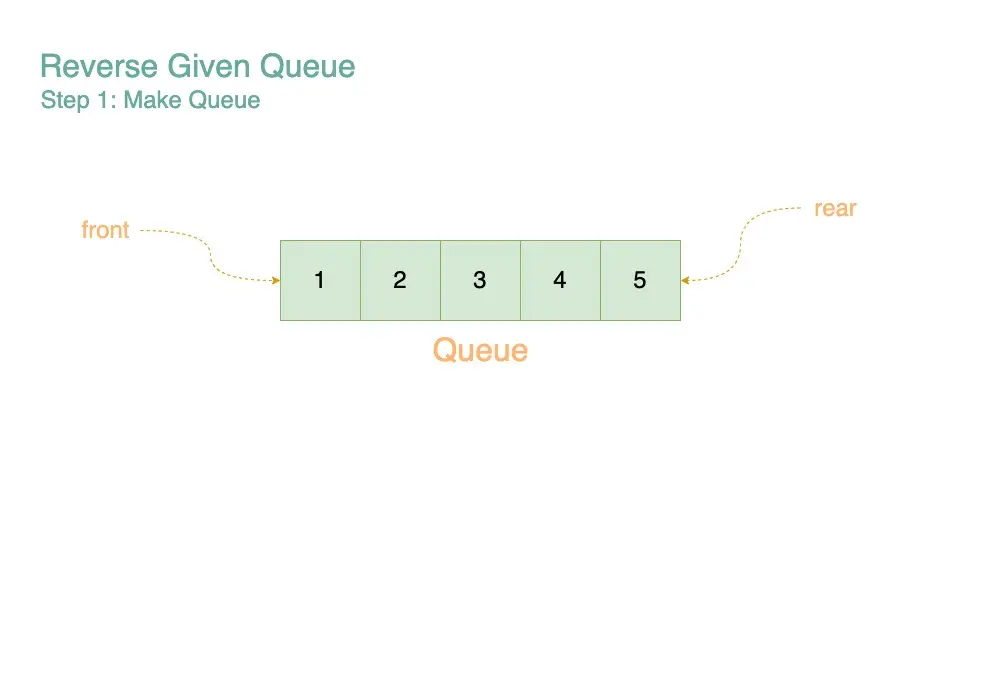
Code
Here is how we can implement this algorithm:
import java.util.LinkedList;
import java.util.Queue;
import java.util.Stack;

public class Solution {

  // Declare a static Queue of Integer type.
  static Queue<Integer> queue;

  // Define a static method to reverse the order of elements in the queue.
  Queue<Integer> reverseQueue(Queue<Integer> q) {
    // Create a Stack to temporarily hold the elements from the queue.
    Stack<Integer> stack = new Stack<>();

    // Transfer elements from the queue to the stack.
    // This will reverse the order of elements because stacks follow LIFO order.
    while (!q.isEmpty()) {
      // Add the front element of the queue to the stack.
      stack.add(q.peek());
      // Remove the front element from the queue.
      q.remove();
    }

    // Transfer elements back from the stack to the queue.
    // The order of elements will now be reversed in the queue.
    while (!stack.isEmpty()) {
      // Add the top element of the stack to the queue.
      q.add(stack.peek());
      // Remove the top element from the stack.
      stack.pop();
    }
    return q;
  }

  // Define the main method to test the reverseQueue method.
  public static void main(String[] args) {
    // Initialize the queue and add some elements to it.
    queue = new LinkedList<Integer>();
    queue.add(1);
    queue.add(2);
    queue.add(3);
    queue.add(4);
    queue.add(5);

    // Call the method to reverse the order of elements in the queue.
    Solution sol = new Solution();
    sol.reverseQueue(queue);

    // Print the reversed queue to the console.
    System.out.println(queue);
  }
}
Complexity Analysis
Time Complexity
-
Transferring elements from the queue to the stack: The first
whileloop iterates over all elements in the queue and pushes them onto the stack. This takestime, where Nis the number of elements in the queue. -
Transferring elements back from the stack to the queue: The second
whileloop pops elements from the stack and adds them back to the queue. This also takestime. -
Therefore, the overall time complexity is
.
Overall time complexity:
Space Complexity
-
Stack space: The stack is used to store the elements from the queue. Since the stack holds all
Nelements from the queue, the space required is. -
Queue space: The queue already holds
Nelements, but since we are using the same queue for input and output, this does not count as additional space.
Overall space complexity:
🎯 STRICT STANDOUT — Solution Reverse a Queue
1. Why / judgment
FIFO out + LIFO in is the only reason reverse works: the first dequeued becomes deepest in the stack, last dequeued sits on top and re-enters the queue first.
2. Hand-run (K13) + complexity (K11)
q:[1,2,3]
  → stack push 1,2,3 (top=3); q empty
  → pop 3,2,1 into q → [3,2,1]
Empty: both loops no-op. One element: push/pop identity.
T = n queue removals + n stack pushes + n pops + n queue adds = Θ(n)
S = Θ(n) stack. Recursive reverse without explicit stack: Θ(n) call-stack space same bound.
3. Pattern (K12)
Name: Reverse FIFO with LIFO auxiliary.
When-NOT stack available: recursion; or if API gives deque, reverse by other means — still Θ(n) space lower bound to reverse order in general. When-NOT: needing stable original for later — reverse copy, not mutate only queue.
4. Interviewer follow-ups
Q1. Why not dequeue and enqueue to same queue in a loop?
A: That rotates (cyclic shift), does not reverse — need LIFO.
Q2. In-place reverse with only O(1) extra?
A: Impossible for general queue ADT without random access; array backing could reverse indices if exposed.
Recognize it: Process in arrival order / level-by-level → a FIFO queue (BFS).
▶ Visualize this problem (step it, predict each fork)
🤖 Don't fully get this? Learn it with Claude
Stuck on Reverse a Queue? Open Claude, copy a block below, and it'll teach you this exact concept — visually and interactively.
Progressively stronger hints — you still solve it.
I'm working on the problem **Reverse a Queue** (DSA). Give me a HINT LADDER: start with the tiniest nudge, then wait. Only reveal the next, stronger hint when I ask. Do NOT show the full solution unless I type 'show solution'. Keep me doing the thinking. If you're unsure or a claim isn't standard, say so and reason from first principles instead of guessing.
See the technique, not just code.
Explain the optimal approach to **Reverse a Queue** with a VISUAL walkthrough: trace it on a small concrete example using ASCII art / a step-by-step diagram, narrate what changes each step, then give time & space complexity with a one-line derivation. If you're unsure or a claim isn't standard, say so and reason from first principles instead of guessing.
Catch bugs, edge cases, sub-optimality.
I'll paste my solution to **Reverse a Queue**. Review it for correctness, missed edge cases, and time/space complexity, then coach me toward the optimal — don't just rewrite it. Ask me to paste my code now. If you're unsure or a claim isn't standard, say so and reason from first principles instead of guessing.
Lock in recognition with look-alikes.
Give me 2 problems that use the SAME underlying pattern as **Reverse a Queue**. For each, let me attempt first, then review my answer and name the trigger signal that reveals the pattern. If you're unsure or a claim isn't standard, say so and reason from first principles instead of guessing.