medium Max of All Subarrays of Size 'k'
Problem Statement
Given an integer array arr and an integer k, return the result list containing the maximum for each and every contiguous subarray of size k.
In other words, for each window start i (from 0 to n−k), result[i] = max(arr[i], arr[i+1], …, arr[i+k−1]).
Examples
Example 1
- Input: arr =
[1, 2, 3, 1, 4, 5, 2, 3, 6], k =3 - Output:
[3, 3, 4, 5, 5, 5, 6] - Description: Here, subarray
[1,2,3]has maximum 3,[2,3,1]has maximum 3,[3,1,4]has maximum 4,[1,4,5]has maximum 5,[4,5,2]has maximum 5,[5,2,3]has maximum 5, and[2,3,6]has maximum 6.
Example 2
- Input: arr =
[8, 5, 10, 7, 9, 4, 15, 12, 90, 13], k =4 - Output:
[10, 10, 10, 15, 15, 90, 90] - Description: Here, the maximum of each subarray of size 4 are 10, 10, 10, 15, 15, 90, 90 respectively.
Example 3
- Input: arr =
[12, 1, 78, 90, 57], k =3 - Output:
[78, 90, 90] - Description: Here, the maximum of each subarray of size 3 are 78, 90, and 90 respectively.
Constraints:
- 1 <= arr.length <= 105
- -104 <= arr[i] <= 104
- 1 <= k <= arr.length
Try it yourself
Try solving this question here:
🎯 STRICT STANDOUT — Max of All Subarrays of Size k (problem)
1. Why / judgment
This is the flagship monotonic deque problem (LC 239 family). Naive rescans are O(nk) and fail n=1e5; deque of indices in decreasing value order answers each window max in amortized O(1).
2. Examples recompute (K13)
[1,2,3,1,4,5,2,3,6] k=3 → windows max [3,3,4,5,5,5,6] ✓
[12,1,78,90,57] k=3 → [78,90,90] ✓
Correct window i is arr[i..i+k-1], not arr[0..k] indexing slip.
3. Pattern cue (K12)
Name: Sliding-window maximum via monotonic decreasing deque of indices.
Recognition: every contiguous window of fixed k; report max/min.
When-NOT stack: stack alone lacks front-expiry of leaving window elements. When-NOT plain queue: cannot pop smaller candidates from the back. When-NOT heap if you need O(n): heap is O(n log n).
4. Interviewer follow-ups
Q1. Why store indices?
A: Expire when index ≤ i−k.
Q2. Min of windows?
A: Monotonic increasing deque — dual pops.
✅ Solution Max of All Subarrays of Size 'k'
Problem Statement
Given an integer array arr and an integer k, return the result list containing the maximum for each and every contiguous subarray of size k.
In other words, for each window start i (from 0 to n−k), result[i] = max(arr[i], arr[i+1], …, arr[i+k−1]).
Examples
Example 1
- Input: arr =
[1, 2, 3, 1, 4, 5, 2, 3, 6], k =3 - Output:
[3, 3, 4, 5, 5, 5, 6] - Description: Here, subarray
[1,2,3]has maximum 3,[2,3,1]has maximum 3,[3,1,4]has maximum 4,[1,4,5]has maximum 5,[4,5,2]has maximum 5,[5,2,3]has maximum 5, and[2,3,6]has maximum 6.
Example 2
- Input: arr =
[8, 5, 10, 7, 9, 4, 15, 12, 90, 13], k =4 - Output:
[10, 10, 10, 15, 15, 90, 90] - Description: Here, the maximum of each subarray of size 4 are 10, 10, 10, 15, 15, 90, 90 respectively.
Example 3
- Input: arr =
[12, 1, 78, 90, 57], k =3 - Output:
[78, 90, 90] - Description: Here, the maximum of each subarray of size 3 are 78, 90, and 90 respectively.
Constraints:
- 1 <= arr.length <= 105
- -104 <= arr[i] <= 104
- 1 <= k <= arr.length
Solution
The approach to solve this problem involves utilizing a deque (double-ended queue) to efficiently track the maximum elements in each window of size 'k' as we traverse the array. Initially, we populate the deque with indices of elements, ensuring that it always contains elements in decreasing order. This way, the front of the deque always holds the index of the current maximum element. As we move the window, we add new elements to the rear of the deque, removing those from the front that fall outside the current window. We also remove elements from the rear if they are smaller than the new element being added, as they are no longer potential maximums. This strategy ensures that for each window, we can quickly identify the maximum element, which is always at the front of the deque.
Step-by-Step Algorithm
-
Initialize Data Structures:
- Create a
Deque<Integer>nameddqto store indices of array elements. - Create a
List<Integer>namedresultto store the maximum values of each sliding window. - Store the length of the input array
arrin a variablen.
- Create a
-
Iterate Through the Array:
- Loop through the array
arrusing an indexithat ranges from0ton-1.
- Loop through the array
-
Remove Out-of-Window Elements:
- Inside the loop, first check if there are elements in the
dqthat are out of the current window. The current window is defined as the subarray fromi-k+1toi. - If the element at the front of the
dequeis out of this window (i.e.,dq.peek() < i - k + 1), remove it from the front of thedqusingpoll().
- Inside the loop, first check if there are elements in the
-
Remove Useless Elements:
- Next, check if there are any elements in the
dqthat are smaller than the current array elementarr[i]. This helps to maintain the queue elements in decreasing order, keeping the largest element in the current window at the front. - Remove these smaller elements from the rear of the
dqusingpollLast(), as they are not useful for finding the maximum in the current window.
- Next, check if there are any elements in the
-
Add Current Element's Index:
- After cleaning up the
dq, add the current element's indexito the rear of thedqusingoffer(i).
- After cleaning up the
-
Add Maximum to Result List:
- If the index
iis greater than or equal tok-1, it means the current window is fully formed. - The element at the front of the
dqis the maximum of the current window, so addarr[dq.peek()]to theresultlist.
- If the index
-
Repeat for All Elements:
- Continue this process for all elements in the array.
-
Return the Result:
- After processing all elements, return the
resultlist containing the maximum values for each sliding window of sizek.
- After processing all elements, return the
Algorithm Walkthrough
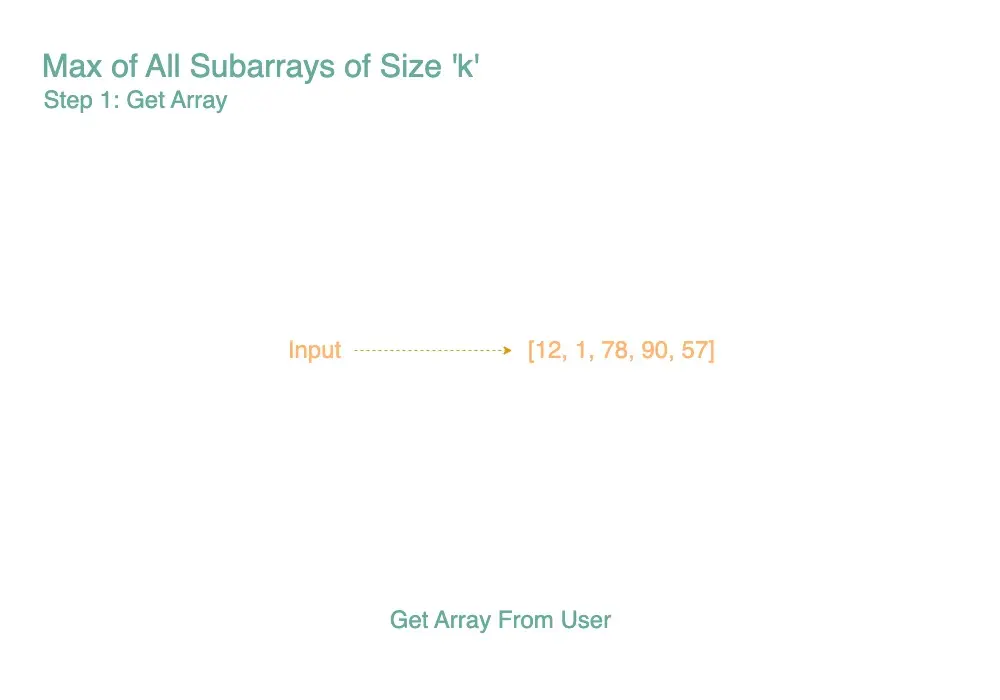
Code
Here is how we can implement this algorithm:
import java.util.ArrayList;
import java.util.Deque;
import java.util.LinkedList;
import java.util.List;

public class Solution {

  public List<Integer> printMax(int[] arr, int k) {
    Deque<Integer> dq = new LinkedList<Integer>();
    List<Integer> result = new ArrayList<Integer>();
    int n = arr.length;
    for (int i = 0; i < n; i++) {
      // Remove the elements which are out of this window
      while (!dq.isEmpty() && dq.peek() < i - k + 1) dq.poll();

      // Remove all elements smaller than the currently being added element
      // (remove useless elements)
      while (!dq.isEmpty() && arr[i] >= arr[dq.peekLast()]) dq.pollLast();

      // Add current element at the rear of dq
      dq.offer(i);

      if (i >= k - 1) result.add(arr[dq.peek()]);
    }

    return result;
  }

  public static void main(String[] args) {
    Solution s = new Solution();
    int arr[] = { 12, 1, 78, 90, 57 };
    int k = 3;
    List<Integer> result = s.printMax(arr, k);

    // Print the result array
    System.out.println(result);
  }
}
Complexity Analysis
Time Complexity
-
Single pass through the array: The algorithm processes each element of the array exactly once by iterating over the array in a single pass. This gives us an initial time complexity of
, where Nis the length of the array. -
Deque operations:
- Each element is added to the deque once and removed from the deque at most once. Therefore, all enqueue (offer) and dequeue (poll) operations are done in constant time,
, per element. - The
whileloops inside the iteration only remove elements from the deque in constant time per iteration. Since each element is processed once and added/removed only once from the deque, the total number of deque operations is.
- Each element is added to the deque once and removed from the deque at most once. Therefore, all enqueue (offer) and dequeue (poll) operations are done in constant time,
-
Therefore, the overall time complexity of the algorithm is
.
Overall time complexity:
Space Complexity
-
Deque space: The deque stores indices of array elements. At most, it will store
kelements (since it only keeps track of elements in the current window of sizek), so the space complexity for the deque is. -
Result list: The result list stores the maximum of each sliding window, which requires
space (where N - k + 1is the number of windows). This is equivalent toin the worst case.
Overall space complexity:
🎯 STRICT STANDOUT — Solution Max of All Subarrays of Size k
1. Why / judgment
Maintain candidates: front = max index in window; back pops anyone ≤ new value (dominated while new stays). Front pops when out of window. That is why both ends of a deque are required.
2. Hand-run (K13) + complexity (K11)
arr=[12,1,78,90,57], k=3
i=0: dq=[0]
i=1: 1<12 keep; dq=[0,1]
i=2: 78≥1,12 pop back → [2]; i≥2 → max 78
i=3: expire none; 90≥78 pop → [3]; max 90
i=4: expire 3? 3<4-3+1=2? no; 57<90 → [3,4]; max 90
Result [78,90,90] ✓

Each index offered once, polled ≤ once → Θ(n) time, Θ(k) deque, Θ(n−k+1) output.
Brute Θ(nk) fails n=1e5,k=n/2.
Use ≥ when popping back so equal values: keep the newer index (older equal expires sooner) — still correct max.
3. Pattern (K12)
Monotonic deque window extreme. When-NOT stack: need pollFirst for expiry. When-NOT: non-contiguous subsequence max — different problem (e.g. heaps/DP).
4. Interviewer follow-ups
Q1. Why while on front not if?
A: At most one index can leave per step for fixed k, but while is safe; for variable constraints while is required.
Q2. LinkedList vs ArrayDeque for dq?
A: ArrayDeque preferred for ends; both OK.
Recognize it: Process in arrival order / level-by-level → a FIFO queue (BFS).
▶ Visualize this problem (step it, predict each fork)
🤖 Don't fully get this? Learn it with Claude
Stuck on Max of All Subarrays of Size 'k'? Open Claude, copy a block below, and it'll teach you this exact concept — visually and interactively.
Progressively stronger hints — you still solve it.
I'm working on the problem **Max of All Subarrays of Size 'k'** (DSA). Give me a HINT LADDER: start with the tiniest nudge, then wait. Only reveal the next, stronger hint when I ask. Do NOT show the full solution unless I type 'show solution'. Keep me doing the thinking. If you're unsure or a claim isn't standard, say so and reason from first principles instead of guessing.
See the technique, not just code.
Explain the optimal approach to **Max of All Subarrays of Size 'k'** with a VISUAL walkthrough: trace it on a small concrete example using ASCII art / a step-by-step diagram, narrate what changes each step, then give time & space complexity with a one-line derivation. If you're unsure or a claim isn't standard, say so and reason from first principles instead of guessing.
Catch bugs, edge cases, sub-optimality.
I'll paste my solution to **Max of All Subarrays of Size 'k'**. Review it for correctness, missed edge cases, and time/space complexity, then coach me toward the optimal — don't just rewrite it. Ask me to paste my code now. If you're unsure or a claim isn't standard, say so and reason from first principles instead of guessing.
Lock in recognition with look-alikes.
Give me 2 problems that use the SAME underlying pattern as **Max of All Subarrays of Size 'k'**. For each, let me attempt first, then review my answer and name the trigger signal that reveals the pattern. If you're unsure or a claim isn't standard, say so and reason from first principles instead of guessing.