easy Implement Stack using Queues
Problem Statement
Implement a stack using only two queues. The stack should behave like a typical last-in-first-out (LIFO) stack, meaning that the last element added should be the first one to be removed.
Implement a Solution class that supports the following operations:
Solution(): A constructor to initialize the object.push(int x): Adds an elementxto the top of the stack.pop(): Removes the element from the top of the stack and returns it.top(): Retrieves the element on the top of the stack without removing it.empty(): Checks whether the stack is empty or not and returnstrueorfalseaccordingly.
Note: You can only use the basic operations of a queue, such as adding an element to the back, removing an element from the front, checking the size, and verifying if the queue is empty.
Input and Output Format
The input and output for this problem are structured using two separate arrays:
-
Input Arrays:
- Method Names Array: This is an array of strings where each string represents a method to be called on the
Solutionclass. The first element is always"Solution", indicating the initialization of the stack. - Arguments Array: This is a nested array where each sub-array contains the arguments for the corresponding method in the Method Names Array. For methods that do not require any arguments (like
Solution,pop,top, andempty), the sub-array will be empty.
- Method Names Array: This is an array of strings where each string represents a method to be called on the
-
Output Array:
- The output is a single array that captures the return value of each method call in the order they were invoked.
- For methods that do not return any value (
Solutionconstructor andpushoperations), the corresponding output isnull. - For methods that return values (
pop,top, andempty), the actual returned value is included in the output array.
Examples
Example 1
-
Input:
- ["Solution", "push", "push", "top", "pop", "empty"]
- [[], [5], [10], [], [], []]
-
Expected Output: [null, null, null, 10, 10, false]
-
Explanation:
push(5)adds5to the stack.push(10)adds10to the top of the stack.top()returns10since it's the top element.pop()removes10and returns it.empty()returnsfalsebecause5is still in the stack.
Example 2
- Input:
- ["Solution", "push", "push", "push", "pop", "top", "pop", "empty"]
- [[], [1], [2], [3], [], [], [], []]
- Expected Output: [null, null, null, null, 3, 2, 2, false]
- Explanation:
push(1)adds1to the stack.push(2)adds2on top of1.push(3)adds3on top of2.pop()removes3and returns it.top()returns2, the new top element.pop()removes2and returns it.empty()returnsfalsesince1is still in the stack.
Example 3
- Input:
- ["Solution", "push", "top", "pop", "empty"]
- [[], [99], [], [], []]
- Expected Output: [null, null, 99, 99, true]
- Explanation:
push(99)adds99to the stack.top()returns99.pop()removes99and returns it.empty()returnstruebecause the stack is now empty.
Constraints:
- 1 <= x <= 9
- At most 100 calls will be made to push, pop, top, and empty.
- All the calls to pop and top are valid.
Try it yourself
Try solving this question here:
🎯 STRICT STANDOUT — Implement Stack using Queues (problem)
1. Why / judgment
This problem forces you to pay for LIFO on top of FIFO. Either push is O(n) (rotate so newest sits at front) or pop is O(n) — you choose which op is hot.
2. Expected trace (K11/K13)
push 5, push 10, top→10, pop→10, empty→false
After two pushes with push-O(n) scheme: main queue front is 10, then 5.
Empty stack: empty() true; pop/top not called (constraints: valid).
3. Pattern cue (K12)
Name: Stack via queue rotation (two-queue or one-queue).
Recognition: “only queue ops” + LIFO API.
When-NOT: real systems use a true stack/deque; this is an interview constraint drill, not production design. When-NOT queue for DFS: if you already have a stack type, do not fake it with queues for performance.
4. Interviewer follow-ups
Q1. Make pop O(n) instead of push?
A: Yes — keep natural FIFO; on pop rotate n−1 to back, then remove front.
Q2. One queue enough?
A: Yes: on push, enqueue then rotate size−1 times.
✅ Solution Implement Stack using Queues
Problem Statement
Implement a stack using only two queues. The stack should behave like a typical last-in-first-out (LIFO) stack, meaning that the last element added should be the first one to be removed.
Implement a Solution class that supports the following operations:
Solution(): A constructor to initialize the object.push(int x): Adds an elementxto the top of the stack.pop(): Removes the element from the top of the stack and returns it.top(): Retrieves the element on the top of the stack without removing it.empty(): Checks whether the stack is empty or not and returnstrueorfalseaccordingly.
Note: You can only use the basic operations of a queue, such as adding an element to the back, removing an element from the front, checking the size, and verifying if the queue is empty.
Examples
Example 1
-
Input:
- ["Solution", "push", "push", "top", "pop", "empty"]
- [[], [5], [10], [], [], []]
-
Expected Output: [null, null, null, 10, 10, false]
-
Explanation:
push(5)adds5to the stack.push(10)adds10to the top of the stack.top()returns10since it's the top element.pop()removes10and returns it.empty()returnsfalsebecause5is still in the stack.
Example 2
- Input:
- ["Solution", "push", "push", "push", "pop", "top", "pop", "empty"]
- [[], [1], [2], [3], [], [], [], []]
- Expected Output: [null, null, null, null, 3, 2, 2, false]
- Explanation:
push(1)adds1to the stack.push(2)adds2on top of1.push(3)adds3on top of2.pop()removes3and returns it.top()returns2, the new top element.pop()removes2and returns it.empty()returnsfalsesince1is still in the stack.
Example 3
- Input:
- ["Solution", "push", "top", "pop", "empty"]
- [[], [99], [], [], []]
- Expected Output: [null, null, 99, 99, true]
- Explanation:
push(99)adds99to the stack.top()returns99.pop()removes99and returns it.empty()returnstruebecause the stack is now empty.
Constraints:
- 1 <= x <= 9
- At most 100 calls will be made to push, pop, top, and empty.
- All the calls to pop and top are valid.
Solution
To solve this problem using two queues, the key idea is to simulate the behavior of a stack by manipulating the elements in the queues. The main challenge is to ensure that the pop and top operations return the most recently added element. To achieve this, we maintain two queues:
- Main Queue: This holds the current state of the stack.
- Helper Queue: This is used temporarily during the
pushoperation.
The approach involves always pushing the new element into the helper queue, then transferring all elements from the main queue to the helper queue. Finally, we swap the roles of the two queues. This way, the last added element always stays at the front of the main queue, ensuring the correct behavior for pop and top. This approach works well because it maintains the order of elements correctly, making it a valid stack implementation using queues.
Step-by-Step Algorithm
-
Initialization:
- Start by creating two empty queues named
queue1andqueue2. - These queues will be used to simulate the behavior of a stack.
queue1will hold the elements in stack order, whilequeue2will be a helper queue used during thepushoperation.
- Start by creating two empty queues named
-
Push Operation (
push(int x)):- Step 1: Add the element
xtoqueue2.- This step places the new element at the front of the queue, which will eventually become the top of the stack.
- Step 2: Transfer all elements from
queue1toqueue2.- This step ensures that the newly added element
xstays at the front of the queue, maintaining the LIFO order of the stack. - Each element is removed from
queue1and added toqueue2.
- This step ensures that the newly added element
- Step 3: Swap the roles of
queue1andqueue2.- After transferring all elements,
queue2now holds the elements in the correct stack order. - Swapping the queues ensures that
queue1will always be the queue representing the current state of the stack, whilequeue2becomes the empty helper queue for the next operation.
- After transferring all elements,
- Step 1: Add the element
-
Pop Operation (
pop()):- Step 1: Remove and return the front element from
queue1.- Since
queue1holds the elements in the correct stack order, removing the front element effectively removes the top element of the stack.
- Since
- Step 1: Remove and return the front element from
-
Top Operation (
top()):- Step 1: Return the front element of
queue1without removing it.- This operation allows you to peek at the top element of the stack without modifying the stack itself.
- Step 1: Return the front element of
-
Empty Operation (
empty()):- Step 1: Check if
queue1is empty.- If
queue1is empty, the stack is empty, so returntrue. - Otherwise, return
falseto indicate that the stack still contains elements.
- If
- Step 1: Check if
Algorithm Walkthrough
Let's go through the algorithm step by step using the example:
Input:
- ["Solution", "push", "push", "top", "pop", "empty"]
- [[], [5], [10], [], [], []]
Steps:
-
Operation:
Solution(Constructor)- Step: Initialize two empty queues,
queue1andqueue2. - Result: Both queues are empty, ready to simulate the stack operations.
- Step: Initialize two empty queues,
-
Operation:
push(5)- Step 1: Add
5toqueue2.queue2now contains:[5]
- Step 2: Transfer all elements from
queue1toqueue2.queue1is empty, so no elements are transferred.queue2remains:[5]
- Step 3: Swap the roles of
queue1andqueue2.- After swapping,
queue1contains:[5] queue2is now empty:[]
- After swapping,
- Step 1: Add
-
Operation:
push(10)- Step 1: Add
10toqueue2.queue2now contains:[10]
- Step 2: Transfer all elements from
queue1toqueue2.- Move
5fromqueue1toqueue2. queue2now contains:[10, 5]queue1is now empty:[]
- Move
- Step 3: Swap the roles of
queue1andqueue2.- After swapping,
queue1contains:[10, 5] queue2is now empty:[]
- After swapping,
- Step 1: Add
-
Operation:
top()- Step 1: Return the front element of
queue1without removing it.- The front element of
queue1is10, so10is returned as the top element of the stack.
- The front element of
- Result: The returned value is
10.
- Step 1: Return the front element of
-
Operation:
pop()- Step 1: Remove and return the front element from
queue1.- The front element of
queue1is10, so10is removed and returned. queue1now contains:[5]
- The front element of
- Result: The returned value is
10.
- Step 1: Remove and return the front element from
-
Operation:
empty()- Step 1: Check if
queue1is empty.queue1contains one element (5), so the stack is not empty.- Return
false.
- Result: The returned value is
false.
- Step 1: Check if
Final Output:
The operations return the following results in sequence: [null, null, null, 10, 10, false].
Code
import java.util.LinkedList;
import java.util.Queue;

class Solution {

  // Two queues to simulate stack behavior
  Queue<Integer> queue1;
  Queue<Integer> queue2;

  // Constructor to initialize the queues
  public Solution() {
    queue1 = new LinkedList<>();
    queue2 = new LinkedList<>();
  }

  // Push element x onto the stack
  public void push(int x) {
    // Add the element to queue2
    queue2.add(x);

    // Move all elements from queue1 to queue2 to maintain stack order
    while (!queue1.isEmpty()) {
      queue2.add(queue1.remove());
    }

    // Swap the names of queue1 and queue2
    Queue<Integer> temp = queue1;
    queue1 = queue2;
    queue2 = temp;
  }

  public int pop() {
    return queue1.remove(); // Remove and return the front of queue1, which is the stack's top
  }

  public int top() {
    return queue1.peek(); // Peek at the front of queue1, which is the stack's top
  }

  public boolean empty() {
    return queue1.isEmpty(); // Check if queue1 is empty
  }

  // Main method to test the stack implementation
  public static void main(String[] args) {
    Solution myStack = new Solution();
    myStack.push(5);
    myStack.push(10);
    System.out.println(myStack.pop()); // 10
    System.out.println(myStack.top()); // 5
    System.out.println(myStack.pop()); // 5
    System.out.println(myStack.empty());
  }
}
Complexity Analysis
Time Complexity
-
push(int x):- The
pushoperation adds an element toqueue2and then moves all elements fromqueue1toqueue2. - If there are
nelements in the stack, this operation will taketime to transfer all elements. - Thus, the time complexity of the
pushoperation is.
- The
-
pop():- The
popoperation removes the front element ofqueue1. - This operation takes constant time
because it only involves removing the front element of the queue. - Thus, the time complexity of the
popoperation is.
- The
-
top():- The
topoperation returns the front element ofqueue1without removing it. - This operation also takes constant time
. - Thus, the time complexity of the
topoperation is.
- The
-
empty():- The
emptyoperation checks whetherqueue1is empty, which is a constant-time operation. - Thus, the time complexity of the
emptyoperation is.
- The
Space Complexity
- The space complexity of the implementation is
where nis the number of elements in the stack. This is because two queues are used, each of which can hold up tonelements.
🎯 STRICT STANDOUT — Solution Implement Stack using Queues
1. Why / judgment
Push-heavy scheme: new element enters helper queue first, old main drains behind it, then swap — so main.front is always stack top. Pop/top/empty stay Θ(1).
2. Hand-run + complexity (K11/K13)
push(5): q2=[5]; drain q1; swap → q1=[5]
push(10): q2=[10]; drain 5 → q2=[10,5]; swap → q1=[10,5]
top → 10; pop → 10; q1=[5]; empty → false
push is Θ(n) transfers; pop/top/empty Θ(1). Space Θ(n) for elements (two queue objects, one empty).

One-queue variant push(x):
  q.add(x); for i in 1..size-1: q.add(q.remove())  // rotate
  also Θ(n) push, Θ(1) pop.
3. Pattern (K12)
Name: Make newest the front via rotation.
When-NOT: need true O(1) stack — use ArrayDeque/stack. Interview only. Do not confuse with “queue using stacks” (dual problem).
4. Interviewer follow-ups
Q1. Amortized O(1) all ops?
A: Not with only queues in worst-case multipop sequences without fancy accounting; standard solution has O(n) on one side.
Q2. Why swap references not copy?
A: O(1) role change after O(n) drain.
✅ Solution Generate Binary Numbers from 1 to N
Problem Statement
Given an integer N, generate all binary numbers from 1 to N and return them as a list of strings.
Examples
Example 1
- Input: N = 2
- Output: ["1", "10"]
- Explanation: The binary representation of 1 is "1", and the binary representation of 2 is "10".
Example 2
- Input: N = 3
- Output: ["1", "10", "11"]
- Explanation: The binary representation of 1 is "1", the binary representation of 2 is "10", and the binary representation of 3 is "11".
Example 3
- Input: N = 5
- Output: ["1", "10", "11", "100", "101"]
- Explanation: These are the binary representations of the numbers from 1 to 5.
Solution
To solve this problem, we'll use a queue to systematically generate binary numbers. Initially, we enqueue the binary representation of '1'. For each number from 1 to N, we perform the following steps: dequeue the front element of the queue and record it as the current binary number. Then, we generate the next two binary numbers by appending '0' and '1' to the current number and enqueue these new numbers. This process continues until we have generated all binary numbers up to N. This method efficiently leverages the queue's FIFO (First In First Out) nature to build upon previous binary numbers, ensuring a systematic and orderly generation of binary representations.
Step-by-Step Algorithm
-
Initialize a Queue: Create a queue data structure which will be used to hold binary numbers in string format.
-
Start with '1': Enqueue the binary representation of the first number, which is '1'.
-
Iterate up to N: Set up a loop that runs from 1 to N. This loop controls how many binary numbers you need to generate.
-
Dequeue and Output: In each iteration of the loop, dequeue an element from the front of the queue. This element is the binary representation of the current number. Store or print this number as part of the solution.
-
Generate Next Binary Numbers:
- Take the dequeued binary number and append '0' to it, forming the next binary number. Enqueue this new number back into the queue.
- Repeat the above step, but this time append '1' instead of '0'.
-
Repeat the Process: Continue this process until the loop completes its iteration up to N. Each iteration generates the next set of binary numbers based on the current numbers in the queue.
Algorithm Walkthrough
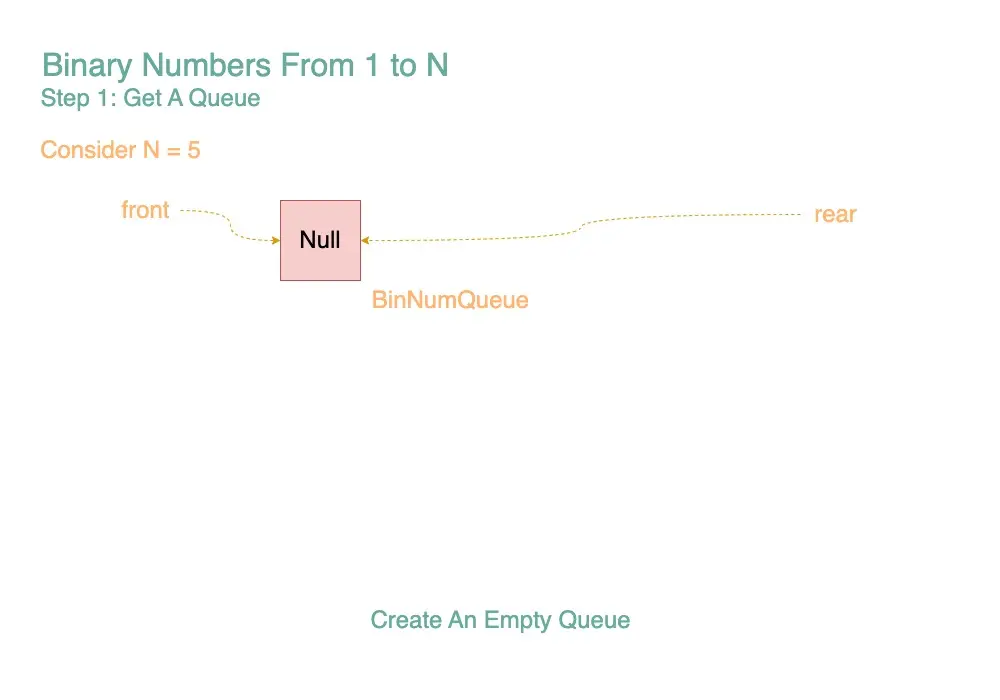
Code
Here is how we can implement this algorithm:
import java.util.LinkedList;
import java.util.Queue;

public class Solution {

  public String[] generateBinaryNumbers(int n) {
    Queue<String> q = new LinkedList<String>();
    q.add("1"); // Initialize the queue with "1".

    String[] res = new String[n]; // Create an array to store the binary numbers.
    for (int i = 0; i < n; i++) {
      res[i] = q.poll(); // Dequeue the current binary number and add it to the result array.
      q.add(res[i] + "0"); // Enqueue the next binary number by appending "0".
      q.add(res[i] + "1"); // Enqueue the next binary number by appending "1".
    }

    return res; // Return the array containing binary numbers.
  }

  public static void main(String[] args) {
    Solution sol = new Solution();
    String[] binaryNums = sol.generateBinaryNumbers(5); // Generate binary numbers for testing.
    for (String binaryNum : binaryNums) {
      System.out.println(binaryNum); // Print each generated binary number.
    }
  }
}
Complexity Analysis
Time Complexity
- Queue operations: The algorithm uses a queue to generate binary numbers in order. For each of the
nnumbers, it performs the following operations:- Dequeue operation: This is done once per number and takes
time. - Enqueue two new numbers: For each number, two new binary numbers (appending '0' and '1') are generated and enqueued. Each enqueue operation also takes
time.
- Dequeue operation: This is done once per number and takes
- Since there are
niterations, and each iteration involves constant-time operations for dequeueing and enqueueing, the overall time complexity is.
Overall time complexity:
Space Complexity
-
Result array: The result array stores the
nbinary numbers, which takesspace. -
Queue space: The queue stores intermediate binary numbers. At any point in time, the queue holds at most two binary numbers for each element processed. This means that the maximum number of elements in the queue is proportional to
n, so the queue requiresspace.
Overall space complexity:
🎯 STRICT STANDOUT — Solution Generate Binary Numbers
1. Why / judgment
Queue BFS expands each prefix to prefix+0 and prefix+1. FIFO yields numeric order. Prefer this pattern when teaching BFS generation; in apps, Integer.toBinaryString is fine.
2. Hand-run + complexity (K11/K13)
N=5 seed "1"
pop 1 → enq 10,11
pop 10 → enq 100,101
pop 11 → enq 110,111
pop 100,101 → stop after 5
→ ["1","10","11","100","101"] ✓
N=0/negative: return empty (guard).
Time: Θ(N) queue ops + Θ(N log N) for string building (immutable).
Space: Θ(N) queue + Θ(N log N) output.
Page claim “O(n) overall” understates string work — state both.
3. Pattern (K12)
BFS generator over implicit tree. When-NOT stack: DFS order ≠ 1..N binary list order. When-NOT: single conversion of one integer.
4. Interviewer follow-ups
Q1. Why not enqueue only up to N without over-generating?
A: You can stop children when count hits N; still O(N) useful outputs.
Q2. LinkedList vs ArrayDeque?
A: ArrayDeque preferred; both correct FIFO.
Recognize it: Process in arrival order / level-by-level → a FIFO queue (BFS).
▶ Visualize this problem (step it, predict each fork)
🤖 Don't fully get this? Learn it with Claude
Stuck on Implement Stack using Queues? Open Claude, copy a block below, and it'll teach you this exact concept — visually and interactively.
Progressively stronger hints — you still solve it.
I'm working on the problem **Implement Stack using Queues** (DSA). Give me a HINT LADDER: start with the tiniest nudge, then wait. Only reveal the next, stronger hint when I ask. Do NOT show the full solution unless I type 'show solution'. Keep me doing the thinking. If you're unsure or a claim isn't standard, say so and reason from first principles instead of guessing.
See the technique, not just code.
Explain the optimal approach to **Implement Stack using Queues** with a VISUAL walkthrough: trace it on a small concrete example using ASCII art / a step-by-step diagram, narrate what changes each step, then give time & space complexity with a one-line derivation. If you're unsure or a claim isn't standard, say so and reason from first principles instead of guessing.
Catch bugs, edge cases, sub-optimality.
I'll paste my solution to **Implement Stack using Queues**. Review it for correctness, missed edge cases, and time/space complexity, then coach me toward the optimal — don't just rewrite it. Ask me to paste my code now. If you're unsure or a claim isn't standard, say so and reason from first principles instead of guessing.
Lock in recognition with look-alikes.
Give me 2 problems that use the SAME underlying pattern as **Implement Stack using Queues**. For each, let me attempt first, then review my answer and name the trigger signal that reveals the pattern. If you're unsure or a claim isn't standard, say so and reason from first principles instead of guessing.