SQL Databases
A SQL database stores data as typed rows inside tables and answers declarative queries by feeding them to a cost-based query planner that turns your SELECT into a physical plan over B-tree indexes, while a write-ahead log (WAL) makes every transaction all-or-nothing and crash-durable. You say what you want; the engine decides how to fetch it and guarantees the data never lands in a half-written state.
The four glossary terms are not vocabulary — each is a mechanism that buys a specific guarantee:
- Table + typed columns — a fixed shape the planner can reason about; knowing a column is
BIGINT NOT NULLlets it pick scans, joins, and storage layout ahead of time. - Primary key (PK) — a uniqueness constraint backed by a unique index. "Unique" is enforced by that index rejecting a duplicate on insert, not by a scan.
- Foreign key (FK) — a rule that a value in one table must already exist as a PK in another. On every insert/delete the engine probes the parent's index; a delete that would orphan children is blocked (or cascades). This is referential integrity, enforced by the storage engine, not your app code.
- Index — a sorted auxiliary structure (usually a B-tree) so a lookup is O(log n) page reads instead of an O(n) full table scan.
- Normalization — storing each fact in exactly one place so an update touches one row, killing the update anomaly (shown below).
Worked example: how a JOIN actually runs
Two tables. Note the FK and the index on the FK column — that index is the whole reason the join is fast.
CREATE TABLE customers (
  id      BIGINT PRIMARY KEY,        -- unique index, auto-created
  email   TEXT NOT NULL UNIQUE,      -- unique index
  country TEXT NOT NULL
);

CREATE TABLE orders (
  id           BIGINT PRIMARY KEY,
  customer_id  BIGINT NOT NULL REFERENCES customers(id),  -- FK
  amount_cents INT    NOT NULL
);

CREATE INDEX idx_orders_customer ON orders(customer_id);
CREATE INDEX idx_customers_country ON customers(country);
Sample data:
| customers.id | country | |
|---|---|---|
| 1 | alice@x.com | IN |
| 2 | bob@x.com | US |
| 3 | cara@x.com | IN |
| orders.id | customer_id | amount_cents |
|---|---|---|
| 101 | 1 | 500 |
| 102 | 1 | 300 |
| 103 | 2 | 900 |
| 104 | 3 | 250 |
The query — total spend per Indian customer:
SELECT c.email, SUM(o.amount_cents) AS total_cents
FROM customers c
JOIN orders o ON o.customer_id = c.id
WHERE c.country = 'IN'
GROUP BY c.email;
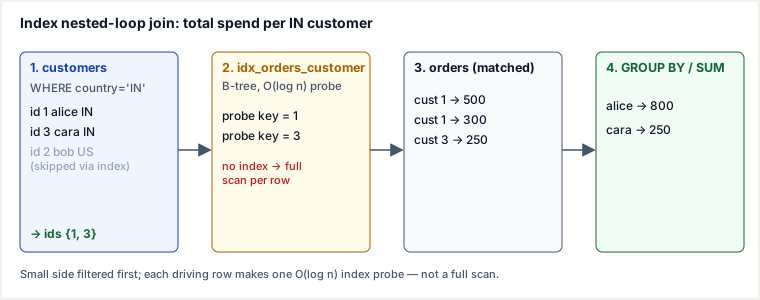
What the planner does, step by step (an index nested-loop join):
- Filter the small side first.
WHERE country = 'IN'hitsidx_customers_country, returning ids{1, 3}without scanning bob's row. (With 1M customers, this reads a handful of index pages, not a million rows.) - Probe the FK index once per driving row. For
id=1, walkidx_orders_customertocustomer_id=1→ orders {101, 102}: amounts 500, 300. Forid=3→ order 104: amount 250. Each probe is O(log n) page reads. - Aggregate.
GROUP BY emailsums each group: alice → 500+300, cara → 250.
| total_cents | |
|---|---|
| alice@x.com | 800 |
| cara@x.com | 250 |
Drop idx_orders_customer and step 2 collapses into a full scan of orders for every driving customer — the join goes from ~O(k·log n) to O(k·n). This is the single most common cause of a slow join in production.
Why normalization exists: the update anomaly
Suppose you flatten everything into one table, repeating the customer's country on every order row:
| order_id | customer_email | country | amount |
|---|---|---|---|
| 101 | alice@x.com | IN | 500 |
| 102 | alice@x.com | IN | 300 |
| 104 | cara@x.com | IN | 250 |
Alice moves to Singapore. Her country now lives in two rows. Update one and miss the other and the database disagrees with itself — country is both IN and SG for the same person, and no query can tell which is true. Normalizing to separate customers and orders tables stores the country once; the update touches a single row and cannot go half-done. That one-fact-one-place rule is the entire point of PK/FK and normal forms.
What ACID buys you: the WAL trace
Move ₹100 between accounts:
BEGIN;
  UPDATE accounts SET balance = balance - 100 WHERE id = 1;
  UPDATE accounts SET balance = balance + 100 WHERE id = 2;
COMMIT;
The mechanism behind Atomicity + Durability is the write-ahead log:
- Both updates are appended as records to the WAL and the change is made in memory.
COMMITdoes not return until the WAL up to this transaction isfsync-ed to disk. Only then is the client told "done."- If the server crashes after the debit but before the credit, restart recovery replays committed WAL records and rolls back the uncommitted transaction. You never observe ₹100 that vanished — the account pair is either fully moved or untouched.
Isolation is the sibling guarantee: while your transaction runs, other sessions don't see your half-applied writes (via locking or MVCC snapshots). Together this is why banks, inventory, and order systems reach for SQL by default.
The four SQL sub-languages, with real statements
SQL is one language split by what it acts on:
| Group | Acts on | Example |
|---|---|---|
| DDL — Definition | schema (structure) | CREATE TABLE, ALTER TABLE ADD COLUMN, DROP INDEX |
| DML — Manipulation | rows (data) | INSERT, UPDATE, DELETE, SELECT |
| DCL — Control | permissions | GRANT SELECT ON orders TO analyst, REVOKE |
| TCL — Transaction | transaction boundaries | BEGIN, COMMIT, ROLLBACK, SAVEPOINT |
The split matters operationally: DDL often takes stronger locks than DML (an ALTER TABLE can block reads/writes on a hot table), and TCL is what actually triggers the WAL fsync above.
Pitfalls
- Missing index on the FK column. A join or a cascading delete then scans the child table fully for every parent row. The classic silent O(n) blowup — the join was fast in dev with 1k rows, unusable at 10M.
- N+1 queries. An ORM loop that fires one
SELECTper parent (100 customers → 101 round-trips) instead of a single join. Network latency, not the DB, becomes the bottleneck. - A function on an indexed column kills the index.
WHERE lower(email) = 'a@x.com'can't use a plain index onemail— it scans. Fix with a functional/expression index or store normalized. Same trap: implicit type casts (WHERE id = '5'whenidisBIGINT). - OFFSET pagination.
LIMIT 20 OFFSET 100000makes the engine read and discard 100,000 rows every page. Use keyset pagination (WHERE id > :last_seen). - Long-running transactions. An open transaction holds locks and, under MVCC, prevents cleanup of old row versions — causing lock waits and table bloat. Keep transactions short.
SELECT *everywhere. Pulls wide/TOASTed columns you don't need and prevents index-only scans. Select the columns you use.
When to use SQL — and when not to
SQL scales vertically beautifully (one big primary + read replicas) but resists horizontal write scaling: sharding breaks cross-shard joins and multi-row ACID transactions, which are the very things you chose SQL for. That tension drives the decision.
Reach for a relational database (PostgreSQL / MySQL) when:
- Data has real relationships and you run ad-hoc, multi-table queries (joins, aggregations, reporting) whose shape you can't predict up front.
- You need multi-row transactional integrity — money, inventory, bookings — where a half-applied write is unacceptable.
- Write volume and dataset fit one strong primary with replicas (the overwhelming majority of apps, up to many TB and tens of thousands of writes/s).
Prefer an alternative when:
- vs a document store (MongoDB): your access is a single self-contained aggregate fetched by key, the schema varies per record, and you want denormalized reads without joins. You gain schema flexibility and simpler horizontal sharding; you pay by losing cheap cross-entity joins and, historically, weaker multi-document transactions.
- vs a wide-column store (Cassandra) or key-value (DynamoDB): you need massive horizontal write throughput and multi-region availability with predictable single-key latency. You gain linear write scaling and AP-style availability; you pay with eventual consistency, no ad-hoc queries (you model tables per query pattern), and no joins.
- vs a cache/KV (Redis): the workload is hot single-key reads that don't need durability or querying.
Rule of thumb: choose SQL when correctness and query flexibility dominate and you're not yet forced to shard writes; prefer a NoSQL store when horizontal write scale, schema fluidity, or single-key latency at scale dominate and you can live without joins and strong cross-row transactions. Most systems should start on SQL and only move specific hot paths off it when a measured scaling wall appears — not before.
Takeaways
- SQL's power is declarative + planned: you describe the result, a cost-based planner uses B-tree indexes to fetch it, and the WAL guarantees all-or-nothing durability.
- PK/FK/index/normalization aren't vocabulary — each enforces a concrete guarantee (uniqueness, referential integrity, O(log n) lookup, one-fact-one-place).
- Almost every "slow SQL" incident is a missing index on a join/filter column, an N+1 loop, or an index defeated by a function/cast — check those first.
- Default to SQL for relational, transactional, query-diverse workloads; move off it only when you hit a measured horizontal-write wall and can trade away joins and cross-row transactions.
Re-authored and deepened for this guide. Mechanism and internals draw on Alex Petrov, Database Internals; Martin Kleppmann, Designing Data-Intensive Applications (Ch. 2–3); the PostgreSQL documentation (query planner, WAL, and index chapters); and Markus Winand's Use The Index, Luke! for the indexing and pagination pitfalls. Normalization framing follows C. J. Date, An Introduction to Database Systems.
🤖 Don't fully get this? Learn it with Claude
Stuck on SQL Databases? Open Claude, copy a block below, and it'll teach you this exact concept — visually and interactively.
Build the mental picture, not memorization.
I just read a lesson on **SQL Databases** (System Design) and want to truly understand it. Explain SQL Databases from first principles using ONE vivid real-world analogy and a visual mental model — draw it as ASCII art or a clear step-by-step diagram — with a concrete example using real numbers. Then ask me one question to check I got the mental picture, and wait for my reply. If you're unsure or a claim isn't standard, say so and reason from first principles instead of guessing.
Socratic — adapts to where you're stuck.
Teach me **SQL Databases** interactively. Ask me ONE guiding question at a time, wait for my answer, and adapt to my confusion — build the idea with me step by step instead of explaining it all at once. If you're unsure or a claim isn't standard, say so and reason from first principles instead of guessing.
Active recall exposes what you missed.
Quiz me on **SQL Databases** with 5 questions, easy to tricky, ONE at a time. Tell me if each answer is right; at the end, explain clearly what I got wrong and why. If you're unsure or a claim isn't standard, say so and reason from first principles instead of guessing.
Intuition + hook + flashcards for long-term memory.
Help me remember **SQL Databases** for the long term: give the one-sentence intuition, a memorable hook/mnemonic, a tiny worked example, and 3 active-recall flashcards (Q -> A). If you're unsure or a claim isn't standard, say so and reason from first principles instead of guessing.