SQL Normalization and Denormalization
The mechanism
Normalization works by splitting a table along its functional dependencies so that every non-key fact lives in exactly one place — then a change touches one row and two copies can never drift apart; denormalization deliberately reverses this, copying related facts back together so a read can skip the joins, buying read speed with write-amplification.
The normal forms are not arbitrary levels. Each one removes one specific kind of dependency that causes one specific update anomaly. Below we take a single real table through 1NF → 2NF → 3NF and watch the anomalies vanish, then denormalize it on purpose and see what it costs.
Step 0 — the unnormalized table (0NF)
A single “orders” table where each row is one order and the purchased items are crammed into one cell:
| OrderID | CustomerID | CustomerName | CustomerCity | Items |
|---|---|---|---|---|
| 1001 | C1 | John Doe | Boston | Laptop×1, Mouse×2 |
| 1002 | C2 | Jane Smith | Austin | Tablet×1 |
The Items cell is non-atomic — you cannot filter or join on “Mouse” without string-parsing. That violates 1NF.
Step 1 — 1NF: make every cell atomic
Give each item its own row. The key becomes the composite (OrderID, ProductID) — only the pair identifies a line:
| OrderID | ProductID | CustomerID | CustomerName | CustomerCity | ProductName | UnitPrice | Qty |
|---|---|---|---|---|---|---|---|
| 1001 | P1 | C1 | John Doe | Boston | Laptop | 1200 | 1 |
| 1001 | P2 | C1 | John Doe | Boston | Mouse | 25 | 2 |
| 1002 | P3 | C2 | Jane Smith | Austin | Tablet | 400 | 1 |
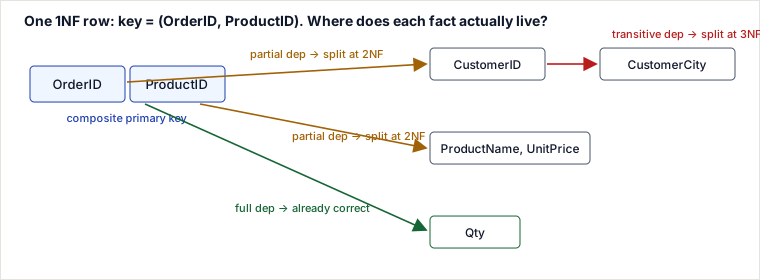
Atomic now, but look at the redundancy: John Doe / Boston is repeated on every line of order 1001. That redundancy is a direct read-off of the functional dependencies hiding in this table:
(OrderID, ProductID) → Qty— full dependency (needs the whole key)OrderID → CustomerID, CustomerName, CustomerCity— partial (depends on part of the key)ProductID → ProductName, UnitPrice— partialCustomerID → CustomerName, CustomerCity— transitive (non-key determines non-key)
Step 2 — 2NF: kill the partial dependencies
2NF demands every non-key column depend on the whole key. ProductName depends only on ProductID, and the customer fields only on OrderID — each on part of the key. Move each fact to sit with its real determinant:
OrderLines (key OrderID, ProductID)
| OrderID | ProductID | Qty |
|---|---|---|
| 1001 | P1 | 1 |
| 1001 | P2 | 2 |
| 1002 | P3 | 1 |
Products (key ProductID)
| ProductID | ProductName | UnitPrice |
|---|---|---|
| P1 | Laptop | 1200 |
| P2 | Mouse | 25 |
| P3 | Tablet | 400 |
Orders (key OrderID)
| OrderID | CustomerID | CustomerName | CustomerCity |
|---|---|---|---|
| 1001 | C1 | John Doe | Boston |
| 1002 | C2 | Jane Smith | Austin |
Product names stop repeating per line. But Orders still hides a problem.
Step 3 — 3NF: kill the transitive dependency
In Orders, CustomerName and CustomerCity depend on OrderID only through CustomerID (OrderID → CustomerID → CustomerCity) — a transitive dependency via a non-key column. Concretely this still breaks: if John moves to Denver you must update every order he ever placed (an update anomaly), and deleting his last order erases his address entirely (a delete anomaly). Lift the non-key determinant into its own table:
Customers (key CustomerID)
| CustomerID | CustomerName | CustomerCity |
|---|---|---|
| C1 | John Doe | Boston |
| C2 | Jane Smith | Austin |
Orders (key OrderID)
| OrderID | CustomerID |
|---|---|
| 1001 | C1 |
| 1002 | C2 |
The final 3NF schema is four tables — Customers, Products, Orders, OrderLines — wired by foreign keys (Orders.CustomerID → Customers, OrderLines.OrderID → Orders, OrderLines.ProductID → Products). Now “John Doe / Boston” exists in exactly one row. His city changes with one UPDATE Customers, and no anomaly is possible. That is the whole payoff of normalization: each fact has a single home.
Denormalizing on purpose
Now the cost side. Rendering an order-confirmation screen — customer name, city, and every line’s product name and price — requires a 4-way join across all four tables. If that read is on a hot path and fires millions of times while the underlying data barely changes, you can precompute the wide shape:
| OrderID | CustomerName | CustomerCity | ProductName | UnitPrice | Qty |
|---|---|---|---|---|---|
| 1001 | John Doe | Boston | Laptop | 1200 | 1 |
| 1001 | John Doe | Boston | Mouse | 25 | 2 |
This is deliberately back to the redundant 1NF shape — a single table read hits one page, no joins. The catch is write-amplification: John’s city now lives in N places again, so a move must fan out to every one of his line rows. The disciplined way to get this is not to hand-copy columns into your base tables, but to keep the 3NF tables as the source of truth and layer the wide shape on top as a materialized view (or a read model fed by CDC / a trigger). Then the database, not your application, owns keeping the copy consistent — at the price of refresh cost and staleness.
Pitfalls
- Denormalized copies silently drift. The moment you copy
CustomerCityinto an orders table and update it in one place but not the other, you have re-created the exact anomaly normalization existed to prevent. Copies must be maintained by the engine (materialized view refresh, trigger, CDC) — never by “we’ll remember to update both.” - Over-normalization taxes every read. Push past what the workload needs and a simple screen becomes a 6-table join; join and planner cost dominates latency even though no single table is large.
- “3NF = correct” is not always true. With overlapping candidate keys, a 3NF table can still have anomalies; BCNF is the stricter fix. Most schemas target 3NF/BCNF and stop — 4NF/5NF matter only for genuine multi-valued dependencies.
- Nulls from premature widening. Flattening one-to-many relationships into a wide table forces repeated or null-padded columns; aggregates like
SUM(UnitPrice)silently double-count across the duplicated rows. - Forgetting to index the join/foreign keys. Normalization’s read cost is only acceptable if
OrderLines.OrderIDetc. are indexed; without that, every join is a scan and normalization looks “slow” for the wrong reason.
When to use it — and when not
Signals that point to normalization (3NF/BCNF): write-heavy or mixed OLTP workload, correctness is non-negotiable (money, inventory, identity), the same entity is referenced from many places, and data changes often. You gain a single source of truth and anomaly-free writes; you pay in joins at read time.
Signals that point to denormalization: a specific read path is hot, that read is join-dominated, and its underlying data is comparatively stable. You gain single-read latency; you pay in write-amplification and the standing risk of drift.
Trade-offs vs. named alternatives:
- Normalized 3NF vs. a hand-denormalized wide table: the wide table wins the read but makes you responsible for consistency on every write — the costliest and most bug-prone option. Only justified when the read volume dwarfs writes and you can enforce the copy in code paths you fully control.
- Normalized 3NF vs. a materialized view / read model: the view keeps 3NF as the source of truth and hands you a precomputed read shape the engine refreshes — the best of both, costing refresh compute and bounded staleness. Prefer this over hand-denormalization whenever your engine supports it.
- Normalized 3NF vs. a star schema (dimensional model): for analytical aggregation over huge fact tables, a star schema’s denormalized dimensions cut join fan-out and are worth the redundancy — but it is an OLAP shape, wrong for transactional writes.
Decide like this: normalize to 3NF by default for anything transactional; when a measured read path is hot and its data is stable, prefer a materialized view / read model over hand-copying columns; reach for a star schema only when the workload is analytical aggregation.
Takeaways
- Each normal form removes one dependency type: 1NF = atomic cells; 2NF = no partial dependency on a composite key; 3NF = no transitive dependency through a non-key column. Anomalies disappear because each fact ends up with a single home.
- Normalization optimizes writes and integrity; denormalization optimizes a specific read by re-introducing redundancy — a deliberate trade, not a mistake.
- The real cost of denormalization is write-amplification and drift; make the engine own consistency via a materialized view or read model rather than copying columns by hand.
- Target 3NF/BCNF, index your foreign keys, and denormalize surgically for measured hot reads — never as a default.
L0 · normalization gives every fact one home; denormalization copies it elsewhere and makes you (or the engine) own keeping the copies the same.
L1 · ① Concurrency — “they ask”
Two writers race: one updates Customers.City, the other concurrently writes a denormalized city copy into OrderLines. What happens?
Trap: “it’s basically the same data, any write order is fine — eventual consistency sorts it out.”
Bar: Two writers racing on independent copies of one fact can diverge permanently unless every writer funnels through a single path (one writer of truth, or a CDC/trigger-fed materialized view) with a monotonic version to resolve order — “eventual consistency” without a defined convergence rule is just a race with extra steps. See strong vs. eventual consistency.
L2 · ② Failure — “they ask”
The reconciliation job that fans a customer’s new city out to every denormalized OrderLines row dies halfway through. Blast radius?
Trap: “just rerun the job from the start — copying a column is idempotent.”
Bar: Partial failure mid-fan-out leaves some rows on the old city and some on the new one — the same customer reads differently depending on which row is hit — so the job must checkpoint by key and resume, and reads during the gap must be treated as a known inconsistency window, not a bug to silently retry away. See replication lag & read-your-writes.
L3 · ③ Scale — “they ask”
Order volume grows 100×; the 4-table join dominates p99 on the confirmation screen. Fix?
Trap: “denormalize by hand — copy the columns straight into OrderLines in application code on every write.”
Bar: Push the wide shape into a materialized view or CDC-fed read model so the engine, not your write paths, owns refreshing the copy, and budget the refresh lag against your staleness tolerance — hand-copying multiplies the number of write paths that must remember to update every copy, which is exactly the anomaly normalization removed. See the denormalization decision: write vs. read cost.
L4 · ④ Time/Lifecycle — “they ask”
A customer legally changes their name three years after placing 500 orders. Should every past order confirmation now show the new name?
Trap: “always refresh — a denormalized copy should always mirror the latest source value everywhere.”
Bar: Distinguish reference data, which must stay live-joined or refreshed (current profile), from event/fact data, whose denormalized copy is a deliberate point-in-time snapshot (the confirmation shows the name as of purchase) — treating every copy’s staleness as a bug instead of an explicit lifecycle policy is the actual mistake. See cache invalidation.
L5 · ⑧ Cost/Simplicity — “they ask”
Bar-raiser: justify why you didn’t just denormalize the whole schema for read speed.
Trap: “reads outnumber writes 10:1, so always optimize for reads — denormalize everything.”
Bar: Count the write fan-out you’d create — N places to update per changed fact versus one — and denormalize only when the read is measured hot, the source data is measured stable, and the copy can be owned by the engine’s own refresh mechanism; otherwise you’ve traded a correctness bug for a latency win and called it an optimization. See cache write strategies: write-through / write-back / write-around.
The floor keeps dropping: staff+ perturbation — two datacenters each denormalize independently during a network partition, reconcile after healing with conflicting last-writer-wins timestamps under clock skew, and a compliance audit later demands you prove which copy was authoritative at a given instant. Now defend your reconciliation protocol and your audit trail, not just your schema.
Self-locate: died at L1 → mid-level; L4+ → staff signal.
Facing any new concept? Hit it with the six: concurrent? failing? at 100×? over time? adversarial? worth the cost? — that’s the interviewer’s whole playbook.
Sources: E. F. Codd’s original relational-model and normal-form papers (1970–1972); C. J. Date, An Introduction to Database Systems (normal forms and functional dependencies); Silberschatz, Korth & Sudarshan, Database System Concepts (2NF/3NF/BCNF decomposition); Martin Kleppmann, Designing Data-Intensive Applications (normalization vs. denormalization and derived/read models). Re-authored and deepened for this guide.
🤖 Don't fully get this? Learn it with Claude
Stuck on SQL Normalization and Denormalization? Open Claude, copy a block below, and it'll teach you this exact concept — visually and interactively.
Build the mental picture, not memorization.
I just read a lesson on **SQL Normalization and Denormalization** (System Design) and want to truly understand it. Explain SQL Normalization and Denormalization from first principles using ONE vivid real-world analogy and a visual mental model — draw it as ASCII art or a clear step-by-step diagram — with a concrete example using real numbers. Then ask me one question to check I got the mental picture, and wait for my reply. If you're unsure or a claim isn't standard, say so and reason from first principles instead of guessing.
Socratic — adapts to where you're stuck.
Teach me **SQL Normalization and Denormalization** interactively. Ask me ONE guiding question at a time, wait for my answer, and adapt to my confusion — build the idea with me step by step instead of explaining it all at once. If you're unsure or a claim isn't standard, say so and reason from first principles instead of guessing.
Active recall exposes what you missed.
Quiz me on **SQL Normalization and Denormalization** with 5 questions, easy to tricky, ONE at a time. Tell me if each answer is right; at the end, explain clearly what I got wrong and why. If you're unsure or a claim isn't standard, say so and reason from first principles instead of guessing.
Intuition + hook + flashcards for long-term memory.
Help me remember **SQL Normalization and Denormalization** for the long term: give the one-sentence intuition, a memorable hook/mnemonic, a tiny worked example, and 3 active-recall flashcards (Q -> A). If you're unsure or a claim isn't standard, say so and reason from first principles instead of guessing.