Database Federation
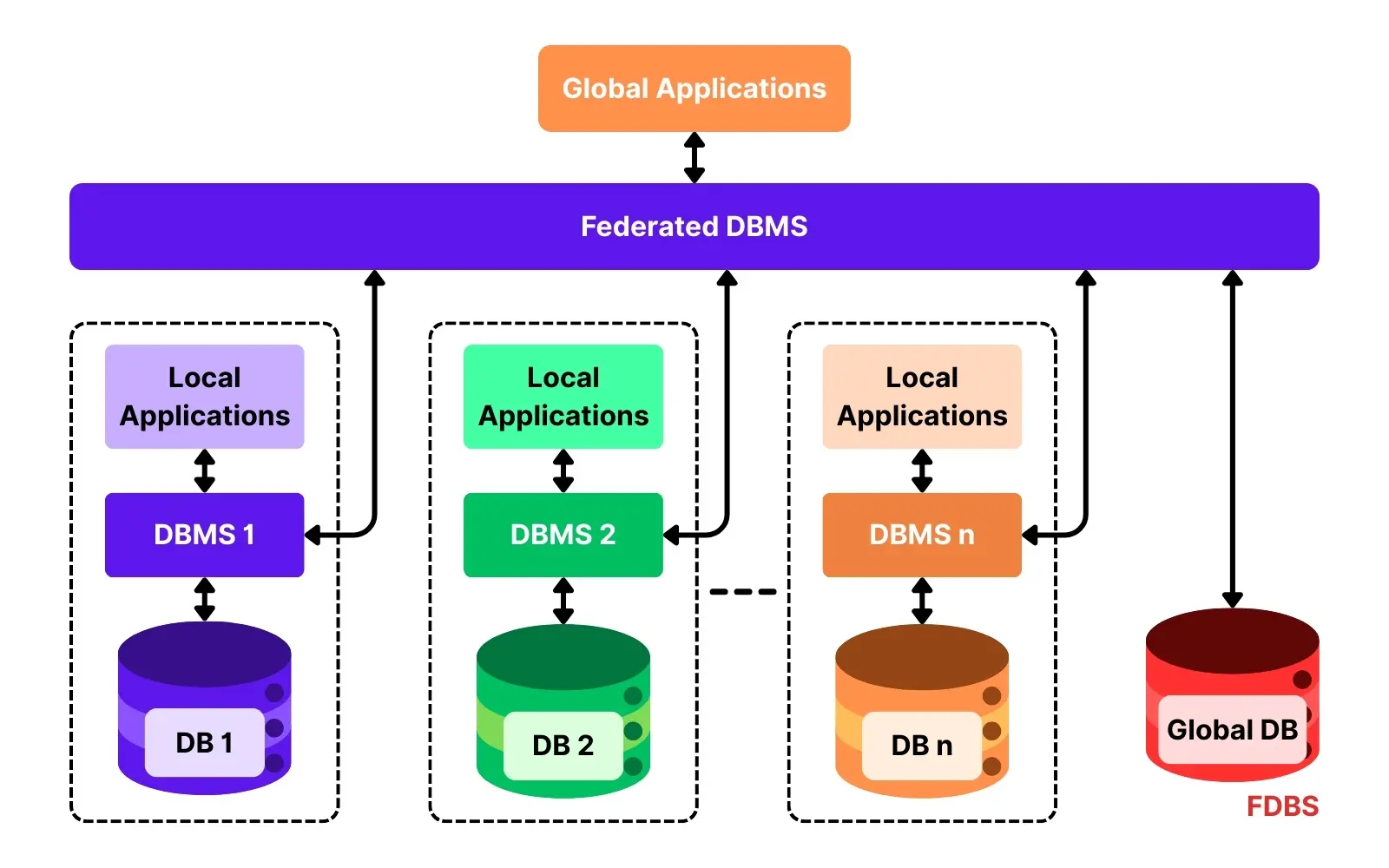
Database federation (also known as a federated database system) is an approach where multiple independent databases are virtually integrated to appear as one single database to the end user. Each underlying database (often called a component database or data source) remains autonomous and self-contained – it keeps its own data, schema, and database engine. The federation layer or system acts as a coordinator, so when an application issues a query, it doesn’t need to know which database holds the data. The federated system will route the request to the appropriate source(s) and combine the results for the application.
In simpler terms, database federation is like having a virtual single database on top of many databases. For example, imagine a city library system with several branch libraries. Each branch library has its own catalog of books (akin to separate databases). Database federation is like a unified catalog that lets you search all branch libraries at once. You submit one book query, and the system figures out which branches have that book and brings the information back to you, as if you searched one big library. From the user’s perspective, it all feels like one database, even though the data is actually distributed across multiple libraries.
Key characteristics of federated databases include transparency, heterogeneity, and autonomy:
- Transparency: The federation hides the complexity from users – you don’t need to know where the data lives or which database engine is used. The separate data sources are masked behind a unified interface.
- Heterogeneity: The different databases in the federation can be of various types or vendors (SQL, NoSQL, different schemas, etc.). A well-designed federated system can handle different hardware, DBMS software, or data models and still query them together.
- Autonomy: Each component database operates independently and is not modified by the federation. They maintain their own schemas and controls. The federated layer doesn’t force a single schema on all members; instead, it maps or translates between the sources and the unified view.
Another term you might hear is functional partitioning, which refers to a form of federation where databases are split by function or domain. For instance, an e-commerce system might have separate databases for user accounts, orders, and product catalog. Through federation, these can function together as one logical database, even though they serve different functions.
How Does Database Federation Work? (High-Level Overview)
At a high level, a federated database system works as a mediator between the application and the multiple databases. The process can be broken down into a few key steps that occur when a query is executed through a federated system:
- Unified Query Submission: The user or application issues a query to the federated database as if querying a single database. For example, a query might ask for a customer’s profile (from a user database) along with their order history (from an orders database) in one go.
- Query Analysis and Routing: The federated query engine (sometimes called the federated database management system, or FDBMS) analyzes the query to figure out which database(s) contain the required data. It essentially acts like a smart dispatcher. In our example, it realizes customer info lives in the user DB and orders live in the orders DB.
- Query Translation: If the underlying databases use different query languages or schemas, the federated engine translates the original query into appropriate sub-queries for each target database. This may involve converting a standard SQL query into the specific dialect or API of each system. Think of this like a translator who speaks to each data source in its native language so they understand the request.
- Distributed Query Execution: The system sends the sub-queries to the respective databases. Each database executes its part of the query on its local data and returns results back to the federation layer. In our example, the user DB returns the customer’s profile, and the orders DB returns that customer’s orders.
- Data Merging and Response: The federated layer takes the results from the multiple databases and combines or merges them into a single cohesive result set. This might involve joining data from different sources or simply concatenating results. The unified result is then returned to the application as the answer to the original query. Continuing the example, the system would merge the profile data with the order history into one result, perhaps a combined view of the customer and their orders.
From the application’s perspective, this all happens “behind the scenes” – it receives one unified answer. No manual intervention is needed to query each database separately or reconcile the data; the federation layer handles that complexity.
To use an analogy, consider federation like asking a travel agent to plan a multi-country trip for you. You (the user) make one request – “I want to visit London, Paris, and Rome.” The agent breaks this into sub-tasks: contact the London office for hotel and tour info, the Paris office for theirs, and Rome’s for theirs. Each local office (database) provides its info. The agent then collects all the info and presents you with a single, consolidated itinerary. In this story, you didn’t have to coordinate with each office yourself – the travel agent (federation system) did it and gave you one combined result.
Architecture Components
- Underlying Databases (Data Sources): These autonomous databases hold the real data, possibly differing by vendor or location.
- Federation Layer (Middleware or FDBMS): A mediator that parses and decomposes queries, coordinates sub-queries, and merges results.
- Global (Federated) Schema: A unified view mapping data from each source.
- Connectors/Adapters: Handle communication and translation between the federated system and each database.
- Federated Query Optimizer: Determines how best to split queries across sources, sometimes pushing filters or partial joins down to reduce data movement.
Each database remains autonomous and can still function alone. Federation focuses on query integration rather than merging or replacing individual systems.
What federation buys you, and what it charges
| The claim | The fine print | |
|---|---|---|
| Gain | Live data — queries hit the sources' current state, not a static copy. | Freshness beats ETL only when the network and query shape cooperate; an ETL copy is stale by its batch window, a federated answer is stale by zero but slow by its slowest source. |
| Gain | Source autonomy — each database keeps its own engine, schema, and controls; SQL and NoSQL vendors coexist. | Data and its governance stay at the source; the federation layer can centralize access control on top. |
| Gain | No migration — integrate what already exists; sources can be added or removed without major rework. | Homogeneous setups can even spread load across members, but see the sharding contrast below before leaning on that. |
| Cost | Fan-out tail latency — every cross-source query pays network round trips and a merge step. | Distributed joins are expensive, and large intermediate results make the mediator the bottleneck. |
| Cost | Mediator SPOF — if the federation layer or a key source is down, the query fails. | Query planning is also weaker than a single engine's: the federator may not push every filter or join down to the sources. |
| Cost | No global transactions — federation is read-oriented; cross-source writes and strict consistency are complex and usually unsupported. | Schema drift compounds this: aligning types and schemas is ongoing work, and one source's rename can break the global mapping. |
When to Use Database Federation
- Heterogeneous Environments: Ideal when integrating varied databases without migrating them all.
- Real-Time Analytics: Useful for up-to-date views from multiple sources (e.g., global fraud detection).
- Geo-Distributed Systems: Lets data remain near each region or comply with local regulations.
- Microservices with Separate Databases: Provides a single interface for data scattered across services.
In essence, database federation offers a single, integrated view across multiple autonomous databases, enabling real-time queries without forcing a centralized repository. While it simplifies data access, designers must weigh the performance, complexity, and consistency trade-offs to determine if federation fits their particular use case.
A federated query, byte by byte
Abstract definitions hide the real cost. Trace one query that joins data from two engines:
SELECT u.name, SUM(o.amount_cents) AS total_spent
FROM users u
JOIN orders o ON o.user_id = u.id
WHERE u.country = 'DE'
GROUP BY u.name;
The users table lives in PostgreSQL (shard A) and the orders table in MySQL (shard B). The federation layer does the following:
- Parse and decompose. The federator recognizes that
usersmaps to the Postgres source andordersto the MySQL source. - Push predicates down. It sends
SELECT id, name FROM users WHERE country = 'DE'to Postgres. This is critical: filtering happens on the source, so only matching rows cross the network. - Fetch the matching orders. For each German user id returned, it issues
SELECT user_id, amount_cents FROM orders WHERE user_id = ?to MySQL — ideally batched or streamed. - Join and aggregate locally. The federation layer hashes or sorts the two result sets in its own memory, performs the GROUP BY, and returns the final rows.
The cost is now the sum of: the Postgres filtered scan, one or more MySQL point lookups, the network transfer of intermediate rows, and the mediator's CPU/memory for the join. If the predicate on country were missing, the federator would have to ship all users and all orders into memory — a hidden full-table shuffle that collapses at scale.
Federation vs. the named alternatives
Federation is one of four common ways to answer a question that spans data owned by different systems. The right choice depends on freshness, consistency, and who controls the schema.
| Approach | Freshness | Consistency | Best when | Cost / risk |
|---|---|---|---|---|
| Federation | Live | Depends on sources; no global transaction | You control both schemas, query shape is stable, and freshness matters more than strict consistency | Source downtime kills the query; tail latency amplifies with each source |
| ETL to warehouse | Batch (hours) | Eventual by design | Analytics/BI over huge historical data, decoupled from OLTP load | Stale by the batch window; not for operational reads |
| CDC (change data capture) | Near-real-time (seconds) | Eventual | You want low-latency derived views without a live cross-source query | Connector/schema-evolution infra; must handle back-pressure and ordering |
| Service API | Live | Domain-enforced | Microservice ownership matters more than arbitrary joins | Network hop per call; N+1 fan-out if the API shape does not match the query |
When federation loses: avoid it when the sources are outside your control, when tail latency matters more than freshness, or when the query would ship large tables across the network to perform the join. In those cases, CDC or a warehouse is usually cheaper and more predictable.
What breaks in production
Federation's convenience hides two operability traps.
Tail-latency amplification. A federated query hitting k sources in parallel is only as fast as the slowest one. If a single source has a 1% chance of being slow (>200 ms), fanning out to k = 10 sources gives a 1 − 0.9910 ≈ 9.6% chance that at least one is slow — nearly a 10× increase in tail risk. The fix is a per-source timeout with partial-result semantics, plus a circuit breaker around sources that are failing.
Federation is not a backup. A federated query faithfully returns whatever the sources contain, including an accidental DELETE, a buggy update, or logical corruption. It protects against source unavailability only if you also have point-in-time backups and a recovery playbook.
Schema drift. Because each source keeps its own schema, a renamed column or changed type in one source can break the global schema mapping. Federation therefore works best when schema changes are coordinated or versioned, not when sources evolve independently.
Federation vs sharding — not the same split
This is the single most-asked question on this topic, and "federation can act like sharding" is not an answer. The two split along different axes.
Federation (functional partitioning) splits BY DOMAIN. users-DB, orders-DB, catalog-DB — each database holds a complete but different dataset, the schemas differ, and any cross-domain question needs the federation layer or a join stitched together in the application.
Sharding splits ONE dataset BY KEY. orders shard 1…N all share the same schema and each holds a slice of the same table, routed by a shard key (see data sharding techniques).
They fail differently. Federation's ceiling is the size of the single busiest domain — the orders DB still cannot outgrow one node, so eventually you shard it. Sharding's ceiling is cross-shard queries and transactions: a question that spans shard keys fans out, and a write that spans them needs two-phase commit or a saga.
They compose. Large systems federate by domain first (cheap, follows team boundaries), then shard the hot domain by key when it outgrows a node. The order matters: federation buys you domains, never capacity within a domain.
L0 · federation virtualizes many autonomous databases into one read interface; it splits by domain, pays fan-out latency, and offers no global transaction.
L1 · “Your federated orders DB is melting under write load. Does more federation help?”
Trap: “yes — federate further, add another database to the federation and spread the load.”
Bar: No. Federation adds domains, not capacity within one domain — every order still lands in the one orders database, so adding a catalog or reviews member changes nothing about the hot node. The fix is to shard the orders DB by key (customer id or order id), which splits the same table across nodes. Federation was the wrong axis for this bottleneck.
L2 · “A nightly report joins users × orders across the two domains. Federate the query or use CDC?”
Trap: “federate — it’s live data and we already have the federation layer.”
Bar: CDC into a warehouse. A live federated query buys freshness the nightly report does not need, and charges for it in fan-out tail latency (the 1 − 0.99k amplification above) plus OLTP load on both production sources at report time. CDC-fed read models decouple the report from the sources and let the join run pre-materialized; reserve federation for operational queries where seconds-old data is genuinely wrong.
🤖 Don't fully get this? Learn it with Claude
Stuck on Database Federation? Open Claude, copy a block below, and it'll teach you this exact concept — visually and interactively.
Build the mental picture, not memorization.
I just read a lesson on **Database Federation** (System Design) and want to truly understand it. Explain Database Federation from first principles using ONE vivid real-world analogy and a visual mental model — draw it as ASCII art or a clear step-by-step diagram — with a concrete example using real numbers. Then ask me one question to check I got the mental picture, and wait for my reply. If you're unsure or a claim isn't standard, say so and reason from first principles instead of guessing.
Socratic — adapts to where you're stuck.
Teach me **Database Federation** interactively. Ask me ONE guiding question at a time, wait for my answer, and adapt to my confusion — build the idea with me step by step instead of explaining it all at once. If you're unsure or a claim isn't standard, say so and reason from first principles instead of guessing.
Active recall exposes what you missed.
Quiz me on **Database Federation** with 5 questions, easy to tricky, ONE at a time. Tell me if each answer is right; at the end, explain clearly what I got wrong and why. If you're unsure or a claim isn't standard, say so and reason from first principles instead of guessing.
Intuition + hook + flashcards for long-term memory.
Help me remember **Database Federation** for the long term: give the one-sentence intuition, a memorable hook/mnemonic, a tiny worked example, and 3 active-recall flashcards (Q -> A). If you're unsure or a claim isn't standard, say so and reason from first principles instead of guessing.